





















































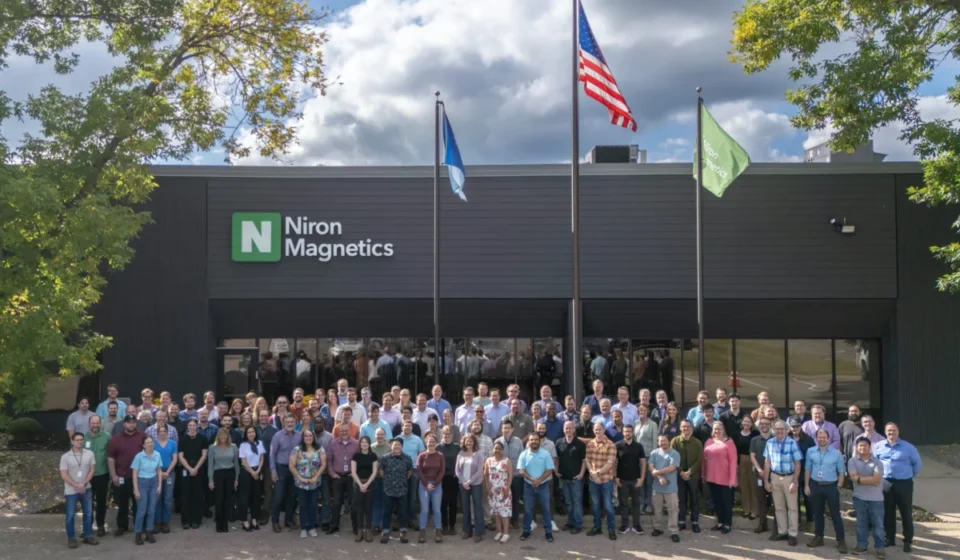

While the contentious debate over the Twin Metals copper-nickel mine near the Boundary Waters Canoe Area (BWCA) has long dominated the headlines, a quieter, potentially more transformative industrial revolution is taking shape in Minnesota. Minneapolis-based Niron Magnetics is currently evaluating the state’s historic Iron Range for its third—and largest—manufacturing facility. If realized, the project promises to bridge the gap between Minnesota’s storied mining heritage and the high-tech demands of the 21st-century green economy, potentially replacing hundreds of jobs lost to the decline of traditional taconite operations.
By leveraging proprietary technology that utilizes iron and nitrogen rather than environmentally taxing “rare-earth” elements, Niron is positioning itself as a vital player in the effort to decouple U.S. manufacturing from Chinese supply chains. With a $1.8 billion facility in its sights, the company represents a rare convergence of academic innovation, private sector ambition, and bipartisan political support.
The Technological Leap: Beyond Rare Earths
At the core of Niron’s value proposition is a patented "secret sauce" developed by University of Minnesota Professor Jian Ping Wang. The global market for high-power magnets—essential for everything from electric vehicle (EV) motors and wind turbines to headphones and defense systems—has historically relied on 17 rare-earth minerals. Today, China maintains a dominant stranglehold on this sector, controlling roughly 70% of global mining and 90% of manufacturing capacity.
The U.S. largely retreated from this market decades ago, deterred by the extreme costs, complex metallurgical processes, and severe environmental degradation associated with rare-earth extraction. Niron’s breakthrough offers a circular, domestic alternative. By reducing iron—often sourced from recycled steel—to a fine powder and combining it with nitrogen, Niron creates permanent magnets that perform at high levels without requiring the intense heat or the chemical separation facilities typical of traditional magnet production.
"Manufacturing permanent magnets from iron and nitrogen reduces the need for rare-earth mining, chemical separation facilities, and complex metallurgical processing," Niron CEO Jonathan Rowntree explained to a congressional committee last November. "A single integrated facility transforms commodity iron ore and atmospheric nitrogen into finished magnets that automotive powertrains, headphones, and refrigerators need."
A Chronology of Growth: From Lab to Industrial Scale
Niron’s trajectory from a university research project to a burgeoning industrial powerhouse has been rapid and calculated:
- Foundation: Based on the pioneering research of Dr. Jian Ping Wang, Niron Magnetics was established to commercialize the iron-nitride magnet technology.
- Pilot Phase: The company established its headquarters and a pilot plant in Northeast Minneapolis, creating a hub for testing and refinement.
- The Sartell Expansion: Recognizing the need to scale, Niron broke ground on its first major production facility in Sartell, Minnesota. This project, supported by a $10 million state investment, is expected to employ 175 people and produce 1,500 tons of magnets annually.
- The Iron Range Proposal: In early 2024, Niron began a formal site-selection process for its third, massive production plant. With the assistance of global real estate advisor Savills, the company is looking for a site capable of hosting a 1.6-million-square-foot facility.
- The 2029 Horizon: The company aims to have the massive Iron Range plant operational by 2029, with a target output of 10,000 tons of magnets per year and a workforce exceeding 700 employees.
Economic Implications: Resurrecting the Range
The Iron Range, once the heartbeat of American steel production, has faced decades of economic headwinds. The rise of imported steel and the shift toward modern mini-mills—which utilize more recycled steel feedstock—have rendered many traditional taconite plants obsolete.
Niron’s interest in the region is viewed by local officials as a potential lifeline. Speculation suggests the company may look to renovate a shuttered taconite facility, repurposing existing infrastructure for 21st-century manufacturing. Ryan Malich, executive director of the Minnesota Department of Iron Range Redevelopment and Resources (IRRR), sees the project as a perfect marriage of regional capacity and future-forward goals.
"It’s a massive opportunity that fits agency priorities," Malich said. "These are the types of jobs that we’re trying to add to the area in evolving, innovative technologies. We want to be on the frontside of technological development. We have a highly skilled, available workforce. All the elements seem to line up well for this potential development."
Beyond the local job creation, the project serves a broader national interest. As geopolitical tensions rise, the ability to produce essential components domestically is no longer just an economic goal; it is a matter of national security. Rowntree has been clear about the urgency: "The Chinese put export controls in place around rare earths, and that’s been a great benefit to us. We seek to solve this problem for western companies as quickly as possible."
Supporting Data and Strategic Partnerships
Niron is not operating in a vacuum. The company has successfully raised approximately $300 million in private-public capital, attracting a "who’s who" of automotive and tech industry heavyweights. Their list of investors and strategic partners includes:
- Automotive Giants: GM Ventures, Volvo, and Stellantis (the parent company of Chrysler and Fiat).
- Tech and Energy: Samsung Ventures, Western Digital, and the U.S. Department of Energy.
This backing underscores the market’s appetite for a rare-earth-free alternative. With plans for future expansion into Europe and Asia, Niron is aiming for $1 billion in annual revenue, a goal that may be accelerated by a planned public offering of stock in the coming years.
Official Responses and Political Landscape
The political reception to Niron has been exceptionally warm, crossing the usual partisan divides that characterize Minnesota politics. While Governor Tim Walz’s administration has consistently opposed the controversial Twin Metals mining project near the BWCA on environmental grounds, it has simultaneously gone all-in on courting Niron.
Kevin McKinnon, Deputy Commissioner of the Department of Employment and Economic Development (DEED), expressed the state’s enthusiasm: "Niron is a fabulous story about technology developed at the University of Minnesota and commercialized over several years… The promise, the trajectory of where they are going is very exciting. The scale is exciting. We believe Minnesota is a compelling location for such a project."
The project also enjoys support from the federal level. Despite the recent legislative victory for proponents of the Twin Metals mine—specifically, the lifting of a mining ban in the Lake Superior National Forest championed by U.S. Rep. Pete Stauber—the entire bipartisan Minnesota congressional delegation has expressed support for Niron’s expansion.
The Broader Context: Twin Metals vs. Niron
The comparison between Niron and Twin Metals is unavoidable, yet the two represent vastly different models of resource extraction and utilization. Twin Metals seeks to extract hard metals from the wilderness, an endeavor that has faced a decade of intense scrutiny from environmental groups concerned about the long-term health of the BWCA watershed.
Niron, by contrast, seeks to revitalize existing industrial zones. Its process is cleaner, its supply chain is more localized, and it aligns with the state’s goals for sustainable development. If Niron’s Iron Range project proceeds, it could effectively provide the economic shot in the arm the region craves without the environmental baggage of the Twin Metals proposal.
By pivoting toward high-tech manufacturing, Minnesota has the chance to prove that the Iron Range is not a relic of the past, but a pillar of the future. As the global economy scrambles for a way out from under the weight of Chinese supply chain dominance, the answer may well be found in the nitrogen-infused iron magnets being developed in the heart of the Midwest. The coming years will be critical as Niron finalizes its site selection, but for a region hungry for innovation and stability, the horizon looks brighter than it has in decades.