

























































The Iron-Nitride Revolution: Niron Magnetics and the Transformation of Minnesota’s Industrial Landscape

For over a century, the Iron Range of Northern Minnesota has been the backbone of American steel production, fueling the industrialization of the 20th century. However, as the global economy pivots toward a decarbonized future, the region stands at a critical crossroads. While traditional mining projects like the Twin Metals proposal face years of litigation and environmental scrutiny, a new contender has emerged that could redefine the region’s economic identity.
Minneapolis-based Niron Magnetics is currently scouting the Iron Range for its third and largest production facility—a $1.8 billion "mega-plant" that promises to replace the jobs lost to the declining iron-ore industry with high-tech, sustainable manufacturing. By utilizing a proprietary iron-nitride technology developed at the University of Minnesota, Niron aims to break the global stranglehold on rare-earth minerals, positioning Minnesota as a central hub in the international green energy supply chain.
Main Facts: A $1.8 Billion Bet on Domestic Magnetism
Niron Magnetics represents a significant shift in how the United States approaches the manufacturing of permanent magnets—the invisible engines behind electric vehicle (EV) motors, wind turbines, defense systems, and consumer electronics. Currently, the global market for these magnets is dominated by rare-earth elements like neodymium and dysprosium, with China controlling upwards of 90% of the processing and manufacturing.
The core of Niron’s value proposition is its "Clean Earth Magnet" technology. Unlike traditional high-performance magnets that require environmentally destructive rare-earth mining, Niron’s magnets are composed of iron and nitrogen—two of the most abundant and sustainable elements on the planet.
The Scale of the Opportunity
The proposed third facility, targeted for completion by 2029, is a project of massive proportions:
- Investment: Approximately $1.8 billion in capital expenditure.
- Employment: Expected to create over 700 high-skilled permanent jobs.
- Capacity: A 1.6 million-square-foot facility capable of producing 10,000 tons of magnets annually.
- Feedstock: Domestic iron ore and atmospheric nitrogen, drastically reducing the carbon footprint of production compared to traditional rare-earth refining.
While the company is also considering sites in other states, the Iron Range is a frontrunner due to its existing transportation infrastructure, availability of skilled labor, and proximity to the very iron ore needed for the manufacturing process.
Chronology: From Academic Discovery to Industrial Scale
The journey of Niron Magnetics is a testament to the "lab-to-market" pipeline that state officials are eager to foster.
2010s: The University Genesis
The technology was pioneered by Dr. Jian-Ping Wang at the University of Minnesota. Dr. Wang and his team discovered a way to stabilize iron-nitride, a material long known for its magnetic potential but historically difficult to manufacture at scale. This breakthrough allowed for the creation of magnets that are more powerful than traditional ferrite magnets and competitive with rare-earth magnets, without the geopolitical and environmental baggage.
2020–2023: Pilot and Proof of Concept
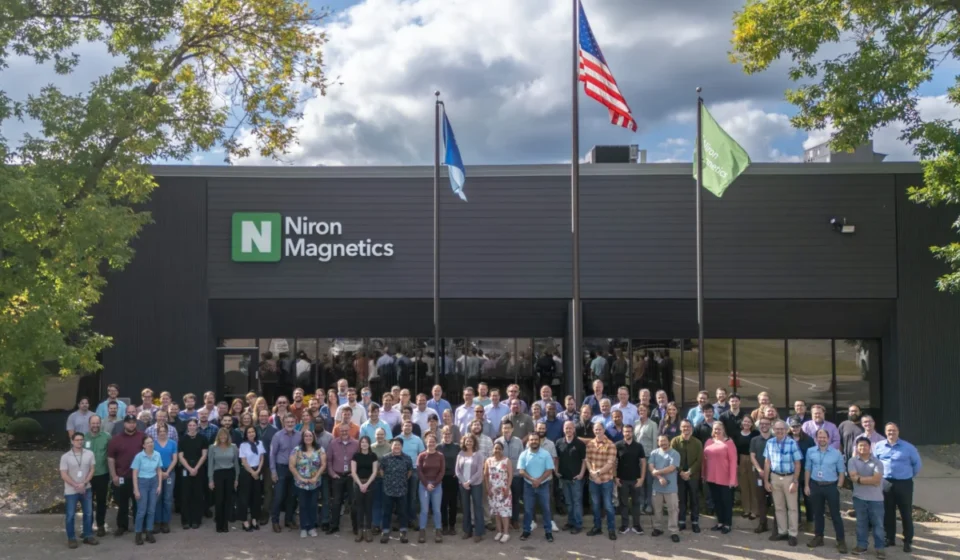
Niron established its headquarters and a pilot plant in Northeast Minneapolis. During this phase, the company focused on refining its "secret sauce"—the patented process of reducing iron or recycled steel to a powder and combining it with nitrogen under specific chemical conditions. In 2023, the company broke ground on its first commercial-scale production facility in Sartell, near St. Cloud. This $10 million facility is expected to employ 175 people and produce 1,500 tons of magnets annually.
2024: The Search for the Mega-Plant Site
Earlier this year, Niron hired Savills, a global commercial real estate adviser, to lead the site selection process for its third facility. The company is seeking a partner—likely a state or local government—that can provide the necessary infrastructure and investment incentives. Speculation has centered on repurposing shuttered taconite plants on the Iron Range, which already possess the rail and power capacity required for large-scale manufacturing.
2028–2029: Looking Toward the Future
Should the Iron Range be selected, construction is slated to begin in 2028. This timeline aligns with the projected surge in EV demand, as major automakers transition their fleets to electric powertrains.
Supporting Data: The Economics of Magnetism and Geopolitics
The drive for Niron’s expansion is fueled by a volatile global market and a domestic push for supply chain resilience.
The China Factor
According to the Center for Strategic and International Studies, China mines approximately 70% of the world’s rare-earth minerals and controls 90% of the manufacturing of the resulting magnets. Recent export controls placed by Beijing on certain minerals have heightened fears in Washington and Brussels regarding "resource nationalism." By utilizing iron and nitrogen, Niron effectively bypasses this geopolitical bottleneck.
Financial Backing and Market Potential
Niron has already raised approximately $300 million in public and private capital. Its investor roster reads like a "who’s who" of the industrial and tech worlds:
- Automotive: GM Ventures, Volvo, and Stellantis (the parent company of Chrysler, Jeep, and Fiat).
- Technology: Samsung Ventures and Western Digital.
- Government: The U.S. Department of Energy (DOE).
The company is eyeing a public stock offering within the next few years, with a target of reaching $1 billion in annual revenue. This financial trajectory is supported by the sheer scale of the magnet market; as the world moves toward electrification, the demand for high-performance magnets is expected to triple by 2035.
Official Responses: A Bipartisan Consensus
Rarely do industrial projects in Minnesota receive such unified support from across the political spectrum. While mining projects often split the state along environmental and economic lines, Niron Magnetics has managed to garner praise from both sides of the aisle.
The State’s Perspective
Ryan Malich, executive director of business development at the Minnesota Department of Iron Range Redevelopment and Resources (IRRR), views the project as a perfect fit for the region’s evolution. "These are the types of jobs that we’re trying to add to the area in evolving, innovative technologies," Malich stated. "We have a highly skilled, available workforce. All the elements seem to line up well for this potential development."
Kevin McKinnon, Deputy Commissioner of the Department of Employment and Economic Development (DEED), echoed this enthusiasm. "The promise, the trajectory of where they are going is very exciting," McKinnon said. "The third project would dwarf Sartell. The scale is exciting. We believe Minnesota is a compelling location for such a project."
The Federal and Local Political Front
U.S. Rep. Pete Stauber, a Republican representing the Duluth area and a staunch advocate for traditional mining, also supports Niron’s expansion. This bipartisan backing is crucial, as the project will likely require significant state and federal infrastructure grants to come to fruition. Governor Tim Walz’s administration, which has been vocal in its opposition to the Twin Metals project due to environmental concerns, has actively courted Niron, seeing it as a way to provide "green" industrial jobs without the risks associated with hard-rock mining near the Boundary Waters.
Implications: A New Era for the Iron Range
The potential arrival of Niron Magnetics on the Iron Range carries profound implications for the region’s environment, economy, and strategic importance.
1. Environmental Reconciliation
The most significant contrast between Niron and projects like Twin Metals is the environmental footprint. Twin Metals seeks to mine copper, nickel, and cobalt within the watershed of the Boundary Waters Canoe Area (BWCA), a pristine wilderness. Environmentalists fear that acid mine drainage could irreparably harm the ecosystem. Niron, conversely, would operate outside this sensitive watershed and use a manufacturing process that avoids the toxic chemical separation required for rare-earth refining. For the Walz administration, Niron offers a "win-win": industrial growth without the political and environmental headache of a permitting battle in the BWCA.
2. Economic Diversification
For decades, the Iron Range has been at the mercy of the global steel market. When imported steel floods the market or domestic mills switch to recycled scrap, the Range suffers. Niron represents a move toward value-added manufacturing. Instead of merely shipping raw taconite pellets to mills in other states, the Range could become a producer of finished, high-tech components. This shift would provide more stable, higher-paying jobs that are less susceptible to the cyclical nature of the raw commodities market.
3. National Security and Strategic Autonomy
On a national level, Niron’s success would be a major victory for U.S. strategic autonomy. Permanent magnets are essential for the guidance systems of missiles, the motors of nuclear submarines, and the communications arrays of fighter jets. Reducing the Department of Defense’s reliance on Chinese-sourced magnets is a top priority in Washington. If the Iron Range becomes the primary source of these iron-nitride magnets, it will cement Minnesota’s role as a critical player in national security.
4. The Path to Site Selection
The final hurdle remains the site selection. While the Iron Range has the heritage and the hardware, other states are also vying for the $1.8 billion investment. The outcome will likely depend on the "partnership" CEO Jonathan Rowntree mentioned—specifically, how much the State of Minnesota is willing to invest in infrastructure, tax credits, and workforce training to ensure that the technology invented at the University of Minnesota stays in Minnesota.
In conclusion, Niron Magnetics represents more than just a new factory; it represents the potential for an industrial renaissance. By bridging the gap between the region’s mining heritage and the future of clean energy, Niron may have found the key to unlocking a sustainable economic future for the Iron Range.