



























































Gamifying the Executive Branch: Inside the White House’s Controversial Policy-Themed Retro Arcade

In an unprecedented departure from traditional executive branch communications, the official White House website has launched a dedicated interactive portal: the "White House Arcade." Visitors to WhiteHouse.gov/arcade are greeted by a collection of low-resolution, browser-based video games that transform complex, highly polarized federal policies—ranging from border enforcement and school lunch nutritional standards to child savings accounts—into casual arcade objectives.
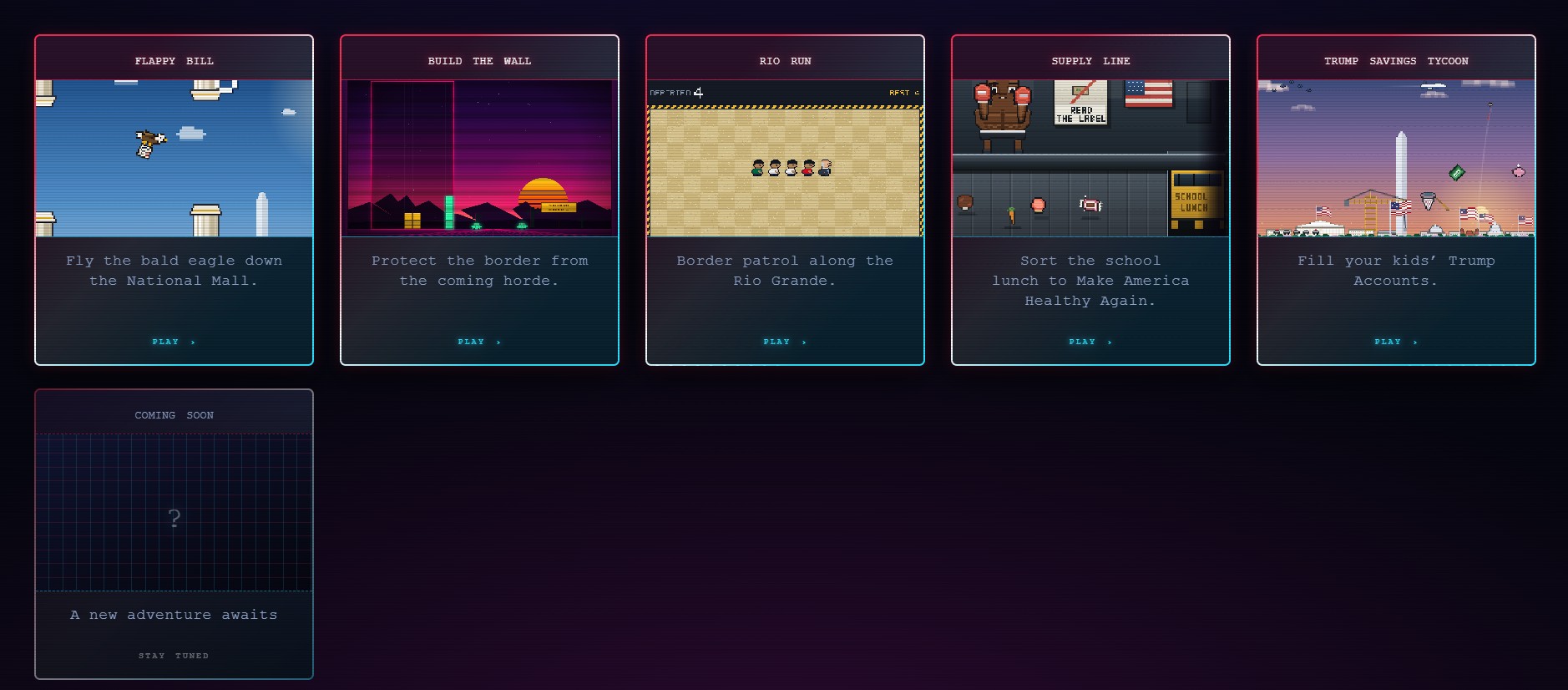
The suite currently features five playable titles: Build the Wall, Rio Run, Supply Line, Flappy Bill, and Trump Savings Tycoon. A sixth tile, marked "Coming Soon," promises future additions to the roster.
While political campaigns have long experimented with digital media to engage voters, hosting playable, retro-themed policy propaganda directly on a taxpayer-funded .gov domain represents a significant shift in state-level public relations. By translating contentious legislative and executive goals into simplistic, dopamine-driven gameplay loops, the administration is testing the boundaries of political communication, gamification, and digital statecraft.
Chronology: The Evolution of Political Gamification
The integration of video games into the political arena has evolved over several decades, moving from independent satire to coordinated campaign strategies, and finally to official government infrastructure.
[Late 1990s - 2000s]
Independent developers release satirical Flash games mocking political figures.
       │
       ▼
[2008 - 2012]
The Barack Obama campaign purchases in-game billboard advertisements in titles like "Burnout Paradise".
       │
       ▼
[2020]
The Joe Biden campaign launches custom virtual spaces, including an "Animal Crossing" island and "Fortnite" maps.
       │
       ▼
[Present]
The Trump Administration launches the "White House Arcade" directly on the official White House (.gov) website.
The Early Era of Political Games (Late 1990s–2000s)
In the early days of the consumer internet, political video games were almost exclusively the domain of independent developers, activists, and satirists. Flash-based games on portals like Newgrounds frequently mocked political figures or critiqued government initiatives, but these were external, third-party commentaries.
Campaign Integration (2008–2020)
Political strategists eventually recognized the demographic reach of the gaming sector. During the 2008 presidential race, the Barack Obama campaign purchased in-game billboard advertisements within popular titles such as Burnout Paradise and Madden NFL.
By 2020, the Biden-Harris campaign had advanced this strategy by building dedicated virtual spaces, launching an official campaign headquarters island in Nintendo’s Animal Crossing: New Horizons and custom maps in Fortnite.
The Shift to Official State Infrastructure
The launch of the White House Arcade marks the first time an active administration has integrated playable, policy-focused video games directly into the official digital infrastructure of the executive branch. Unlike campaign-funded mobile apps or external platforms, these games are hosted alongside executive orders, presidential proclamations, and official press briefings.
The promotional rollout for the portal embraced a distinct retro aesthetic, featuring simulated classic console startup screens and a stylized logo that parodies the iconic Sega branding with the acronym "MAGA" (Make America Great Again).
Supporting Data: A Deep Dive into the Game Suite
The five games currently available on the website are direct adaptations of well-known retro game mechanics, retrofitted with specific policy narratives.
| Game Title | Gameplay Inspiration | Core Policy Focus | Key Visual/Narrative Elements |
|---|---|---|---|
| Build the Wall | Tetris | Immigration / Physical Border Barriers | Stacking colored blocks to prevent a "coming horde." |
| Rio Run | Snake | Border Enforcement / Apprehension | Trump-shaped avatar collecting migrants along the Rio Grande. |
| Supply Line | Tapper / Conveyor Belt | Make America Healthy Again (MAHA) | Sorting school lunch trays to eliminate non-compliant foods. |
| Flappy Bill | Flappy Bird | Legislative Process / Civic Education | A bald eagle carrying a legislative bill through obstacles. |
| Trump Savings Tycoon | Collect-em-up / Side-scroller | "Trump Accounts" (Child Savings Program) | Collecting floating gold and cash over the National Mall. |
1. Build the Wall
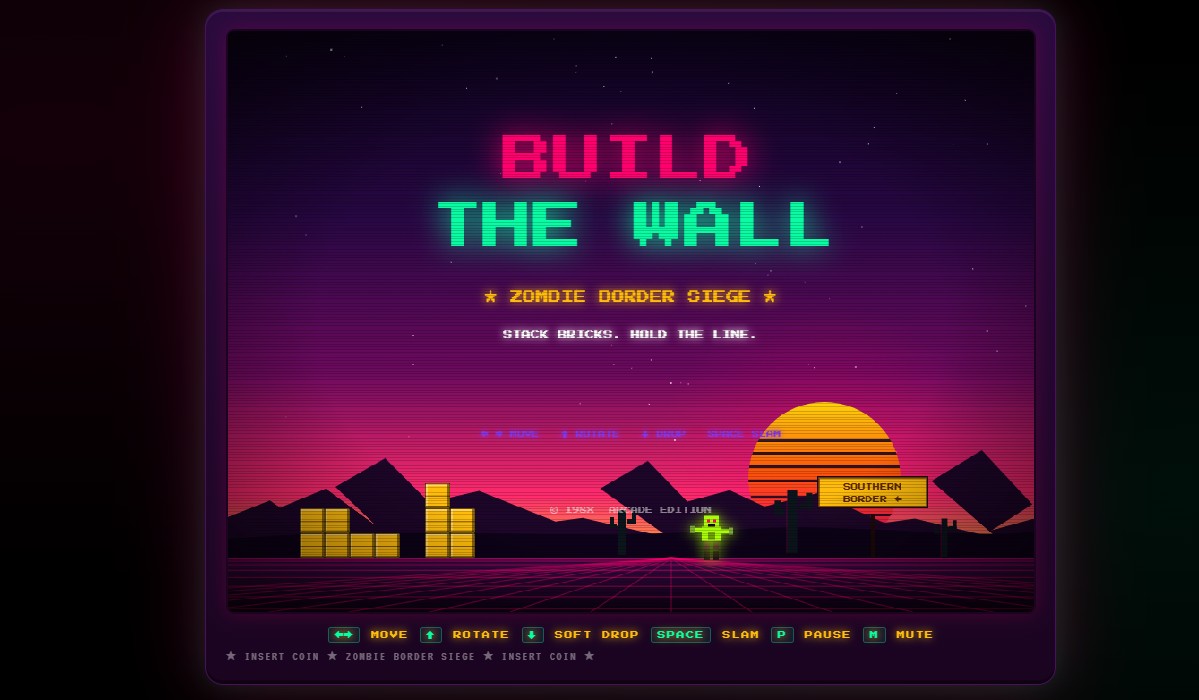
Build the Wall adapts the spatial puzzle mechanics of Tetris. Players are tasked with rotating and arranging falling colored blocks to construct solid, unbroken horizontal lines.
The political messaging of the game is direct. The official White House description instructs players to arrange the blocks to protect the southern border from what it characterizes as a "coming horde." By framing border wall construction as a clean, satisfying puzzle, the game abstracts a complex geopolitical and humanitarian issue into a series of rewarding spatial fits.
2. Rio Run
Based on the classic arcade game Snake, Rio Run features a stylized, Trump-shaped avatar navigating the banks of the Rio Grande. As the player guides the character, they collect small, pixelated figures representing individuals attempting to cross the border.
With each figure collected, the player’s score increases, and the figures line up directly behind the avatar, mimicking the growing tail of the classic Snake mechanic. The game simplifies the highly sensitive and legally complex process of border apprehension into a routine collection mechanic.
3. Supply Line
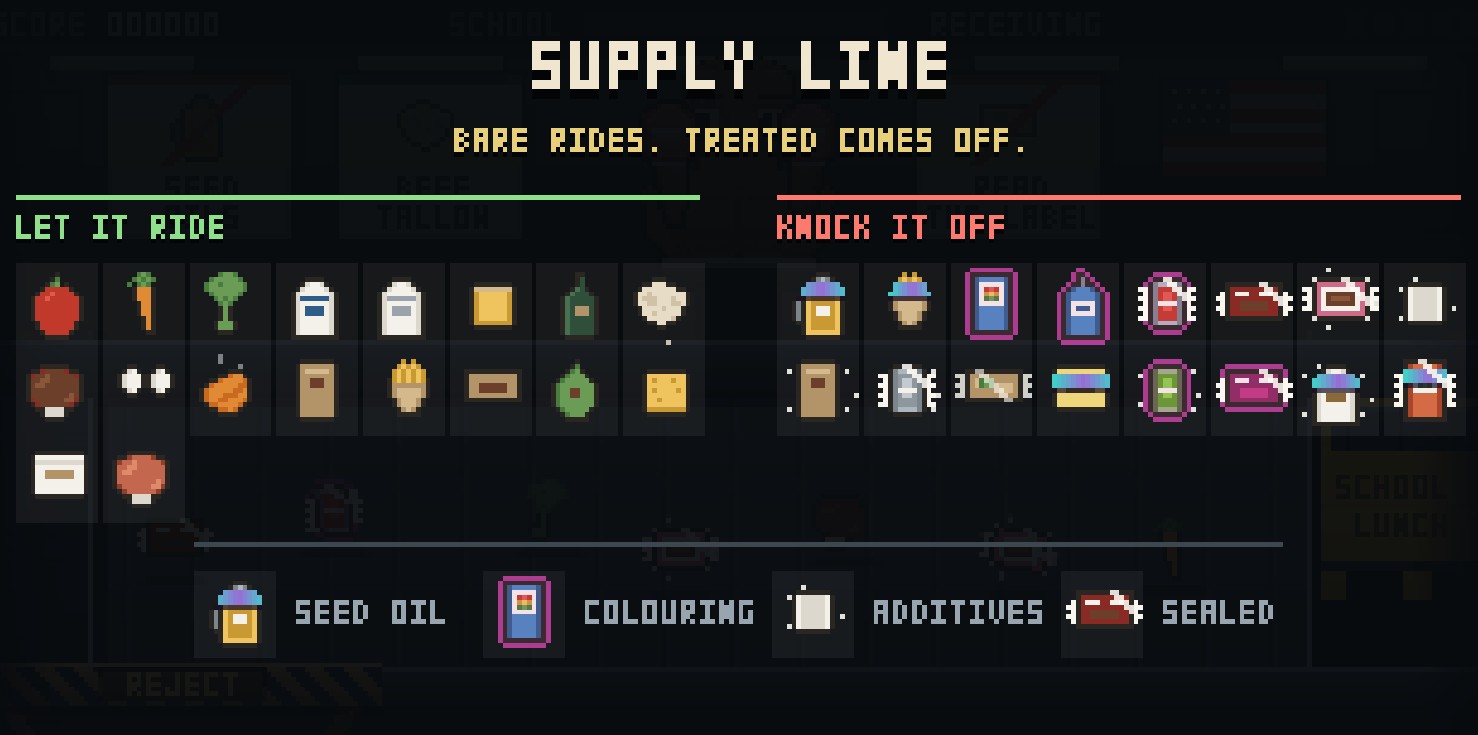
Supply Line moves away from immigration to highlight the administration’s "Make America Healthy Again" (MAHA) school lunch initiative. Drawing inspiration from classic fast-paced conveyor belt games like Bally Midway’s Tapper, the game requires players to monitor school lunch trays moving rapidly across the screen.
Players must quickly identify and discard food items that do not meet the administration’s updated nutritional standards. Of the five games, Supply Line aligns most closely with traditional educational browser games, though it remains explicitly branded around a specific political campaign.
4. Flappy Bill
Flappy Bill is a clone of the mobile game Flappy Bird, which became a global phenomenon in 2013. In this iteration, players tap or click to keep a bald eagle airborne as it flies over a pixelated rendering of the National Mall.
Clutched in the eagle’s talons is a legislative bill. The player must navigate the eagle through gaps between vertical obstacles. The official description is simple—"Fly the bald eagle down the National Mall"—presenting a whimsical, high-difficulty metaphor for the challenges of passing legislation through Washington.
5. Trump Savings Tycoon
Set against the backdrop of the Washington monument, Trump Savings Tycoon is designed to promote "Trump Accounts," a proposed federal savings program for children that includes a one-time federal contribution of $1,000 for eligible newborns.
In the game, players control an airborne character collecting floating gold coins and stacks of cash to fill up digital savings accounts. The game translates a complex fiscal proposal into a literal exercise of grabbing money out of the air.
Official Responses and Public Reaction
The launch of the arcade immediately sparked intense debate among political analysts, ethicists, digital media scholars, and civil rights organizations.
Ethical and Legal Concerns
Critics have raised questions regarding the use of official, taxpayer-funded digital resources to host highly partisan and stylized games. Under federal guidelines, official government channels are intended to provide objective public information, services, and administrative updates.
Immigration advocacy groups have been particularly critical of Build the Wall and Rio Run, arguing that depicting border enforcement as an 8-bit game dehumanizes migrants. "Reducing human beings fleeing violence and economic hardship to pixelated tokens in a game of Snake is deeply concerning," said one advocacy spokesperson. "It trivializes human suffering for political entertainment."
Support and Populist Appeal
Supporters of the administration have defended the arcade as an innovative, lighthearted, and highly effective way to cut through mainstream media filters and communicate directly with the public. Proponents argue that traditional policy papers and press releases fail to reach younger, digitally native demographics.
"The media is obsessed with traditional decorum, but the reality is that people digest information differently today," noted a conservative digital strategist. "By using humor, retro nostalgia, and simple gameplay, the White House is making its policy goals accessible and viral. It’s a brilliant piece of modern political marketing."
Academic Analysis: "Procedural Rhetoric"
Digital media scholars view the portal as a textbook example of what game theorist Ian Bogost calls procedural rhetoric—the practice of using game rules and mechanics to make arguments and persuade players.
In Build the Wall, the game rules dictate that the only way to "win" or progress is to build a solid barrier; there are no alternative mechanics for processing or integration. By hardcoding a specific political outcome as the sole win condition, the game implicitly argues that physical barriers are the only logical solution to border security.
Implications: The Gamification of State Power
The integration of retro video games into WhiteHouse.gov has broader implications for the future of political communication and democratic institutions.
┌─────────────────────────────────────────────────────────┐
│              THE LUDIC LOOP OF POLICY SUPPORT           │
├─────────────────────────────────────────────────────────┤
│                                                         │
│   1. Player Engages with Retro Nostalgia (Tetris/Snake) │
│                          │                              │
│                          ▼                              │
│   2. Complex Policy is Simplified into Game Mechanics   │
│                          │                              │
│                          ▼                              │
│   3. Player Achieves Dopamine Hit via "Winning"         │
│                          │                              │
│                          ▼                              │
│   4. Policy Outcome is Normalized as a Success State   │
│                                                         │
└─────────────────────────────────────────────────────────┘
1. The Normalization of Controversial Policy
By wrapping controversial administrative objectives in the safe, nostalgic aesthetic of 1980s arcade classics, the White House lowers the barrier to entry for political messaging. Nostalgia is a powerful emotional tool; by linking childhood memories of playing Tetris or Snake with physical border barriers and immigration enforcement, the administration seeks to soften the edges of highly contested policies.
2. The Dopamine Loop of State Consensus
Traditional policy debates require cognitive effort, critical analysis, and engagement with counterarguments. Gamification bypasses this process by establishing clear, binary rules: the player has a goal, obstacles are presented, and overcoming those obstacles triggers a dopamine release associated with winning. When the state controls the rules of the game, it can define "success" in a way that aligns perfectly with its political agenda.
3. The Erosion of Institutional Decorum
For decades, the official website of the President of the United States has maintained a highly formal, institutional tone. The introduction of low-resolution Flash-style games alongside official executive orders represents a deliberate deconstruction of that decorum. It fits into a broader populist communication strategy that values direct engagement, viral content, and anti-establishment styling over traditional institutional norms.
With a sixth slot on the White House Arcade page explicitly labeled "Coming Soon," the administration has signaled that this interactive experiment is far from over. Whether this portal remains a quirky footnote in digital political history or marks the beginning of a new era of gamified state propaganda, it has successfully established a new, highly controversial frontier in presidential public relations.