






















































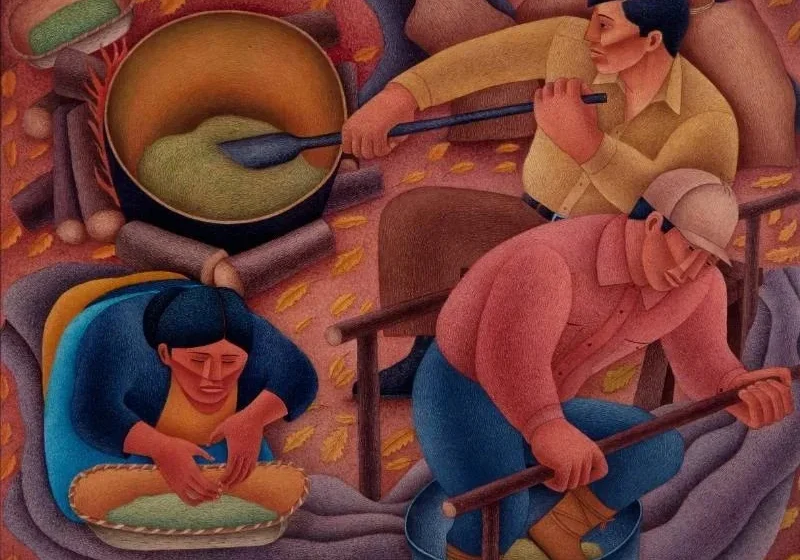

In the annals of 20th-century American art, few figures bridge the gap between commercial accessibility and profound cultural preservation as effectively as Patrick DesJarlait. A member of the Red Lake Nation, DesJarlait (1921–1972) was a transformative Ojibwe modernist painter whose work challenged the pervasive, reductive stereotypes of Native Americans that dominated mid-century media. While his name is indelibly linked to iconic American commercial imagery—specifically the Land O’Lakes butter maiden and the Hamm’s Beer bear—his true legacy lies in his lifelong commitment to portraying the Red Lake Ojibwe people with dignity, heroism, and a vibrant sense of living history.
Main Facts: An Artist of Two Worlds
Patrick DesJarlait’s life was defined by a unique tension: he was a man who navigated the rigid structures of federal boarding schools and the high-pressure environment of Madison Avenue advertising, all while maintaining a deep, spiritual connection to his Ojibwe roots.
Known in Ojibwemowin as Nagawbo ("Boy in the Woods"), his early life was marked by both profound observation and significant trauma. He was later bestowed the name Gwiwizens Odayn Ozhibii’ignaak—"Boy with a Pencil"—a testament to his early and voracious need to document the world around him. His artistic style was characterized by clean, heroic lines and a commitment to showing the Red Lake community not as relics of a vanishing past, but as a dynamic, contemporary society.

His work served as a counter-narrative to the "cowboy and Indian" tropes of the 1940s and 50s. While Hollywood was casting Native Americans as static foils to heroic pioneers, DesJarlait was painting scenes of maple sugaring, wild rice harvesting, and familial love. He proved that Native identity was not merely a historical costume, but a living, breathing, and evolving culture.
Chronology: A Life of Resilience and Evolution
The trajectory of DesJarlait’s life is a journey through the transformative decades of the American 20th century.
- 1921: Born on March 2 on the Red Lake Reservation in Minnesota.
- 1926–1935: At age five, he contracted trachoma, leading to temporary blindness. His recovery was followed by the displacement inherent in the federal boarding school system. He attended St. Mary’s, Red Lake Boarding School, and eventually graduated from the Pipestone Indian School in 1935.
- 1939–1942: Following high school, he received a Bureau of Indian Affairs scholarship to attend Arizona State College, where he formally honed his artistic skills.
- 1942: The onset of World War II interrupted his studies. He briefly worked as an art supervisor at the Poston, Arizona, Japanese concentration camp before joining the U.S. Navy. His wartime service focused on the creation of instructional and propaganda films.
- 1945–1946: His first solo exhibition at the Fine Arts Gallery in San Diego was a resounding success, selling out in a week. He returned to Red Lake to immerse himself in tribal life.
- 1947: A pivotal year; he moved to St. Paul to launch his commercial career. He produced masterpieces like "Maple Sugar Time" and "Making Wild Rice," the latter winning the top prize at the Philbrook Indian Annual.
- 1954: He famously revised the "Land O’Lakes" butter maiden, infusing her with authentic Ojibwe design elements, such as intricate beadwork.
- 1968–1972: As the American Indian Movement (AIM) rose to prominence in Minneapolis, DesJarlait focused on educational outreach, using his art to foster pride in the next generation.
- 1972: DesJarlait passed away at age 51 due to cancer-related complications, leaving behind a body of work that continues to influence contemporary Native artists.
Supporting Data: The Commercial and Cultural Synthesis
DesJarlait’s career was marked by a sophisticated interplay between fine art and commercial illustration. His work for advertising giants like Campbell-Mithun required him to translate complex cultural aesthetics into recognizable mass-market icons.

His revision of the Land O’Lakes butter maiden is a masterclass in subtle, subversive design. By incorporating Ojibwe floral patterns and adjusting the logo’s typography to evoke the Byzantine halo—an aesthetic choice reflecting his appreciation for religious iconography—he reclaimed a corporate symbol for the Ojibwe people. Similarly, his work on the Hamm’s Beer bear commercials allowed him to introduce Northern Woodland aesthetic references to a mainstream television audience, proving that Native influence could be seamlessly woven into the fabric of American consumer culture.
His fine art, however, remains his most enduring contribution. Paintings such as "Red Lake Fishermen" are archived in major institutions, and they are noted for their flat, stylized, yet deeply emotive composition. These works remain significant in art history for their defiance of the "primitive" label often slapped on Native painters of the era; DesJarlait was a modernist who understood color theory, spatial dynamics, and the power of the human form.
Official Responses and Critical Reception
The critical reception of DesJarlait’s work has evolved significantly since his death. In the mid-20th century, he was often praised by mainstream galleries for his "decorative" quality, a term that, while intended as a compliment, often minimized the political and social weight of his subjects.

Modern scholars and curators, however, view his work through a different lens. Organizations such as the Minnesota Historical Society (MNopedia) have highlighted his role as a precursor to the modern Indigenous arts movement. His 1970 work, "Indian Educations," is frequently cited as a turning point in his later career, where his commitment to positive representation—specifically the depiction of nurturing Native fathers—moved to the forefront. This series was a deliberate response to the lack of healthy, realistic depictions of Native family life in the public imagination, demonstrating his keen awareness of the power of media to shape social reality.
Implications: The Enduring Impact of a Modernist Pioneer
The implications of DesJarlait’s life and work are manifold for both the art world and the broader discourse on Indigenous identity in America.
Bridging the Gap
DesJarlait proved that one could be a commercial success without sacrificing cultural integrity. His ability to navigate the Twin Cities advertising world while maintaining his role as a chronicler of Red Lake life provided a blueprint for future generations of Native creatives. He demonstrated that art is not just for the gallery wall; it is a tool for communication, identity formation, and social advocacy.

A Catalyst for Pride
In the shadow of the American Indian Movement, DesJarlait recognized that his role as an elder and educator was just as vital as his role as a painter. By speaking in schools and colleges, he helped bridge the divide between Native and non-Native populations. He was instrumental in teaching the public that Ojibwe life was not an artifact of the past, but a contemporary reality worthy of respect and understanding.
The Future of Native Modernism
Today, DesJarlait’s legacy lives on in the burgeoning movement of Indigenous contemporary art. His insistence on depicting Native people in positions of dignity, agency, and community-building laid the groundwork for artists who now dominate the contemporary scene. By refusing to paint "vanishing" Indians and instead choosing to paint "living" ones, he secured a future where Native stories are told by Native hands.
Patrick DesJarlait did not simply paint the world as he saw it; he painted the world as he envisioned it could be. His "Boy with a Pencil" moniker was more than a nickname—it was a call to document the truth of his people, a mission he fulfilled with unwavering focus until his final days. As we look back on his contributions, we are reminded that true modernism is not about discarding the past, but about using the tools of the present to honor and protect the stories that define us.