
























































A Homecoming Ten Years in the Making: How Nia Coffey Found Her Rhythm with the Minnesota Lynx

By [Your Name/Journalistic Staff]
For the Minnesota Lynx, the 2026 WNBA season has been a masterclass in adaptation. Facing the challenge of a roster reshaped by free agency and the expansion draft, and weathering the temporary absence of superstar Napheesa Collier, the league-leading franchise (11-3) has looked to unlikely sources to maintain its championship-caliber identity. Chief among them is a familiar face to the local basketball community: Nia Coffey.
After a decade-long odyssey that saw her don the jerseys of five different organizations, Coffey has finally returned to her roots. While "coming home" is a common sports trope, for the 31-year-old forward, joining the Lynx is not merely a sentimental reunion—it is the professional catalyst that has unlocked her career-best basketball.
The Arc of a Journey: From Hopkins to the Pros
To understand the gravity of Coffey’s current success, one must look at the foundation of her basketball pedigree. A product of the legendary Hopkins High School program—a suburban Minneapolis powerhouse that also groomed 2025 No. 1 overall pick Paige Bueckers—Coffey’s life has always been defined by the sport.
Her lineage is steeped in athletic excellence. Her father, Richard Coffey, was a decorated Army paratrooper who carved out a collegiate legacy at the University of Minnesota before a professional stint in the NBA. Her younger brother, Amir, has spent seven seasons in the NBA, currently competing for the Phoenix Suns.
Despite this pedigree, Coffey’s professional path was far from a straight line. Drafted fifth overall out of Northwestern in 2017, she struggled to find a permanent home. For years, she occupied the role of a reliable utility player, rarely logging significant minutes or consistent offensive production. Prior to this season, she had only managed to average more than seven points per game once in her nine-year career. She was a journeyman, a player defined by what she could provide for others rather than what she could build for herself.
A Statistical Renaissance: The Monday Night Breakthrough
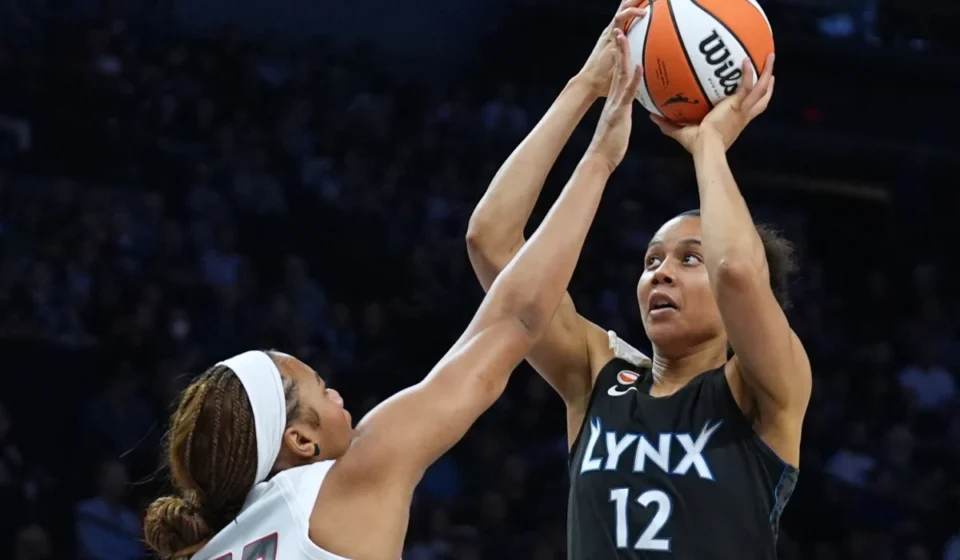
The true turning point in her integration into the Lynx system arrived this past Monday in a dominant 107-74 victory over Portland. In a game that saw the Lynx set a franchise record with seven players reaching double-digit scoring, Coffey was the undeniable centerpiece.
Her stat line—15 points, five rebounds, four assists, three steals, and three blocks—was more than just impressive; it was historic. Coffey became only the fifth player in the storied history of the Minnesota Lynx to record those specific minimums in a single contest.
The performance electrified the Target Center crowd. It was a display of efficiency and versatility: three 3-pointers in the opening quarter and a high-IQ layup at the halftime buzzer that left the opposition scrambling. The effort was so complete that head coach Cheryl Reeve, rarely one to offer hyperbolic praise, awarded Coffey the game ball—a symbolic gesture of her elevated status within the team hierarchy.
Analyzing the Impact: Why the Lynx System Fits
The "Lynx identity" has long been synonymous with high-level defensive intensity, rebounding, and disciplined offensive sets. Historically, it is a system that demands complete buy-in. According to Coach Reeve, the chemistry between the team’s philosophy and Coffey’s skill set is no accident.
"Her level of compete, her ability to play so vertically, shot-blocking, rebounding—she gives you all that energy and sets the tone for us," Reeve noted during the post-game press conference. "She’s such a big part of our defensive identity and our toughness, and then shooting the 3 as we’ve asked for. We do ask a lot from her at both ends."
The statistics back up Reeve’s assessment of a "renaissance." This season, Coffey is posting career-highs across the board:
- Minutes per game: 26.4
- Points per game: 8.7
- Rebounds per game: 5.9
- Assists per game: 2.1
- Field Goal Percentage: 50%
- 3-Point Percentage: 43.9%
These are not the numbers of a role player; they are the numbers of an essential starter. With Collier sidelined due to ankle surgery, the pressure on the forward rotation has been immense. Coffey has not just filled the void; she has expanded the team’s tactical options.
The Coaching Dynamic: A Matter of Listening
Perhaps the most revealing aspect of Coffey’s tenure in Minnesota is the relationship she has forged with Cheryl Reeve. In professional sports, the transition from being a bench player to a starter often requires a psychological shift—an ability to absorb complex instructions and apply them under pressure.
"There are so many things," Reeve said when asked what makes Coffey so valuable. "I think what I appreciate about her—probably because I don’t get it from the rest of the starters—is she listens. She really looks at you dead in the eye and receives the information and goes out there and does exactly what you’re asking her to do."
When relayed this quote, Coffey offered a humble response, laughing off the implication that her teammates might be less attentive. "I like to do a good job, so you kind of have to know what they’re asking for," she said.
This coachability has allowed Coffey to flourish in a system that often frustrates players who are used to more individual freedom. For Coffey, the discipline is a relief. After a decade of moving from city to city, she has finally found a coaching staff that provides a clear roadmap for her success.
Implications for the Season Ahead
The broader implications for the Minnesota Lynx are significant. As the team moves toward the mid-point of the season with an 11-3 record, they are proving that their success is not tethered to a single superstar. The "next woman up" mentality has been codified by players like Coffey, who have seized the opportunity to redefine their careers.
As Napheesa Collier prepares to return to the court, the Lynx find themselves in an enviable position. They are no longer a team waiting for their star to return; they are a cohesive unit that has discovered hidden depth. Coffey’s emergence as a legitimate two-way threat gives the coaching staff unprecedented flexibility in rotation management.
For the league, the story of Nia Coffey serves as a reminder of the volatility of professional basketball. A player’s trajectory is rarely defined by their draft position or their first five years in the league. Sometimes, it is defined by timing, environment, and the willingness to look a coach in the eye and trust the process.
"I always loved how the Lynx played. It just felt weird because I was always on other teams," Coffey reflected. "I’m glad it was a possibility for me to be on this team. I love the way we play. I love our coaching staff and our players. It’s great. So I’m glad it worked out."
As the Lynx look toward the playoffs, one thing is certain: Nia Coffey is no longer just a player from the Twin Cities. She is the engine driving one of the most resilient teams in the WNBA. Her journey, which began in the suburban gyms of Minneapolis, has come full circle, resulting in the most productive and rewarding chapter of her professional life. Whether she can sustain this level of output remains to be seen, but for now, the hometown hero has firmly planted her feet in the paint, ready to lead the charge.