
























































The Paraquat Papers: Inside the Decades-Long Corporate Campaign to Keep a Controversial Weed Killer on the Market

For over 40 years, the global consensus on the herbicide paraquat has been clear: it is a dangerous chemical with severe health implications. Yet, in the United States, the toxic weed killer remained a staple of industrial agriculture, its usage nearly tripling between 2000 and 2018. Newly revealed internal corporate records from Syngenta—the primary manufacturer of paraquat—have finally shed light on how the company managed to maintain its grip on the U.S. market even as nations across the globe, including the chemical’s country of origin, moved to ban it.
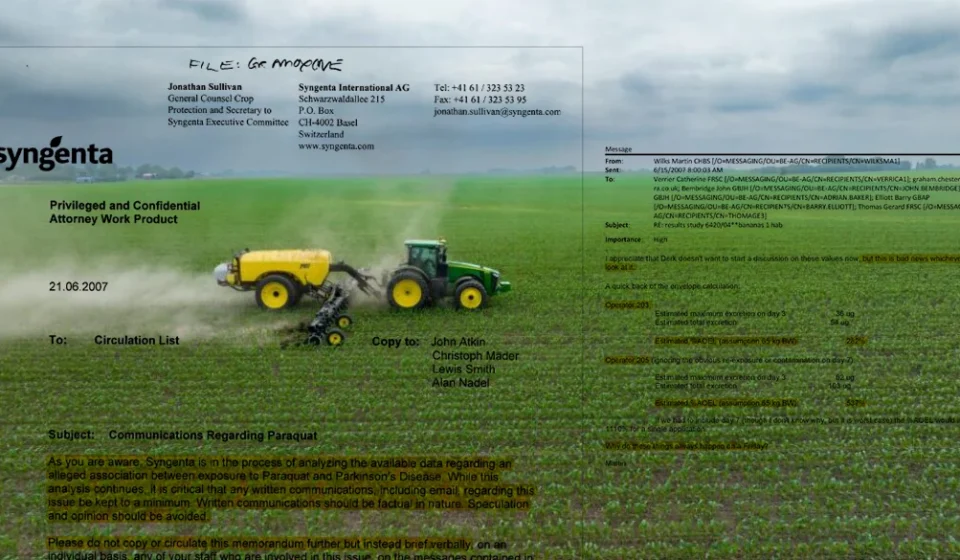
These documents, totaling roughly 3,700 pages and unearthed through extensive litigation, paint a portrait of a calculated, multi-decade strategy to downplay the risks of Parkinson’s disease, discredit independent scientific research, and withhold critical safety data from the U.S. Environmental Protection Agency (EPA).
The Global Retreat vs. The American Exception
The international rejection of paraquat began in 1983, when Sweden led the charge by banning the chemical. As scientific evidence mounted regarding its link to neurotoxicity and, specifically, Parkinson’s disease—an incurable, debilitating neurological disorder—countries followed suit one by one. Even China, which owns Syngenta, eventually halted the use of the pesticide in 2016 after conducting its own independent safety studies that yielded alarming results.

In the United States, the tide is only just beginning to turn. Vermont recently enacted a ban, and California regulators successfully pushed for the voluntary cancellation of paraquat products following state-level research into health concerns. Despite this, the federal government has historically been slow to act. The EPA continues to authorize the use of paraquat on millions of acres of American farmland, maintaining that there is “no clear link” between the herbicide and adverse health outcomes.
A Chronology of Corporate Strategy
The internal files reveal that Syngenta’s defensive maneuvers were not reactive; they were proactive, strategic, and often clandestine.
- 2001: As independent research began to solidify the link between paraquat and Parkinson’s, Syngenta set a clear goal: “steer the focus of serious research away from paraquat.” An internal strategy document from that year explicitly outlined the company’s intent to protect its “blockbuster” product.
- 2007–2008: Company officials began emphasizing the need for verbal-only communication to avoid creating a paper trail regarding their internal analysis of health risks. In 2008, one executive went so far as to order a halt to internal correspondence after a staffer noted that a program’s objective was to "reduce the risk" of losing lawsuits.
- 2011–2016: The company ramped up efforts to manufacture "independent" science. By funding research through third-party consultants and contract research organizations, Syngenta sought to replace a decade of independent findings with their own, carefully curated data. A 2016 study, which company insiders internally described as "invaluable," was published in PLOS One after three years of development, with the express intent of countering growing public health concerns.
- 2021–2025: Facing over 10,000 lawsuits and having paid at least $187 million in initial settlements, Syngenta announced in 2026 that it would cease global production. However, the company maintains that its decision was purely market-driven, denying any liability regarding Parkinson’s disease.
Withheld Science: The "Holes" in Regulatory Oversight
Under the Federal Insecticide, Fungicide, and Rodenticide Act (FIFRA), manufacturers are legally obligated to report "unreasonable adverse effects" to the EPA. The newly released documents suggest Syngenta systematically failed to do so.

Among the data withheld were analyses regarding the chemical’s ability to permeate clothing and its rapid absorption into the human bloodstream. Perhaps most damning is the information concerning surfactants—additives used by farmers to make the herbicide more effective. Since the 1970s, Syngenta was aware that mixing paraquat with surfactants significantly increased its toxicity. Internal correspondence from 1975 noted that registering a pre-mixed product would be “very undesirable due to increased toxicity.” Yet, the company continued to recommend the addition of surfactants on its U.S. product labels without disclosing these findings to federal regulators.
Other withheld data included studies on animal exposure and evidence of paraquat metabolites found in urine, which the company allegedly deemed unimportant because the chemical is excreted. Plaintiffs’ experts, such as Tim Fort, a professor of Business Law and Ethics at Indiana University, argue that Syngenta essentially “substituted its own judgment” for that of the regulatory agency, effectively undermining the EPA’s ability to protect the public.
The Official Response: A Regulatory System Under Fire
The EPA’s stance remains a point of intense controversy. When questioned about the withheld data, the agency stated it "cannot speculate" on how the new information would impact its past assessments, while simultaneously asserting that it requires companies to submit all information regarding adverse effects. "Failure to comply is a direct violation of federal law," an agency representative noted.

However, critics point out that the EPA is fundamentally constrained. The agency relies heavily on industry-submitted data and has seen its own research capabilities diminished over the years. Wendy Wagner, a law professor at the University of Texas, notes that the system leaves "a lot of holes" in public health protection, as the EPA is essentially an arbiter that is only as well-informed as the corporations it regulates choose to make it.
Syngenta continues to reject all allegations of wrongdoing. In a statement, a company spokesperson insisted that Syngenta has never "knowingly failed" to provide relevant information to regulators and argued that the data in question was either not relevant to the U.S. market or had been misinterpreted by plaintiffs in litigation.
Implications: A Failure of Precaution
The saga of paraquat is increasingly viewed by public health experts as a cautionary tale of regulatory capture and corporate influence. By creating a shroud of secrecy around internal studies and aggressively funding "independent" research to muddy the waters, Syngenta successfully delayed regulatory action for decades.

The implications are profound. As Dr. Tracey Woodruff of Stanford University noted, "When the pesticide companies know from their own studies that their pesticides are harmful and don’t tell the public or regulators, then they are knowingly contributing to people getting sick and dying."
The recent Supreme Court ruling—which declares the EPA as the preemptive authority for pesticide labeling—further complicates the landscape. If the EPA remains convinced by the industry-provided data, and states are stripped of their ability to enforce stricter, evidence-based warnings, the "holes" in the regulatory system will only widen.
For the thousands of Americans currently living with Parkinson’s disease—many of whom spent their lives working the fields with this chemical—the revelations in the Paraquat Papers are not just historical footnotes. They are proof that their illness may have been a preventable casualty of a system designed more to protect corporate profits than human lives. As litigation continues, the spotlight remains fixed on whether the EPA will finally conduct its own independent analysis or continue to rely on the "invaluable" science provided by the very companies standing to profit from the status quo.