






















































Rising from the Sands: Construction Resumes on Saudi Arabia’s Record-Breaking Jeddah Tower

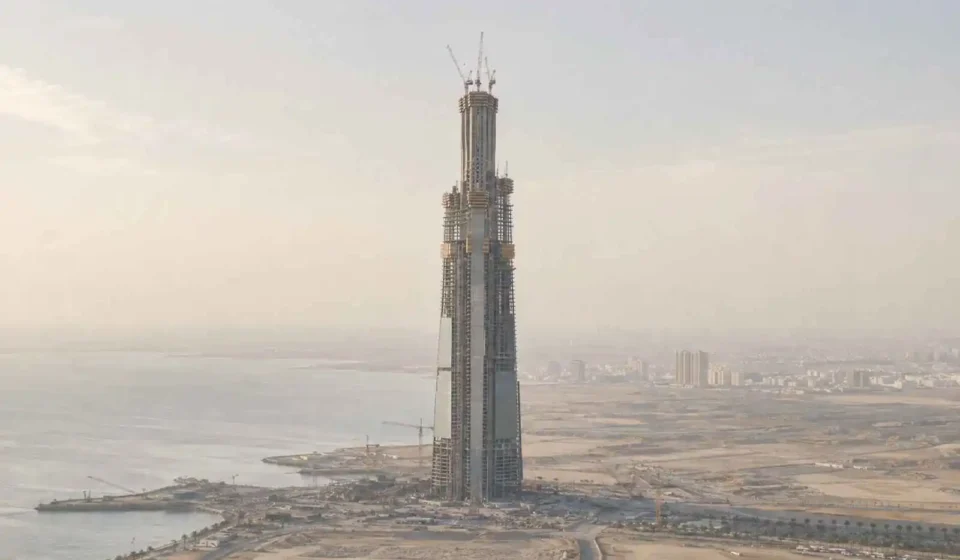
For years, a colossal concrete monolith stood frozen on the Red Sea coast of Saudi Arabia. Even in its half-finished state, the skeletal core of the Jeddah Tower dominated the local landscape—a silent, grey monument to halted global ambition. Once envisioned as the crown jewel of the Kingdom’s modern architecture, the project sat dormant for nearly seven years, leaving onlookers to wonder if the world’s first one-kilometer-tall building would ever be completed.
Now, the cranes are moving once again. In a highly publicized revival, construction on the Jeddah Tower has officially resumed. Crews have returned to the site, pouring concrete on the upper decks and installing sleek glass façade panels on the lower levels. The race to breach the clouds has restarted in earnest, signaling a major turning point for Saudi Arabia’s real estate and economic landscape.
1. Main Facts: The Resurrection of a Megatall Giant
The Jeddah Tower (formerly known as the Kingdom Tower) has officially surpassed the 430-meter (1,411-foot) mark, reaching Level 107, according to Saudi billionaire investor Prince Alwaleed bin Talal. This milestone means the structure has achieved approximately 43% of its final targeted height.
Even at its current incomplete state, the tower is taller than most completed skyscrapers worldwide. However, to achieve its ultimate goal, it must climb another 570 meters (1,870 feet)—an unfinished section that, on its own, would rank among the tallest buildings on Earth.
Once completed, the Jeddah Tower will stand at over 1,000 meters (3,281 feet), comfortably eclipsing Dubai’s Burj Khalifa to become the tallest man-made structure in history.
Key Project Specifications:
- Target Height: $1,000+$ meters ($3,281+$ feet)
- Current Height: 430 meters (1,411 feet)
- Current Floor Count: 107 floors
- Total Planned Floors: ~160 floors
- Lead Architect: Adrian Smith + Gordon Gill Architecture
- Main Contractor: Saudi Binladin Group (SBG)
- Developer: Jeddah Economic Company (JEC)
- Projected Completion: 2028
2. Chronology: The Decadelong Journey of the Kingdom’s Tallest Ambition
The path of the Jeddah Tower from blueprint to physical reality has been defined by bold engineering, financial turbulence, and geopolitical shifts.
[2008] Project announced as "Mile-High Tower" (later scaled back to 1 km)
   │
[2013] Official groundbreaking and foundation work begins
   │
[2018] Construction halts at Level 63 due to financial and political disruptions
   │
[2020-2024] Project remains dormant; site undergoes maintenance and structural assessments
   │
[2025] Jeddah Economic Company (JEC) restarts project; Saudi Binladin Group returns
   │
[2026] Tower surpasses 430 meters (Level 107); target set for 2028 completion
The Genesis (2008–2013)
The concept was first unveiled in 2008 by Prince Alwaleed bin Talal as the "Mile-High Tower." However, geological assessments of the coastal soil near the Red Sea forced architects to scale back the target to a still-unprecedented minimum of 1,000 meters. Following years of planning and soil testing, the Jeddah Economic Company (JEC) broke ground in 2013, with the Saudi Binladin Group (SBG) serving as the primary contractor.
The Great Freeze (2018–2024)
By late 2017, the tower had climbed past 60 stories, reaching approximately 250 meters. However, in early 2018, work ground to a sudden halt. The project was derailed by a combination of financial difficulties, contractor issues, and the wider domestic disruptions stemming from the 2017–2018 Saudi Arabian purge, which affected key backers of the project, including Prince Alwaleed and executives within the Binladin Group.
The onset of the COVID-19 pandemic in 2020 further complicated logistics, leaving the concrete core untouched for years. It became one of the world’s most famous "stalled megaprojects," a symbol of overreach.
The Revival (2024–2025)
After years of silence, rumors of a restart began circulating in late 2023 when JEC officially invited contractors to bid on completing the structure. In early 2025, JEC finalized an agreement to bring the Saudi Binladin Group back to the site under a revised multi-billion dollar contract. Work resumed immediately, and by mid-2026, the building had pushed past the 100-floor threshold to reach its current 430-meter height.
3. Supporting Data and Engineering Marvels
To appreciate the scale of the Jeddah Tower, one must look at the structural engineering and design innovations required to construct a stable building of this height.
Structural Design and Wind Engineering
Designing a building taller than a kilometer requires solving immense aerodynamic challenges. The Jeddah Tower features a sleek, three-sided "Y-shaped" footprint, designed by Adrian Smith, the architect who also designed the Burj Khalifa.
This triangular design serves a crucial purpose:
- Wind Mitigation: The three wings taper at different rates and heights, creating a series of setbacks. This changing profile prevents powerful wind currents from forming organized, destructive vortexes around the structure, effectively "confusing" the wind and reducing lateral sway.
- Structural Load Distribution: The central reinforced concrete core acts as a giant pillar, supported by the three wings, providing maximum torsional rigidity.
Foundations and Coastal Soil Challenges
Building a megatall skyscraper next to the Red Sea presents severe geological challenges. The ground consists of soft sand, silt, and weak limestone. To secure the tower:

- Engineers cast 270 cast-in-place bored piles reaching depths of up to 105 meters (344 feet) into the earth.
- The concrete used in the foundations was specially formulated to resist the highly corrosive, saline groundwater of the coastal environment.
Interior Layout and Vertical Transportation
The interior of the Jeddah Tower is designed to function as a self-contained vertical city. With approximately 530,000 square meters (5.7 million square feet) of usable floor space, the building will house:
- A luxury Four Seasons Hotel
- High-end office spaces
- Serviced residences and luxury condominiums
- Retail hubs and fine-dining venues
- The world’s highest observation deck, situated over 640 meters (2,100 feet) above ground level.
Moving thousands of people daily through a 1,000-meter column requires an advanced elevator network. The tower will feature 59 elevators, including double-deck units. Because steel elevator cables become too heavy at extreme lengths, passengers traveling to the highest zones will not take a single continuous ride from the lobby. Instead, they will utilize high-speed shuttle elevators to reach "sky lobbies" (transfer levels) before boarding local elevators to their final destinations.
Comparative Height Analysis
When completed, the Jeddah Tower will reorder the list of the world’s tallest buildings. The following table illustrates how the completed tower will compare to the current reigning giants:
| Building | Location | Height | Status |
|---|---|---|---|
| Jeddah Tower | Jeddah, Saudi Arabia | >1,000 meters (3,281 ft) | Under Construction (Est. 2028) |
| Burj Khalifa | Dubai, UAE | 828 meters (2,717 ft) | Completed (2010) |
| Merdeka 118 | Kuala Lumpur, Malaysia | 679 meters (2,227 ft) | Completed (2023) |
| Shanghai Tower | Shanghai, China | 632 meters (2,073 ft) | Completed (2015) |
4. Official Responses: Leadership and Corporate Endorsements
The resumption of work has been accompanied by a wave of public optimism from the project’s key stakeholders. Prince Alwaleed bin Talal, the chairman of Kingdom Holding Company and a primary backer of the development, took to social media to announce the milestone personally. Sharing images of himself visiting the active construction site alongside engineers, Alwaleed declared:
"We are back. The Jeddah Tower is rising again, and we are on track to deliver a landmark that will redefine the global skyline."
"The tower has passed 430 meters... Crews are pouring new upper floors while
 workers install façade panels on the lower levels."
 — Prince Alwaleed bin Talal, Investor and Developer
Representatives from the Jeddah Economic Company have also expressed confidence in the project’s revised timeline, pointing to the finalized agreement with the Saudi Binladin Group as proof of financial stability.
However, independent construction analysts and structural engineers remain cautiously optimistic. While the return of workers is a massive step forward, experts point out that the most difficult engineering stages lie ahead. Pumping high-strength concrete to heights exceeding 600, 800, and eventually 1,000 meters requires specialized machinery and highly favorable weather conditions. High winds at upper levels can halt crane operations for days, meaning the targeted 2028 completion date leaves very little room for error.
5. Strategic Implications: Vision 2030 and the Geopolitical Sky-Race
The completion of the Jeddah Tower is about more than just setting a world record; it is a key piece of Saudi Arabia’s broader geopolitical and economic transformation.
The Centerpiece of Jeddah Economic City
The tower is designed to serve as the anchor for Jeddah Economic City (JEC), a massive, master-planned urban development spanning 5.3 million square meters (57 million square feet) along the Red Sea. Similar to how the Burj Khalifa anchored Dubai’s Downtown district—turning a barren patch of land into one of the most expensive real estate sectors in the world—Saudi Arabia hopes the Jeddah Tower will attract international business, luxury tourism, and high-net-worth residents to the country’s western coast.
Alignment with Vision 2030
Under the stewardship of Crown Prince Mohammed bin Salman, Saudi Arabia is undergoing a rapid modernization drive known as Vision 2030. This initiative seeks to diversify the Kingdom’s economy away from its historic reliance on oil exports by investing heavily in:
- Tourism and entertainment
- Real estate and infrastructure
- Technology and sustainable industries
While Riyadh (the capital) has been the focus of major developments like the New Murabba and the Mukaab, the Jeddah Tower ensures that the historic port city of Jeddah remains a primary player in the country’s economic future.
The Regional Architectural Rivalry
For over a decade, Dubai has held undisputed bragging rights as the home of the world’s tallest building. The resumption of the Jeddah Tower directly challenges this supremacy, shifting the center of gravity of the architectural world from the United Arab Emirates to Saudi Arabia.
While Dubai has occasionally teased plans for its own next-generation megatall structures—such as the Dubai Creek Tower—the Jeddah Tower is currently the only active project in the region designed to cross the mythical one-kilometer threshold.
As the concrete continues to rise along the Red Sea coast, the world is watching. If successful, the Jeddah Tower will not only shatter physical records but will also stand as a towering testament to Saudi Arabia’s dramatic economic rebirth.