























































Beyond the Shire: How Zephyr Theatre’s ‘The Hobbit’ Reimagines Myth for a Modern Age

In an era defined by rapid technological shifts and global uncertainty, the human appetite for mythic escapism has rarely been more pronounced. Following the colossal, genre-defining success of recent cinematic epics like Christopher Nolan’s The Odyssey, audiences are clearly signaling a desire for stories that transport them to faraway realms while grounding them in universal truths. Minnesota’s cultural landscape is answering this call with a bold, site-specific reimagining of J.R.R. Tolkien’s The Hobbit, staged by the Zephyr Theatre amidst the rolling, sun-dappled backdrop of Aamodt’s Apple Farm in Stillwater.
A New Artistic Vision: Why This Story, Why Now?
At the helm of this ambitious production is Reed Sigmund, the Zephyr Theatre’s new artistic director. A familiar and beloved fixture of the Twin Cities’ performing arts community, particularly for his storied tenure at the Children’s Theatre Company, Sigmund approached this classic fantasy with a pointed question: "Why this show, and why now?"
The answer, he suggests, lies in the evolution of the story’s protagonist, Bilbo Baggins. Tolkien’s original narrative centers on a creature defined by his profound love for comfort and domestic stability. Yet, Bilbo is thrust into a situation that demands he choose between the safety of his armchair and the moral necessity of engaging in a struggle that is not his own.
This thematic core resonates deeply with the contemporary Minnesota experience. Sigmund draws a direct line between Bilbo’s journey and the spirit of community mobilization witnessed during the state’s recent civic challenges, such as the winter’s Operation Metro Surge. The production asserts that apathy is not an option in a fractured world. As one character poignantly declares during the performance, "A wrong that is silently seen will not fix itself."
The Craft of Minimalist Fantasy
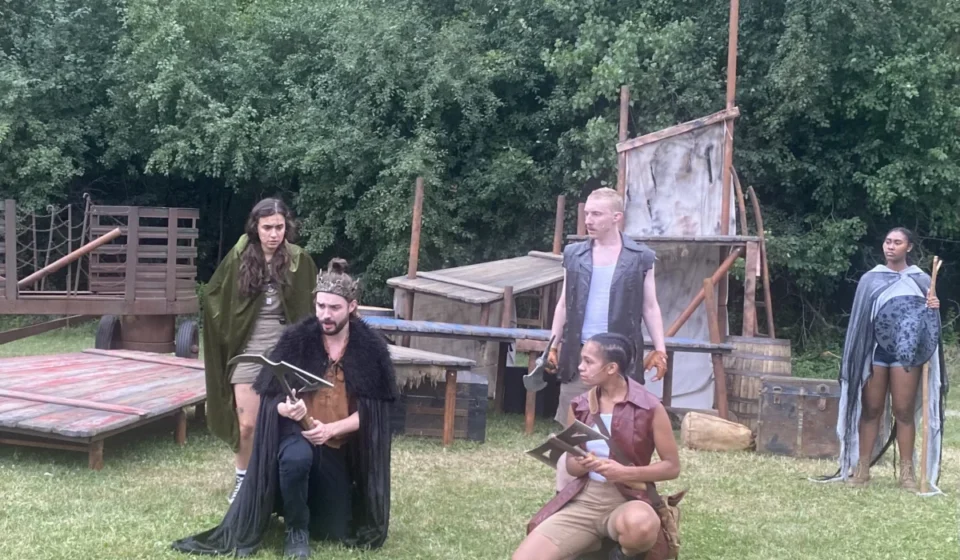
Directed by Sigmund, the play utilizes a droll and minimalist adaptation penned by playwright Greg Banks. This iteration eschews the bloated, CGI-heavy spectacle of Peter Jackson’s cinematic trilogy in favor of agility and raw performance. With a compact cast of just five actors tasked with inhabiting multiple roles, the production is a masterclass in theatrical efficiency.
Sigmund’s directorial ethos emphasizes playfulness over grand artifice. The production privileges creative, human-centric choices over the limitations of big-budget spectacle. When the narrative calls for a gallop, there are no horses; instead, the actors utilize physical movement and rhythmic sound effects to create the illusion of travel. It is a reminder that the most immersive theater often occurs when the audience is invited to collaborate with the actors through imagination.
Gender Dynamics and the Re-envisioning of Middle-earth
Perhaps the most significant departure from the source material is the gender-fluid casting. Bilbo Baggins is portrayed with a stirring, empathetic vulnerability by Grace Hillmyer, while the wizard Gandalf is played with a savvy, grounding calm by Antonisia Collins. Additionally, the dwarf Balin is played by Anya Naylor, who imbues the character with a poignant sweetness.
These casting choices serve more than just the pursuit of inclusivity; they provide a fresh, tonal shift to a narrative traditionally dominated by male archetypes. Hillmyer’s Bilbo delivers one of the production’s most resonant lines with genuine conviction: "I’m here because right now it’s the right time to do what’s right." By placing women at the center of this foundational fantasy, Zephyr Theatre invites a contemporary audience to view the struggle against tyranny through a lens that feels both new and necessary.
The Cultural Implications: Escapism and Accountability
The decision to diversify the roles of Middle-earth takes on additional weight when contrasted with the current landscape of fantasy literature and film. As prominent figures in the genre—most notably J.K. Rowling—become increasingly embroiled in public controversies regarding the funding of anti-trans advocacy, many fans are finding themselves at a crossroads.

For families and theatergoers seeking a beloved fantasy world that feels both inclusive and ethically aligned with their values, the Zephyr Theatre’s production offers a welcoming, forward-thinking alternative. It is a deliberate pivot toward a more ensemble-driven, supportive, and progressive representation of the classic "hero’s journey."
Ensemble Performance and Technical Economy
The production thrives on its ensemble spirit. Antonisia Collins, for instance, juggles her duties as Gandalf with a comic turn as a dwarf who faces an inconveniently timed need for the bathroom whenever the wizard is required on stage. This brand of meta-humor keeps the tone light and prevents the show from becoming overly precious.
The technical design relies on economy: goblins are represented by wonderfully minimalist masks, and the iconic barrel-escape scene—a moment that required massive special effects in film—is rendered here with a few simple cylinders and clever choreography. Jeffrey Nolan delivers a standout performance, transitioning rapidly between the gruff, snarly dwarf Kili, the iconic and wretched Gollum, and a haughty, impishly silly dragon, Smaug.
A Note on the Score
If the production has a singular point of friction, it is found in the musical choices. While Sophia Schott provides excellent sound effects that effectively build the atmosphere of the forest and the mountain, the inclusion of folk songs by Peter, Paul and Mary, Simon and Garfunkel, and John Denver often feels jarring. While the lyrical themes of "Puff the Magic Dragon" or "Country Roads" might seem tangentially related to the plot, they fail to integrate into the world-building of Tolkien’s universe. The music remains a distraction rather than a support, though one hopes future performances might see a refinement in the curation of the soundtrack.
Venue: A Community-Centered Escape
The setting of Aamodt’s Apple Farm serves as a vital character in its own right. Located in Stillwater, the venue offers a quintessential Minnesota experience. Before the show, patrons can engage in apple picking or visit the adjacent Saint Croix Vineyards and Thor’s Hard Cider. The culinary offerings—ranging from bakery sweets to apple brats and the popular Honeycrisp apple salsa—transform the outing into a full evening of local discovery. The stage itself, tucked away from the main orchard traffic and framed by a wooded area, provides an intimate, tranquil setting that bridges the gap between high fantasy and community gathering.
Supporting Data: Scheduling and Logistics
The production runs through early August, with limited performances remaining. For those interested in attending, the logistics are as follows:
- Dates: Thursday, July 30th and Friday, July 31st (7 p.m.); Saturday, August 1st (2 p.m. and 7 p.m.); Sunday, August 2nd (2 p.m.).
- Location: Aamodt’s Apple Farm & Saint Croix Vineyard, 6428 Manning Ave N., Stillwater.
- Pricing: $42 for a premium chair seat; $37 for a standard "bring your own chair" ticket; $21 for children aged 10 and under.
- Information: Prospective attendees can find more details at the Stillwater Zephyr Theatre website.
The Broader Context: Dinner and a Show
The success of the Zephyr’s outing highlights a broader trend in the Twin Cities: the integration of high-quality theater with elevated dining. A secondary option for those seeking a similar synthesis of culture and cuisine is the recent opening of Indígena by Owamni at the Guthrie Theater.
Following a viewing of Noël Coward’s Private Lives—a sophisticated, albeit morally complex, farce—the opportunity to dine on maple and sumac-glazed venison or smoked whitefish tostadas offers a refreshing post-show experience. Private Lives remains on stage at the Guthrie through August 23rd, providing a stark, witty contrast to the mythic, pastoral energy found at the apple orchard.
Whether it is the whimsical, gender-fluid trek through Middle-earth or the biting, domestic drama of Coward, the Twin Cities’ theater scene is currently offering a vibrant selection of ways to engage with the world. In doing so, it proves that whether we are escaping to a fantasy realm or examining the complexities of human relationships, the stage remains the most effective mirror for our own times.