































Bridging Generations: "Sakowin Synergy" Celebrates the Collaborative Future of Indigenous Art

At the All My Relations Gallery in Minneapolis, a powerful dialogue is unfolding—not just between the art and the viewer, but between the masters of the past and the innovators of the present. The latest exhibition, titled "Sakowin Synergy," serves as a testament to the enduring strength of the Oceti Sakowin (Seven Council Fires). By bridging the generational gap between established legends and rising contemporary voices, the exhibition redefines the boundaries of Indigenous artistic expression.
The Convergence of Tradition and Modernity
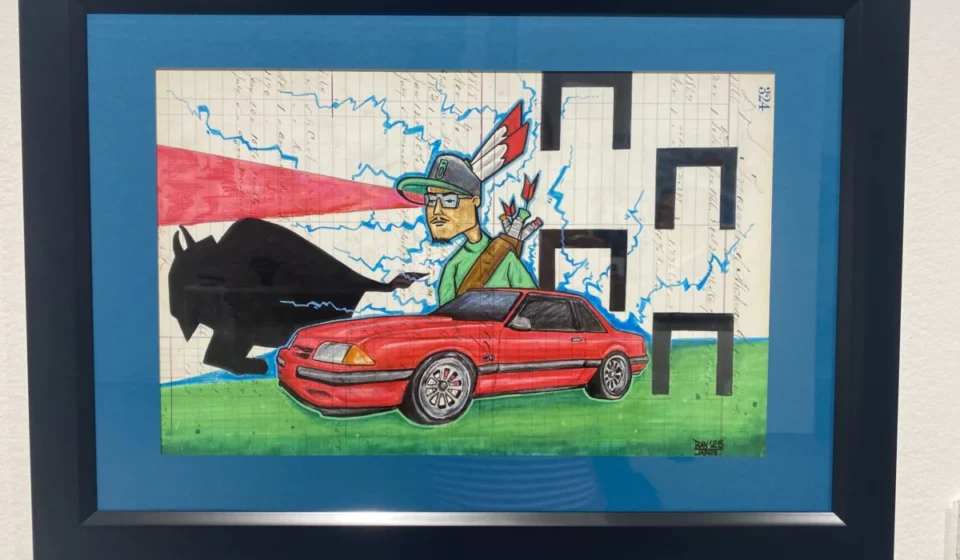
At the heart of the exhibition is South Dakota-based artist Ray "Rock Boy" Janis. A visionary who frequently incorporates superhero motifs, fast cars, and sharp, contemporary digital sensibilities into his work, Janis has curated a space where his aesthetic is not merely displayed but deeply intertwined with those who paved the way.
"Sakowin Synergy" refers to the historic alliance of the Dakota, Lakota, and Nakota nations. In this exhibition, that alliance is manifested through the collaborative efforts of Janis, his friend Sheldon Starr, and esteemed mentors Dwayne "Chuck" Wilcox and Jim Yellowhawk. While Yellowhawk hails from the Itazipco Band of the Cheyenne River Sioux Tribe, Wilcox, Starr, and Janis are all Oglala Lakota, creating a familial and cultural nexus that pulses through the gallery walls.
Chronology of a Creative Alliance
The path to "Sakowin Synergy" was not a singular event but the culmination of years of relationship building and artistic evolution.
- 2020: The professional relationship between the gallery and the artists began in earnest when Ray Janis and Sheldon Starr participated in an emerging artist cohort, a partnership facilitated by the Hennepin Theatre Trust.
- 2022: All My Relations Gallery showcased the work of Janis and Starr in a successful group exhibition, proving their capacity to hold space in a professional gallery setting.
- January 2026: The original opening date for the current exhibition. However, in a display of community solidarity, the gallery shifted its focus to become a hub for mutual aid in response to "Operation Metro Surge." The exhibition was postponed to prioritize the immediate needs of the community.
- July 9, 2026: The delayed but triumphant opening of "Sakowin Synergy," marked by a celebration that included traditional fry bread and community gathering.
- September 5, 2026: The scheduled closing date for the exhibition.
The Artistic Process: "Rez Boys Boogie" and Beyond
Perhaps the most compelling piece in the collection is "Rez Boys Boogie" (2026). This work represents a significant milestone, as it is the only instance where Yellowhawk and Wilcox—both veteran artists—have collaborated on the same surface.

The piece utilizes the tradition of ledger art, a form of historical documentation where Native artists in the 19th century painted on the pages of bookkeeping ledgers when traditional materials like hides became scarce. In "Rez Boys Boogie," the artists have modernized this medium. The long, rectangular canvas depicts a pow wow circle viewed from a bird’s-eye perspective.
Janis provided the structural foundation, painting the central circle and the celestial sky elements. Sheldon Starr contributed dynamic geometric forms and signature bat imagery, while Wilcox and Yellowhawk, both experienced pow wow dancers themselves, rendered themselves as dancing figures on either side of the composition. The result is a unified, harmonious whole that manages to honor four distinct artistic voices while maintaining a singular vision of movement and ceremony.
Mentorship as a Catalyst for Evolution
Angela Two Stars, director of All My Relations, notes that the exhibition’s power lies in its contrast. "Wilcox and Yellowhawk have been like mentors to the younger artist generation," she explains. "They have the old-school style, whereas Janis and Starr are more contemporary and digital. The show is about blending those together and using their work to speak to the influences of each other."
The collaboration was sparked by a simple moment of mutual respect. When Jim Yellowhawk saw one of Janis’s paintings—a work inspired by a character from the "Fantastic Four"—he was struck by the ingenuity of the composition. He extended an invitation to Janis to collaborate on a painting. For Janis, it was a career-defining moment. "I was like, ‘For real?’ It’s one of my heroes growing up in the art world," Janis recalled.
This interaction highlights the broader implication of the exhibition: that the future of Indigenous art is not a departure from the past, but an active, ongoing conversation with it.

The Political and Social Context
Art does not exist in a vacuum, and "Sakowin Synergy" is deeply informed by the political realities of the current moment. This is perhaps most visible in Janis’s piece "Tatanka O’sni." The painting depicts a bison rendered in chilling, icy shades of blue, charging through a field of diagonal lines. The work is a direct commentary on the anti-ICE (Immigration and Customs Enforcement) movement. The visual language—the bison "breaking through" the ice and the radiating spirit lines—serves as a metaphor for resilience against state-sponsored hostility.
The fact that this exhibition was delayed to facilitate mutual aid efforts during a period of local political unrest adds a layer of depth to the work. It reinforces the gallery’s position as a community anchor, where art is not just a commodity but a site of resistance and support.
Implications for the Twin Cities Art Scene
"Sakowin Synergy" is a highlight of a broader, vibrant season for Native art in the Twin Cities. The exhibition sits alongside other critical shows currently on view, such as "Encounters" at the Bockley Gallery, "Queering Indigeneity" at the Minnesota Museum of American Art, and "Merciless: Indigenous Lands Since 1776" at the Weisman Art Museum.
The cumulative effect of these exhibitions is a shift in the local cultural landscape. Indigenous artists are increasingly being viewed not as "traditional" relics, but as architects of modern, relevant, and highly sophisticated contemporary art. By placing these works in professional spaces, galleries are forcing a reconsideration of what "Native art" looks like—it is digital, it is ledger-based, it is superhero-inspired, and it is unapologetically political.
Official Perspective and Future Outlook
The success of "Sakowin Synergy" lies in its rejection of hierarchy. By putting the "old-school" techniques of Wilcox and Yellowhawk in direct dialogue with the "new-school" sensibilities of Janis and Starr, the exhibition creates a feedback loop. The mentors gain a fresh perspective on digital and conceptual layering, while the mentees gain a grounded, historical perspective on the importance of lineage and community representation.

As the exhibition prepares to conclude on September 5, its impact is already being felt. It serves as a blueprint for future collaborations, proving that when generational lines are blurred, the resulting "synergy" is capable of creating something that is not only visually stunning but historically significant.
For visitors, the gallery experience—enhanced by the presence of local staples like the Pow Wow Grounds coffee shop—provides a holistic view of a community that is thriving. Whether it is the playful energy of the dancers in "Rez Boys Boogie" or the fierce, icy resolve of the bison in "Tatanka O’sni," the message is clear: the Oceti Sakowin are here, they are collaborating, and they are defining the future of American art on their own terms.