

























































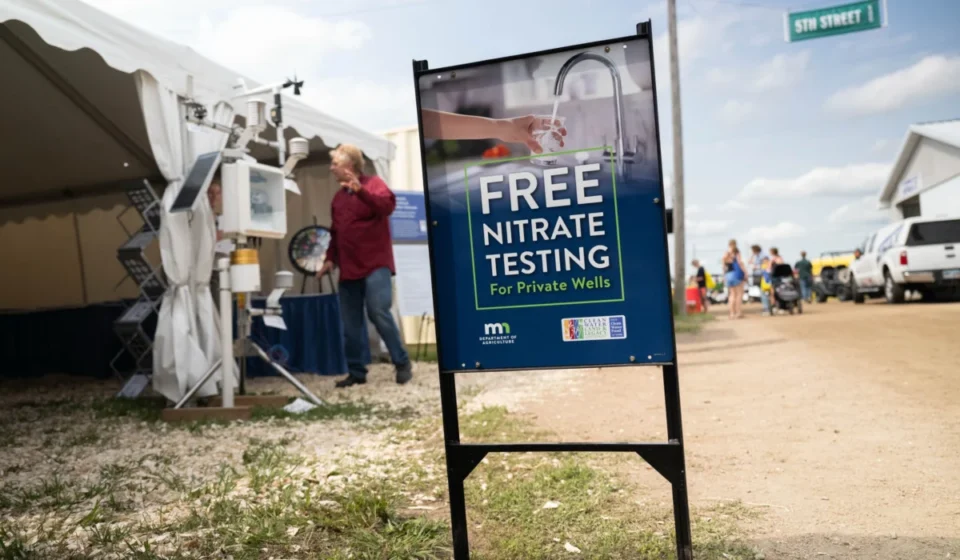

At the bustling Farmfest grounds in Morgan, Minnesota, the contrast is stark. Between the sensory overload of deep-fried corn dogs, the roar of modern tractors, and the polite maneuvering of politicians seeking votes, a small, unassuming booth hums with a different kind of urgency. Here, Denton Bruening, an employee with the Minnesota Department of Agriculture (MDA), operates a clunky, briefcase-sized spectrophotometer.
With surgical precision, Bruening uses clear tubes to pump yellow-tinted water from a plastic cup into the machine. An ultraviolet ray pulses through the sample, measuring its light-absorbing wavelengths. After a thirty-second pause, the screen flashes a digit: 7.3.
Bruening records the figure on a ledger already crowded with 40 other entries—results from water samples dropped off by attendees earlier that morning. For the person who brought this sample, the news is sobering. The water they use for their morning coffee, for boiling pasta, and for bathing their children is carrying a heavy chemical load. In the world of groundwater safety, 7.3 milligrams per liter (mg/L) is a red flag.
The Invisible Threat: Nitrate Contamination
Nitrate contamination is a decades-old specter haunting Minnesota’s rural landscape. While the state is a titan of American agriculture—exporting $9.3 billion in goods annually and ranking as the seventh-largest farming state in the nation—that productivity comes with a significant environmental cost.
Nitrogen-rich fertilizer and livestock manure are the primary culprits. When these substances wash off fields, they infiltrate the soil, eventually seeping into the groundwater that supplies the state’s private wells. This process is accelerated by the porous geology of central, southeastern, and southwestern Minnesota, where shallow aquifers offer little natural filtration against surface-level pollutants.
The federal government sets the maximum contaminant level (MCL) for nitrate in public drinking water at 10 mg/L. Above this, the risk of methemoglobinemia—a condition colloquially known as "blue baby syndrome"—spikes, as the water interferes with the blood’s ability to carry oxygen. However, recent health research suggests the danger threshold may be far lower. Levels above 3.5 mg/L have been linked to adverse health outcomes, including increased cancer risks and complications in pregnancy.
A Systemic Gap: The Vulnerability of Private Wells
The core of the problem lies in a regulatory blind spot. While public water systems are strictly governed by the federal Safe Drinking Water Act—mandating regular, transparent testing and mandatory treatment—the estimated 93,000 Minnesotans relying on private wells are largely left to fend for themselves.
"It’s a DIY system of public health," says one observer. Once a homeowner drills a well, the responsibility for its chemical composition shifts entirely to them. There are no federal mandates requiring a private well owner to test their water, and even when contamination is discovered, the burden of remediation falls squarely on the individual.
The financial barrier to safety is significant. A reverse osmosis filtration system, which can effectively strip nitrates from water, typically costs between $500 and $5,000. For many families, this is a prohibitive expense. While some counties in southeastern Minnesota have pioneered programs to provide free filtration systems to those with high-nitrate wells, these initiatives are rare, often limited by the same budgetary constraints that plague rural infrastructure. Drilling a new, deeper well—often the only permanent solution—can cost tens of thousands of dollars, a price point that is entirely out of reach for many.
Chronology of a Crisis
The MDA’s presence at events like Farmfest is the culmination of decades of incremental policy. The agency began offering free nitrate tests in the 1990s, recognizing that the lack of data was the first hurdle in protecting rural health.
- 1990s: The Minnesota Department of Agriculture initiates rural well-testing clinics, identifying "hot spots" in the state’s agricultural belt.
- 2010s: Environmental advocacy groups begin a concerted push to lower the state’s safety threshold from 10 mg/L to 3.5 mg/L, citing evolving medical literature on chronic exposure.
- 2020–2026: Increased legislative scrutiny meets stiff opposition from agricultural lobbyists. Despite the mounting evidence, the state maintains the 10 mg/L standard.
- August 2026: The current nitrate clinics continue to operate, gathering data while navigating the sensitive political climate of the agricultural heartland.
Supporting Data and the "Heavy Lift"
The data gathered at clinics like the one at Farmfest provides a vital, albeit anonymous, snapshot of the state’s health. According to Bruening, approximately 6% of the tests run at these clinics consistently show nitrate levels exceeding the 10 mg/L limit.

Despite this, changing the regulatory standard remains a "huge heavy lift," according to Tony Runkle, lead geologist at the University of Minnesota’s geological survey. "There’d be a ton of opposition from the ag industry," Runkle notes. Because agriculture is so deeply woven into the state’s economic and political fabric, any move to regulate runoff or lower the contamination limit is perceived as an existential threat to farming livelihoods.
The political reality is visible at Farmfest itself, where politicians from across the spectrum engage with voters. The influence of the agricultural lobby means that while mitigation strategies—such as planting cover crops to absorb excess nitrogen—are technically available and recommended, they remain voluntary. Without state mandates, these practices are limited to farms with the capital and the inclination to absorb the extra cost.
Official Responses and the Mitigation Dilemma
Bruening, a former farmer himself, is careful to avoid villainizing the agricultural sector. He points out that nitrates are ubiquitous in the human diet, noting that a single serving of spinach contains about 70 parts per million of nitrate.
"If we get a farmer that comes into a water clinic, we talk about some of those [mitigation] tactics because a lot of times that well might be affected by his own practices," Bruening says. This highlights a tragic irony: the people most affected by agricultural runoff are often the ones working the land.
The MDA’s current strategy is one of education and voluntary participation. They urge well owners to test their water annually. Beyond the Farmfest booths, most Soil and Water Conservation Districts provide similar services, and the agency even allows partners to borrow equipment to host their own clinics.
Yet, for the person holding the 7.3 mg/L test result, the advice often feels insufficient. When the agency cannot regulate the polluters, the conversation inevitably turns to survival tactics. "Some people just drink bottled water," Bruening says. "That’s kind of become a preference for a lot of people."
The Path Forward: Implications for Rural Minnesota
The implications of this silent crisis are long-term and multifaceted. As long as private wells remain outside the scope of the Safe Drinking Water Act, the disparity between public and private water quality will only widen.
The reliance on bottled water is a temporary, unsustainable patch for a problem that is fundamentally rooted in land use. Environmental advocates argue that the state must shift from a model of "individual responsibility" to one of "systemic accountability." This would involve not just subsidizing filtration for households, but potentially regulating fertilizer application rates and incentivizing the widespread adoption of nitrogen-management techniques.
Until then, the clunky, gray spectrophotometers will continue to operate, one sample at a time. The machine provides a number, but it cannot fix the problem. It serves as a reminder that for thousands of Minnesotans, the most basic necessity—a glass of clean water—is a luxury that must be verified, feared, and often, paid for out of pocket.
As the sun sets on Farmfest, the ledger on Bruening’s desk serves as a quiet record of a community in transition. Every 7.3, every 10.2, and every 0.5 represents a household grappling with the intersection of public policy, economic pressure, and the fundamental right to safe drinking water. For now, the solution remains in the hands of the individuals, standing in line with their Ziploc bags, waiting to find out if their well is safe.
Claire Carlson is a Report for America corps member, covering drinking water for MinnPost and the Mississippi River Basin Ag & Water Desk. Report for America places talented journalists in local newsrooms to report on under-covered issues and regions.