













































Bridging the Literacy Gap: How On-Screen ASL Translation is Revolutionizing Media Accessibility

For decades, the standard for media accessibility for the Deaf and hard-of-hearing community has been closed captioning. Since its inception in the 1970s, text-based subtitles have served as the primary bridge between auditory content and visual comprehension. However, for a significant portion of the global Deaf population, text is not a perfect surrogate for sound. A burgeoning movement, led by innovators like SignUp Media and translators such as Everett Glenn, is now challenging the status quo by bringing American Sign Language (ASL) directly onto the screen.
The Limitation of Text: A Barrier to Inclusion
The reliance on closed captions assumes a level of English literacy that is not universal among the Deaf community. While captions are helpful for many, they present substantial hurdles for Deaf children who have not yet developed reading skills, as well as for adults with limited English literacy.
The scope of this challenge is global and staggering. According to the World Health Organization, there are more than 430 million Deaf people worldwide, 34 million of whom are children. Research conducted by the Institute of Education Sciences has revealed a sobering statistic: the median literacy rate of Deaf high school graduates has remained stagnant at a fourth-grade level for over a century.
This educational gap is often attributed to "language deprivation"—the lack of consistent, robust exposure to a natural, accessible language during the critical windows of early childhood development. When children are not provided with a fluent language foundation—whether it be ASL or a spoken language—their cognitive and educational trajectory can be severely hampered. By shifting the focus from text to ASL, advocates are attempting to bypass these literacy barriers, providing direct, immediate access to storytelling.
Chronology of a Movement: From Grassroots to Netflix
The trajectory of accessible media has evolved rapidly in the last few years. The catalyst for this current shift was the founding of SignUp Media in 2021. Established by then-17-year-old Mariella Satow, the organization began with a humble offering of only three translated titles.
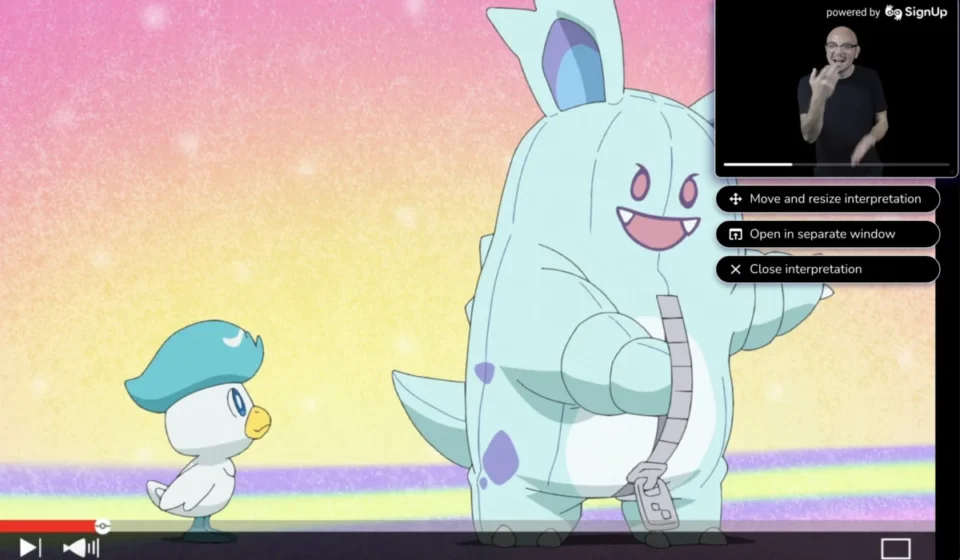
The concept was simple but revolutionary: place a professional ASL translator in a designated corner of the screen, mirroring the tone, emotion, and nuance of the spoken dialogue. What started as a small, student-led project quickly gained momentum, scaling to support more than 25,000 monthly active users.
The pivotal moment for the platform arrived with its recent collaboration with Netflix. This partnership has significantly expanded the reach of ASL-integrated media, featuring over 70 movies and television shows, primarily curated for children and families. Among the most notable projects in this expansion is the translation of 45 hours of Pokémon Horizons, a monumental task undertaken by Minneapolis-based translator Everett Glenn.
The Art and Science of Translation: An Interview with Everett Glenn
Everett Glenn, a social worker currently pursuing his license as a mental health therapist, has been a central figure in this movement since joining SignUp Media in 2023. His work on Pokémon Horizons is not merely about mechanical translation; it is about performance, cultural adaptation, and deep emotional resonance.
"My process begins by watching the entire episode to get a sense of the narrative arc," Glenn explains through an interpreter. "I look for specific moments where I want to explore the meaning more deeply. I have to figure out how to sign the concept, not just the word, and understand the underlying intent of the vocabulary."
This process is fundamentally different from reading captions. For a native ASL speaker, reading English text while simultaneously watching an action-heavy scene is cognitively demanding. "Those words go by so fast," Glenn notes. "Captions are hard to match up with the emotion of what’s happening. You’re trying to figure out what they’re saying and reading at the same time."
When a viewer watches an ASL translator, they are receiving the information in a format that prioritizes visual flow. The translator’s expressive facial movements, shifting posture, and precise hand gestures allow the viewer to focus entirely on the story rather than straining to parse text.
Supporting Data: The Impact on Deaf Youth
The integration of ASL into popular media serves two primary functions: providing essential access for Deaf children and offering an educational tool for the broader public.
For the Deaf child, seeing a character they love represented through their native language is a transformative experience. It validates their identity and provides a source of entertainment that doesn’t feel like "work." For the hearing community, the platform serves as an accessible entry point to learn ASL.

"There are a lot of problems in the Deaf community with language deprivation," Glenn emphasizes. "Deaf kids don’t always have the access to language that they need. This platform provides that access to so many kids."
The data surrounding language deprivation highlights that early, consistent exposure to language is the strongest predictor of future academic success. By embedding ASL into the content that children are already consuming—like Pokémon—the barrier to entry for learning is removed. It transforms media from a passive experience into an active, linguistic engagement.
Creative Challenges: The Case of Pokémon
Translating a franchise as expansive as Pokémon presents unique logistical and creative hurdles. One of the most significant challenges is the creation of "name signs." In the Deaf community, name signs act as a shorthand for identifying people and characters. Rather than finger-spelling a name, which is slow and cumbersome, a sign name is an iconic, memorable gesture.
"Coming up with appropriate name signs to give those characters identity is very important for Deaf kids," Glenn explains. "They are associating the names and the characters in the same way that a hearing kid would when they hear the name."
For the franchise’s mascot, Pikachu, Glenn developed a sign that highlights the character’s iconic dimples. This level of creative detail is vital. It acknowledges that for a child, the character is not just a collection of letters—it is a personality. By creating sign names that reflect physical or personality traits, translators like Glenn are helping to build a shared cultural vocabulary within the Deaf community that is both efficient and deeply personal.
Implications for the Future of Media
The work being done by SignUp Media and individuals like Everett Glenn is indicative of a broader shift in how technology and media corporations view accessibility. The "one-size-fits-all" approach of closed captioning is being replaced by a more nuanced understanding of linguistic diversity.
1. Industry Standards
The success of the Netflix-SignUp Media partnership suggests that major streaming platforms are beginning to recognize the commercial and moral value of inclusive design. If this trend continues, we may see "ASL-ready" becoming a standard toggle option on major platforms, similar to audio description or alternative language tracks.
2. The Role of the Translator
The role of the media translator is expanding from a purely functional task to an interpretative one. As the demand for ASL content grows, the need for skilled, culturally competent translators will increase, potentially creating new career paths for members of the Deaf community who possess the linguistic expertise required for such high-stakes media work.
3. A New Generation of Accessibility
Glenn’s sentiment—"Every generation figures out a way to do it better"—serves as the manifesto for this movement. The transition from physical, in-person interpreters to on-screen, digital integration is the latest step in a journey that began with the invention of the teleprompter and the decoder chip.
As we look toward the future, the integration of AI, better motion-capture technology, and wider platform support could make the presence of an ASL translator as common as the presence of a soundtrack. For millions of children who have historically been left on the margins of the television experience, this is not just a technological upgrade—it is a cultural revolution.
Conclusion
The partnership between streaming giants and organizations like SignUp Media is a testament to the power of thoughtful innovation. By centering the needs of the Deaf community—specifically those who struggle with traditional text-based captions—the industry is finally acknowledging that true accessibility requires more than just a literal translation of words. It requires the translation of emotion, personality, and identity.
As Everett Glenn continues his work on projects like Shang-Chi and the Legend of the Ten Rings and The Grinch, he remains focused on the bigger picture. Whether he is signing for a superhero or a beloved Pokémon, the goal remains the same: to ensure that no child is excluded from the magic of a story, and that the language of the Deaf community is recognized as a vital, vibrant, and essential part of the modern media landscape.