


























































The On-Device Intelligence Revolution: How Qualcomm is Redefining the Smartphone Architecture

In a strategic shift that breaks from its traditional "big reveal" marketing cycle, Qualcomm has spent the last several weeks methodically deconstructing the architecture of its next-generation premium Snapdragon mobile platform. By providing a granular look at its custom silicon long before the official Snapdragon Summit in Maui, the chipmaker is signaling that the era of simple mobile processing is over. The future, Qualcomm contends, lies in keeping compute, memory, and AI-driven logic as close to the user as possible—directly on the handset.
This multi-phase disclosure—covering the Oryon CPU, the Adreno GPU, and the Hexagon NPU—reveals a unified vision. Qualcomm is moving beyond the era of static smartphone performance, pushing toward a paradigm of "agentic" AI, where devices act as proactive assistants rather than passive screens.
The Architectural Foundation: A Shift Toward Memory Locality
The most compelling narrative emerging from Qualcomm’s recent disclosures isn’t just raw clock speed, but rather the philosophy of "memory locality." In modern mobile computing, the greatest energy drain and performance bottleneck is the "trip" data takes between the processor cores and the external DRAM. By optimizing the distance data travels, Qualcomm is aiming to unlock sustained performance that was previously unreachable within a mobile power envelope.
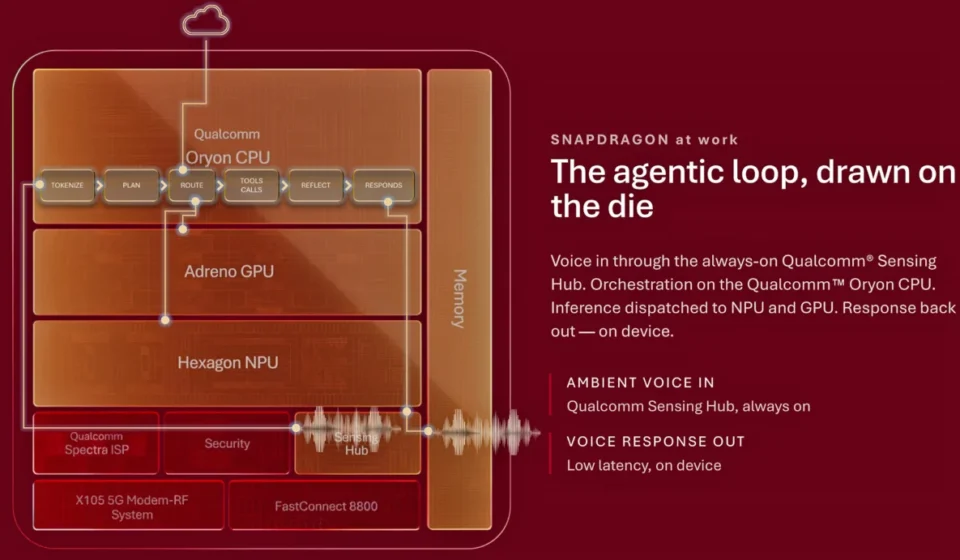
This approach is essential for the next generation of generative AI. Unlike simple chatbots that require a cloud connection, agentic AI—systems capable of performing complex, multi-step tasks across apps—demands low-latency, persistent compute power. Qualcomm’s architecture is being re-engineered specifically to support this, distributing the heavy lifting across the CPU, GPU, and NPU to keep the device responsive and power-efficient.
Chronology of Innovation: A Three-Part Unveiling
Qualcomm’s decision to drip-feed its technological advancements has provided a rare, transparent view into the engineering challenges of modern mobile silicon.
- Phase One: The 5GHz Milestone (Oryon CPU): In August, Qualcomm made headlines by announcing that its next-generation Oryon CPU would be the first mobile processor to hit the 5GHz threshold. Comprising two 5GHz "Prime" cores and six "Performance" cores, the custom-built, Arm-based architecture represents a complete departure from off-the-shelf designs.
- Phase Two: Graphic Intelligence (Adreno GPU): Following the CPU reveal, the company detailed an overhaul of its Adreno GPU. By integrating dedicated AI engines directly into the graphics pipeline and introducing High-Performance Memory (HPM), Qualcomm moved the needle on how mobile devices render complex scenes.
- Phase Three: The Brain (Hexagon NPU): Most recently, Qualcomm unveiled the new Hexagon NPU. Engineered specifically for transformer-based models and long-context reasoning, this NPU serves as the central hub for the platform’s agentic capabilities.
Supporting Data: Efficiency Through Specialization
The raw specifications provided by Qualcomm paint a picture of highly specialized hardware designed to bypass the traditional limitations of mobile silicon.
The Power of FlexCache
While the 5GHz clock speed of the Oryon CPU grabs the headlines, the real engineering marvel is the "FlexCache" architecture. By allowing the Prime and Performance cores to share a dynamic cache pool, Qualcomm has eliminated the inefficiency of fixed memory slices. When a core requires more memory to handle a complex AI task, it can "borrow" from the pool. This keeps large data sets local to the CPU, reducing high-latency requests to external memory—a move that fundamentally improves both speed and battery life.
Adreno Neural Fusion and the Graphics Pipeline
The integration of Adreno Matrix Cores and 18MB of HPM represents a massive upgrade in mobile graphics. Qualcomm’s "Neural Fusion" technology—which combines AI super-resolution, neural processing, and frame generation—is effectively bringing desktop-grade upscaling to the palm of your hand.
Internal testing on the "Dragon Alley" demo showed a 40% reduction in power consumption when Neural Fusion is active. This efficiency is critical; by offloading rendering tasks to dedicated AI hardware, the GPU can handle higher graphical fidelity without causing the phone to overheat or drain the battery prematurely. Qualcomm has already moved to secure support from game engine giants like Unity and Unreal, ensuring that developers can leverage these hardware features immediately upon launch.
Hexagon NPU and Agentic Workloads
The new Hexagon NPU is the most significant leap forward for AI. By introducing an "Element Accelerator" specifically for transformer models, Qualcomm has optimized for the "action loops" required by agentic AI.

The NPU now supports context lengths of up to 32K and features 50% more shared memory than its predecessor. Most notably, the chip is designed to handle "Mixture-of-Experts" (MoE) models, such as those with 30 billion parameters. By activating only the "expert" segments of a model necessary for a specific task—roughly 3 billion parameters at a time—the system provides high-level reasoning without overwhelming the handset’s physical memory constraints.
Official Responses and Industry Outlook
Qualcomm’s leadership emphasizes that this transition is a response to the changing needs of the ecosystem. "AI is no longer just a feature; it is the foundation of the platform," a company spokesperson suggested during the disclosure sessions.
Industry analysts note that Qualcomm is effectively playing a "platform game." By providing a cohesive, AI-ready hardware suite to partners like Samsung, Xiaomi, and Honor, Qualcomm is shielding these OEMs from the massive R&D costs of building their own AI-optimized silicon. This cements the Snapdragon platform as the standard-bearer for the premium Android experience.
Furthermore, by unifying its Oryon architecture across mobile, Windows PCs, and eventually servers, Qualcomm is positioning itself as the bridge between cloud-based and local AI. For business users, this is a major win: sensitive data can be processed on-device rather than sent to the cloud, improving both privacy and latency.
Implications for the Future of Mobile Computing
The move toward on-device intelligence has massive implications for the competitive landscape. Apple’s long-standing advantage has been its closed-loop control over silicon, software, and the OS. Qualcomm’s latest disclosures represent a direct, aggressive push to match that level of integration.
Closing the Gap with Apple
For years, Apple Silicon has led the pack in terms of IPC (instructions per cycle) and thermal efficiency. By shifting to a custom-designed Oryon architecture, Qualcomm is no longer playing catch-up with off-the-shelf Arm designs. They are now playing by their own rules, optimizing their silicon for the specific AI workloads that will define the next decade of smartphone usage.
The Developer’s Role
The success of this hardware will ultimately rest on software adoption. Qualcomm’s efforts to integrate Neural Fusion into Unity and Unreal Engine demonstrate an understanding that even the most powerful hardware is useless without an ecosystem to support it. If developers adopt these tools, we can expect a rapid influx of mobile apps that feel significantly more intelligent, reactive, and capable than anything currently on the market.
What Lies Ahead
As we look toward the upcoming Snapdragon Summit, several questions remain. We have yet to see the final, real-world power characteristics of the finished SoC, nor do we know which specific handsets will be the first to feature these advancements. Furthermore, the performance of these "agentic" AI features will depend heavily on the maturity of the Android operating system and the AI models that developers choose to deploy.
However, the trajectory is clear. Qualcomm is betting that the future of the smartphone is not just a faster camera or a brighter screen, but a persistent, intelligent assistant that lives entirely within the user’s hardware. By prioritizing memory locality and specialized AI acceleration, Qualcomm is not just building a better chip—they are building the infrastructure for the next generation of mobile interaction.
The 5GHz CPU will likely be the marketing hook, but the true story of the next Snapdragon platform will be written in the background—in the caches, the neural engines, and the silent, power-efficient loops that keep our devices one step ahead of our next request. As the tech industry gathers in Maui later this month, all eyes will be on whether this hardware can deliver on its bold promise of an intelligent, local, and agentic future.