













































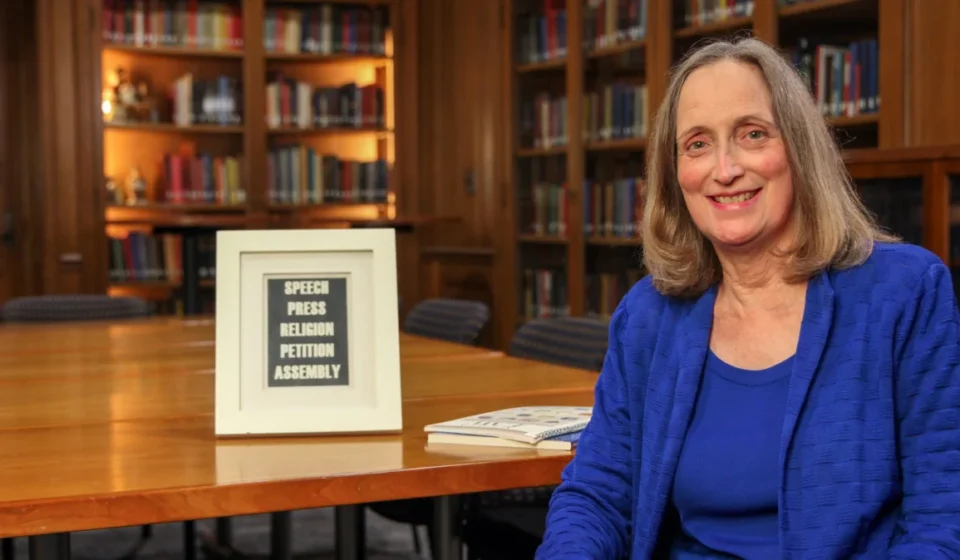

After nearly three decades of shaping the next generation of journalists and providing a definitive voice on the sanctity of the First Amendment, Jane E. Kirtley, the Silha Professor of Media Ethics and Law at the University of Minnesota’s Hubbard School of Journalism and Mass Communication, will retire on May 25.
For scholars, legal experts, and journalists alike, Kirtley’s name is synonymous with the defense of freedom of information. As a go-to authority interviewed by legacy media outlets across the globe, her departure marks the end of an era for the Silha Center for the Study of Media Ethics and Law—an institution she has stewarded with unwavering moral clarity.
A Legacy Built on Legal Expertise
Kirtley’s career has been defined by a deep-seated commitment to the legal foundations of democracy. Before joining the University of Minnesota faculty in 1999, she spent 14 years as the executive director of the Reporters Committee for Freedom of the Press in Arlington, Virginia. This tenure placed her at the epicenter of national battles for government transparency. Prior to that, she honed her legal acumen during a five-year stint as an attorney with a major law firm operating in New York and Washington, D.C.
Her academic career at the Hubbard School has been marked by a rigorous approach to media ethics. She has not merely taught law; she has acted as a sentinel for the press, guiding students through the complexities of libel, privacy, and the evolving digital landscape.
Why Now? A Reflection on Mortality and Duty
The decision to retire, at age 72, was not made lightly. Kirtley reveals that the prospect of retirement has been on her mind since late 2019, shortly after her husband, Notre Dame law professor Stephen Cribari, stepped down from his post. However, the onset of the COVID-19 pandemic—with its abrupt shift to remote learning and the cessation of international travel—gave her pause.
"You just can’t take for granted you can keep doing the things you care about doing," Kirtley notes, reflecting on the fate of her predecessor, Don Gillmor, who passed away shortly after his 2009 retirement. "Travel is very important to me. I want to make sure I’m healthy enough to do it."
Despite the desire for personal time, Kirtley repeatedly delayed her departure, driven by a sense of duty during the political turbulence of the second Trump administration. Now, she believes the time is right to pass the torch, though her concerns for the future of journalism remain as sharp as ever.
The Weaponization of Law: A Structural Threat
In an exclusive interview, Kirtley outlined the most pressing legal and operational challenges facing the modern Fourth Estate. While she has witnessed attacks on the press throughout her career—from the Nixon era to the present—she argues that the current landscape is unprecedented.
"The biggest concern I have right now is the weaponizing of the law to go after the independent media," Kirtley explains. While she acknowledges that previous administrations have certainly been hostile toward the press, the current era introduces a dangerous legal novelty: the use of consumer fraud statutes and novel libel theories to punish news organizations.
The Erosion of New York Times v. Sullivan
Central to Kirtley’s anxiety is the potential collapse of the New York Times v. Sullivan standard, the 1964 landmark ruling that established the "actual malice" threshold for libel claims against public figures. For decades, this standard has served as the bedrock of American press freedom.
"We know the current Supreme Court has been willing in other contexts to reverse or overrule existing precedent of long standing," she observes. "Whether they would do so to Times v. Sullivan is anyone’s guess. But that threat represents the greatest risk to the stability of a principle that has served us so well."
The Crisis of Ownership and Purpose
Beyond the courtroom, Kirtley sees a fundamental shift in the philosophy of journalism. She notes that many modern media owners approach their outlets not as a public service, but as instruments of power or profit.
"Whether it’s the venture capitalists or the Silicon Valley bros, they don’t approach their operations in an altruistic way," she states. While historical press barons like William Randolph Hearst certainly sought power, they still understood the essential role of a free press in holding the powerful accountable. Kirtley fears that this recognition of the media’s civic function is rapidly evaporating.
The "Fake News" Silo: A Deliberate Dismantling
Kirtley argues that the current climate of distrust did not materialize overnight. It is the result of a "systematic attack" on mainstream media that has spanned nearly four decades, emanating from both ends of the political spectrum.
"That confidence that you were getting truthful, accurate reporting has been undermined quite deliberately," she says. By labeling the press as "the enemy of the people," political actors have successfully enabled audiences to retreat into ideological silos. In this environment, even the most rigorous documentation and fact-checking are dismissed as "liberal bias."
Artificial Intelligence: The "Devil’s Tool"
Perhaps the most striking aspect of Kirtley’s retirement is her candid assessment of artificial intelligence. She does not mince words, labeling AI as "the devil’s tool." Her opposition to the technology is so profound that it became a deciding factor in her retirement.
"I don’t feel able to train my students in how to use it," she admits. "I would feel complicit in a plot to undermine so many values that matter to me, like accuracy and critical thinking."
Kirtley highlights the absurdity of newsrooms replacing human copy editors—the final, vital line of defense against error—with AI-driven systems. She points to the New York Times’ recent, stringent prohibitions against AI in freelance work as a necessary, if difficult, reaction to a broader technological trend that threatens the integrity of the profession.
Political Interference: The FCC and the "Equal Time" Rule
Kirtley also expressed grave concern over the current direction of the Federal Communications Commission (FCC) under Chairman Brendan Carr. She describes his aggressive posture toward broadcast networks and late-night satire programs as a departure from historical norms.
"I’ve never seen anything so blatantly political in modern history," Kirtley asserts. She warns that by targeting content that criticizes the administration, the FCC is violating the spirit of the Federal Communications Act of 1934. She cautions that the potential for the FCC to revisit the "equal time" rule—exempting bona fide news programming—could be the next front in the effort to silence critical voices.
Looking Toward the Future
Despite these monumental challenges, Kirtley remains hopeful about the next generation of journalists. She distinguishes between "influencers" and those driven by a genuine, burning desire to hold institutions accountable.
"I know there are still many young people who want and who need to do journalism," she says. "They want to provide the public with information they need to make good, informed decisions."
As she prepares to leave the classroom, Kirtley leaves behind a void that will be difficult to fill. Her career stands as a testament to the idea that the law is not just a set of rules, but a shield for the truth. Her final lesson to the industry is clear: journalism is not merely a job or a business—it is an essential pillar of a functioning society that must be defended with vigilance, courage, and an uncompromising commitment to the truth.
As she departs for her next journey, the academic and legal communities will undoubtedly feel the absence of her steady, uncompromising hand. For Kirtley, the work of defending the First Amendment is never truly finished, but she has spent her life ensuring that the tools for that defense remain in capable hands.