








































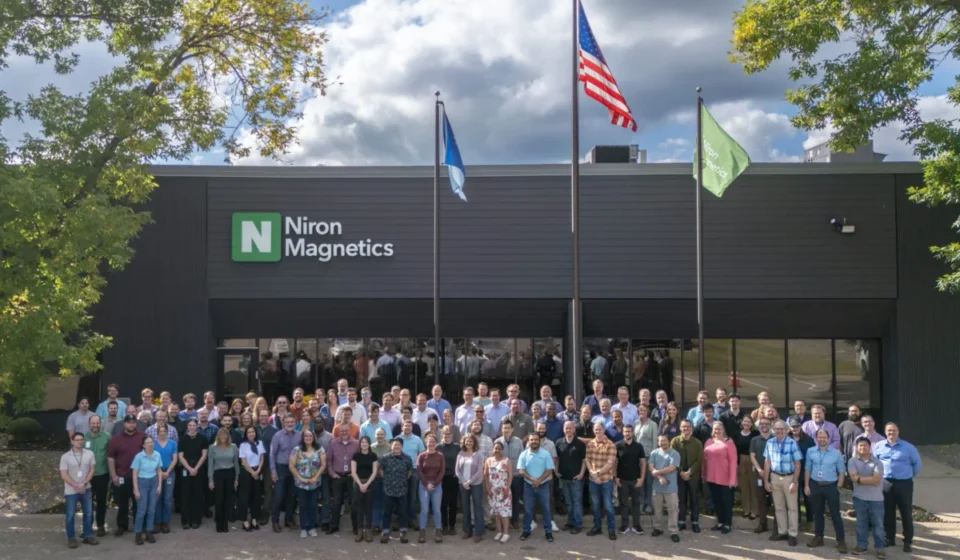

While the contentious debate over the Twin Metals copper-nickel mine near the Boundary Waters Canoe Area (BWCA) has long dominated the headlines regarding Minnesota’s natural resources, a quieter, potentially more transformative industrial revolution is brewing on the Iron Range.
Niron Magnetics, a Minneapolis-based innovator, is currently scouting locations for its third and most ambitious facility—a $1.8 billion manufacturing plant that could reshape the state’s economic landscape. By pivoting from traditional iron-ore extraction to the production of cutting-edge, iron-based magnets, Niron is positioning itself as a cornerstone of U.S. supply chain independence. This development offers a promising remedy for the Iron Range, a region that has faced decades of economic contraction as global steel markets shifted and domestic demand for traditional taconite waned.
The Technological Pivot: Beyond Rare Earths
At the heart of Niron’s mission is a breakthrough in material science. For decades, the global technology sector has been shackled by a reliance on 17 "rare-earth" minerals. China currently controls approximately 70% of the mining and 90% of the manufacturing capacity for these critical materials, which are essential for everything from electric vehicle (EV) motors and wind turbines to consumer electronics and defense systems.
Niron Magnetics, utilizing technology invented by University of Minnesota Professor Jian Ping Wang, has developed a patented process that replaces these scarce, environmentally taxing rare-earth elements with abundant, domestically sourced materials: iron and nitrogen.
"Minnesota has an opportunity to address this crisis and offer a transformative solution to U.S. commercial and defense manufacturers," the company stated recently. "An alternative to rare-earth permanent magnets has been invented in Minnesota… using domestically sourced raw materials."
The "secret sauce" behind Niron’s technology involves reducing iron or recycled steel to a fine powder, which is then infused with a chemical compound that induces powerful magnetism without the need for the extreme heat and complex, hazardous chemical separation processes required by traditional rare-earth magnets.
Chronology of a Growing Industrial Giant
Niron’s ascent from a university lab project to a prospective industrial titan has been marked by steady, calculated growth:
- The Inception: Leveraging research from the University of Minnesota, the company established its headquarters and a pilot facility in Northeast Minneapolis.
- The Sartell Expansion: Niron broke ground on its first commercial-scale production plant in Sartell, Minnesota. With a $10 million investment from the state, this facility is designed to employ 175 people and produce 1,500 tons of magnets annually.
- The Search for Scale: Early in 2024, Niron engaged Savills, a global commercial real estate advisor, to scout locations for its "Mega-Plant." This facility is projected to cost $1.8 billion, span 1.6 million square feet, and employ over 700 workers, with an targeted annual output of 10,000 tons of magnets by 2029.
- Site Selection: The company is currently evaluating sites across Minnesota and other states. Industry speculation strongly suggests that the repurposing of a shuttered taconite plant on the Iron Range is a primary contender, as it offers existing industrial infrastructure and a ready, skilled workforce.
Supporting Data and Economic Impact
The scale of the proposed Iron Range facility would represent one of the most significant industrial investments in Minnesota’s recent history. To date, Niron has successfully raised approximately $300 million in private-public capital, with a portfolio of backers that reads like a "who’s who" of global industry: GM Ventures, Volvo, Samsung Ventures, Stellantis, and Western Digital, alongside support from the U.S. Department of Energy.
The economic implications are profound. The Iron Range has been hit hard by the decline of traditional taconite mining, driven by the influx of cheaper foreign steel and the industry’s shift toward recycled steel feedstocks. A $1.8 billion facility would not only replace hundreds of lost mining jobs but would also signal a transition toward high-tech manufacturing.
Niron CEO Jonathan Rowntree emphasized the strategic importance of this expansion during a congressional hearing last November: "Manufacturing permanent magnets from iron and nitrogen reduces the need for rare-earth mining, chemical separation facilities, and complex metallurgical processing. A single integrated facility transforms commodity iron ore and atmospheric nitrogen into finished magnets that automotive powertrains, headphones, and refrigerators need."
Official Responses and Strategic Alignment
The potential for a massive Niron plant on the Iron Range has garnered bipartisan support, a rarity in modern political climates. Both the administration of Governor Tim Walz and members of the Minnesota congressional delegation, including Rep. Pete Stauber, have championed the company’s expansion.
Ryan Malich, executive director of the Minnesota Department of Iron Range Redevelopment and Resources (IRRR), views the prospect as a perfect alignment of agency priorities. "It’s a massive opportunity that fits agency priorities," Malich said. "These are the types of jobs that we’re trying to add to the area in evolving, innovative technologies. We want to be on the frontside of technological development. We have a highly skilled, available workforce. All the elements seem to line up well for this potential development."
Kevin McKinnon, Deputy Commissioner of the Minnesota Department of Employment and Economic Development (DEED), echoed this enthusiasm, noting that while the Sartell plant is an important milestone, the proposed third facility would "dwarf" current operations in terms of scale and impact. "The promise, the trajectory of where they are going is very exciting," McKinnon remarked.
Broader Implications: The "Twin Metals" Factor
The juxtaposition of Niron’s growth and the Twin Metals saga is impossible to ignore. While the Twin Metals project remains trapped in a polarized battle between environmental advocates and mining proponents, Niron offers a path forward that bypasses the environmental concerns associated with sulfide-ore copper mining.
Niron’s technology operates outside the sensitive BWCA watershed, effectively removing the "environmental vs. economic" friction that has stalled other regional developments. By positioning Minnesota as a global hub for sustainable magnet production, the state can satisfy the demand for essential materials—needed for the green energy transition—without compromising its natural heritage.
Furthermore, the geopolitical urgency cannot be overstated. As Rowntree noted to Fast Company last year, "The Chinese put export controls in place around rare earths, and that’s been a great benefit to us." By decoupling U.S. manufacturing from Chinese supply chains, Niron is effectively participating in an economic and national security imperative.
The Road Ahead
Niron Magnetics stands at a critical juncture. Having successfully transitioned from research to pilot production, the company now faces the challenge of scaling to meet global demand. With plans for a potential public stock offering on the horizon and a goal of reaching $1 billion in annual revenue, the next few years will be defining.
For the Iron Range, the prospect of hosting a $1.8 billion high-tech manufacturing plant represents more than just a job-creation statistic. It represents a potential evolution of the region’s identity—moving from a resource-extraction hub to a center for advanced, sustainable manufacturing. As Niron continues its site selection process, the eyes of the manufacturing world remain fixed on Minnesota, where the intersection of abundant iron, innovative nitrogen-based technology, and a legacy workforce could very well write the next chapter of American industrial resilience.
Whether the facility lands in a decommissioned taconite mill or elsewhere, the message is clear: the future of magnet technology is not just being researched in Minnesota—it is being built there.