


















































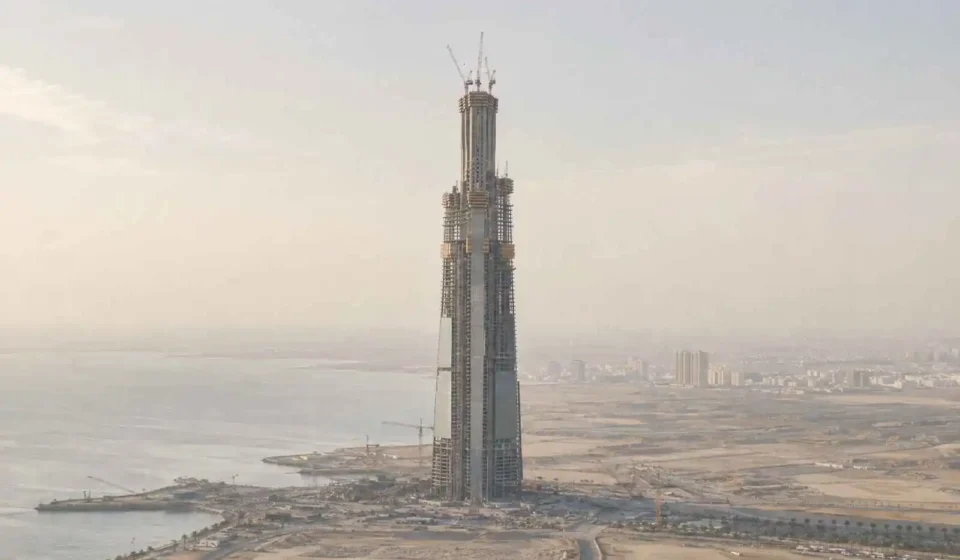

For years, a massive concrete monolith stood silent along Saudi Arabia’s Red Sea coast. Even in its frozen, incomplete state, the core of the Jeddah Tower dominated the local skyline—a towering, skeletal monument to interrupted ambition. Once positioned to be the crown jewel of the Kingdom’s architectural achievements, construction on the supertall skyscraper ground to a halt nearly six years ago, leaving the world to wonder if the ambitious structure would ever reach its record-breaking destination.
Now, the silence has been broken. Construction has officially and vigorously resumed on the Jeddah Tower.
According to Saudi investor Prince Alwaleed bin Talal, the structure has recently surpassed the 430-meter (1,411-foot) mark, successfully reaching Level 107. Active construction crews have returned to the site, pouring concrete for the upper residential and commercial floors while specialized teams install high-performance exterior façade panels on the lower levels.
Though the tower is still less than halfway to its ultimate target, the visible progress signals a major turning point for global architecture. Once completed at a height exceeding 1,000 meters (3,281 feet), the Jeddah Tower will officially shatter the world record, becoming the tallest man-made structure in human history.
Chronology: The Decadelong Journey of an Icon (2013–2026)
To understand the significance of the tower’s current revival, one must look back at its turbulent timeline, which reflects both the rapid economic ambitions of the Gulf region and the systemic challenges of executing megaprojects on a historic scale.
[2013] Construction Begins (Known as Kingdom Tower)
   │
[2018] Construction Halts (Financial & Contractor Disruption)
   │
[2020] Pandemic Delays (Global Supply Chain & Labor Stagnation)
   │
[2025] Official Resumption (Saudi Binladin Group Re-engaged)
   │
[2026] Milestone Reached (430m / Level 107 Passed)
   │
[2028] Projected Completion Target
The Initial Launch and Early Milestones (2013–2017)
The project was first unveiled to the public under the name "Kingdom Tower." Ground was broken in 2013, with the Jeddah Economic Company (JEC) spearheading the development. The original vision was to create a centerpiece for the massive Jeddah Economic City development, establishing a new commercial hub on the Red Sea. In the first few years, progress was steady. Concrete poured into the deep-pile foundations, and the unique three-winged footprint began to rise above the coastal sands, capturing the attention of structural engineers worldwide.
The Sudden Halt and Years of Stagnation (2018–2024)
In early 2018, construction abruptly ceased. The stoppage was triggered by a combination of financial restructuring, contractor difficulties, and broader corporate disruptions within the principal entities backing the project.
The onset of the COVID-19 pandemic in 2020 further complicated any immediate hopes of a restart, paralyzing global supply chains and shifting capital priorities. For over six years, the unfinished concrete core stood as one of the world’s most recognizable stalled megaprojects—an imposing, half-built obelisk visible from miles away, serving as a reminder of the immense financial and logistical risks of supertall engineering.
The 2025 Resumption and Present Progress (2025–2026)
The turning point arrived in 2025. Following extensive negotiations and financial restructuring, the Jeddah Economic Company formally re-engaged the Saudi Binladin Group as the primary contractor to complete the tower.
Heavy machinery was remobilized, and cranes at the tower’s peak began operating once more. By early 2026, the tower had successfully pushed past its 100th floor, reaching its current milestone of 430 meters. Work is now proceeding simultaneously on multiple fronts: structural concrete pouring at the top, mechanical, electrical, and plumbing (MEP) installations in the mid-sections, and glass cladding near the base.
Technical Specifications and Engineering Marvels
Building a structure that stands over a kilometer high requires pushing the boundaries of material science, aerodynamics, and structural engineering. The Jeddah Tower is not merely a scaled-up version of a standard skyscraper; it is a highly specialized vertical ecosystem designed to withstand extreme environmental forces.
Aerodynamics and Wind Mitigation
At heights exceeding 500 meters, wind forces become the primary threat to a building’s structural integrity. To combat this, the Jeddah Tower utilizes a tapering, three-winged aerodynamic design.

Designed by Adrian Smith + Gordon Gill Architecture—the same architectural minds behind Dubai’s Burj Khalifa—the tower’s wings taper at different rates along its height. This asymmetric profile disrupts wind patterns, preventing organized vortex shedding (the phenomenon where wind creates alternating low-pressure pockets that cause a building to sway dangerously). By breaking up the wind’s path, the building significantly reduces lateral structural load.
Foundation and Concrete Engineering
The tower stands on a highly complex foundation system designed to handle its immense dead load on the soft coastal soil of the Red Sea.
- Piles: The foundation features 270 bored concrete piles reaching depths of up to 120 meters (394 feet) to anchor into solid geological strata.
- Concrete Strength: High-strength, low-permeability concrete mixes were custom-formulated to resist the corrosive, saline groundwater of the coastal environment.
- Pumping Technology: To build the upper floors, concrete must be pumped vertically under immense pressure. Special high-pressure pumps are utilized to push wet concrete hundreds of meters upward in a single, continuous lift before it sets.
Vertical Transportation: The Elevator Network
Moving thousands of daily occupants through a kilometer-high structure requires an unprecedented transit network. The Jeddah Tower will feature 59 elevator systems, including double-deck cabins.
To manage transit times and structural space, the elevators will not run in single, continuous shafts from the ground floor to the peak. Instead, the tower features strategic "sky lobbies" and transfer levels. Occupants traveling to the highest floors will change elevators at these hubs, optimizing travel efficiency and reducing the space required for vertical shafts.
Comparison of the World’s Tallest Structures
| Building | Location | Height | Status |
|---|---|---|---|
| Jeddah Tower | Jeddah, Saudi Arabia | >1,000 meters (3,281 ft) | Under Construction (Target: 2028) |
| Burj Khalifa | Dubai, UAE | 828 meters (2,717 ft) | Completed (2010) |
| Merdeka 118 | Kuala Lumpur, Malaysia | 679 meters (2,227 ft) | Completed (2023) |
| Shanghai Tower | Shanghai, China | 632 meters (2,073 ft) | Completed (2015) |
Official Responses and Leadership Vision
The resumption of construction has been accompanied by high-level endorsements from key stakeholders. Prince Alwaleed bin Talal, a major investor in the Jeddah Economic Company, recently conducted a high-profile site visit to review progress and meet with the engineering teams.
Following the inspection, Prince Alwaleed expressed confidence in the project’s renewed momentum, highlighting that the tower had officially conquered its most critical transition phase from a stalled asset to an active construction site.
"The tower has officially reached 430 meters. We are looking forward to completing this historic landmark, which will serve as a global symbol of Saudi Arabia’s modernization."
— Prince Alwaleed bin Talal
While project officials have set an optimistic completion target of 2028, independent construction analysts caution that the most demanding phases of the project lie ahead. The logistics of lifting materials, managing crane safety in high-altitude winds, and installing complex MEP systems at heights above 600 meters will test the limits of the engineering team. However, the re-engagement of the Saudi Binladin Group and the secured financial backing indicate a much more stable foundation for the project than during its previous active phase.
Economic and Geopolitical Implications
The Jeddah Tower is far more than an exercise in architectural vanity; it is a critical component of Saudi Arabia’s broader geopolitical and economic transformation under Vision 2030.
                       ┌────────────────────────┐
                       │  Saudi Vision 2030     │
                       └───────────┬────────────┘
                                   │
         ┌─────────────────────────┼─────────────────────────┐
         ▼                         ▼                         ▼
┌──────────────────┐      ┌──────────────────┐      ┌──────────────────┐
│ Non-Oil GDP      │      │ Global Tourism   │      │ Foreign Direct   │
│ Diversification  │      │ Hub Attraction   │      │ Investment (FDI) │
└──────────────────┘      └──────────────────┘      └──────────────────┘
Jeddah Economic City: The Wider Master Plan
The tower will serve as the anchor for the Jeddah Economic City (JEC), a massive, mixed-use urban development covering approximately 5.3 million square meters (57 million square feet). Once fully realized, this coastal district will feature:
- Commercial Hubs: High-density office spaces, retail districts, and international business parks designed to attract foreign direct investment.
- Luxury Hospitality: A premier Four Seasons hotel located within the tower itself, alongside high-end serviced apartments and residential condominiums.
- Public Amenities: Public parks, cultural centers, and an observation deck situated more than 640 meters (2,100 feet) above the ground, offering unprecedented views of the Red Sea coast.
Shifting the Center of Gravity
For over a decade, Dubai’s Burj Khalifa has stood unchallenged as the ultimate symbol of Gulf architectural and economic dominance. By constructing a building that exceeds the Burj Khalifa by at least 172 meters (564 feet), Saudi Arabia aims to shift the symbolic center of gravity of the Middle East’s real estate sector.
This ambition aligns directly with the Kingdom’s goal to transition from an oil-reliant economy to a global hub for tourism, technology, and finance. The completed tower will serve as a physical testament to Saudi Arabia’s engineering capabilities and its readiness to compete on the world stage.
As crews pour concrete high above the Red Sea, the world is watching. If the project maintains its current momentum toward the 2028 target, the Jeddah Tower will not only redefine the skyline of Saudi Arabia but will also write a new chapter in the history of human engineering.