











































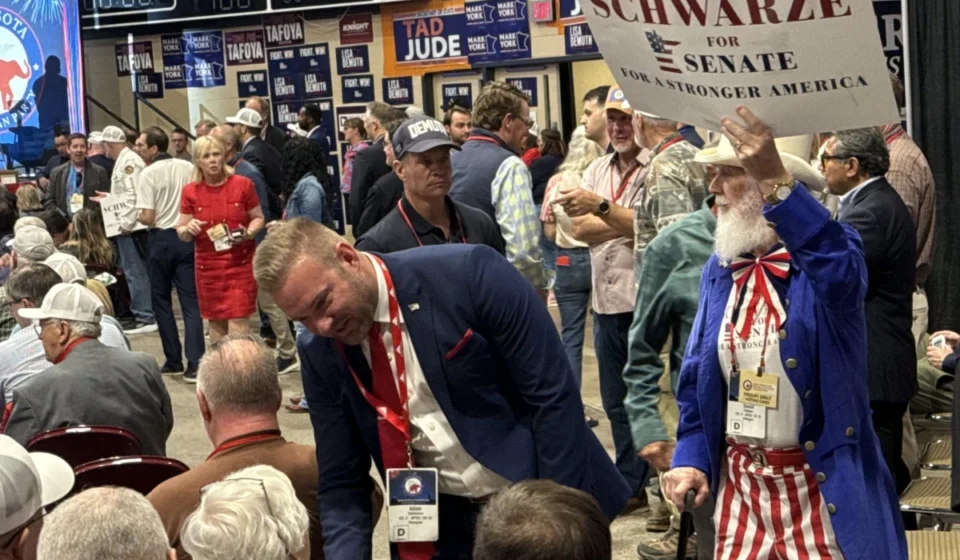

DULUTH, Minn. – The Minnesota Republican Party convention in Duluth has concluded with a dramatic outcome, setting the stage for a contentious primary battle for the U.S. Senate seat currently held by retiring Democratic Senator Tina Smith. In a move that openly defied decades of state GOP tradition, Michele Tafoya, a well-known former sports broadcaster, vowed to continue her campaign despite failing to secure the party’s coveted endorsement. The delegates, after a protracted six rounds of balloting, ultimately threw their support behind Adam Schwarze, a former Navy SEAL whose staunch conservative platform resonated deeply with the party’s activist base.
Tafoya’s decision to press on marks a significant moment for the Minnesota Republican Party, which has struggled to win statewide office for two decades. Her challenge to the endorsed candidate is a high-stakes gamble against an unofficial, yet potent, rule: candidates who bypass the party endorsement process in Minnesota nearly always face insurmountable odds in the subsequent primary election. The unfolding contest will test the power of party machinery versus individual brand recognition, significant financial backing, and a strategic appeal to a broader electorate.
The Convention’s Verdict: Purity Over Pragmatism
The atmosphere at the Duluth convention was charged with ideological fervor, as delegates weighed the perceived electability of a moderate candidate against the unwavering conservative principles championed by others. Michele Tafoya, leveraging her extensive public profile and media savvy, presented herself as the most viable option to unseat a Democrat in the general election, appealing to delegates with a pragmatic message of winning. However, her past stances on critical issues, which deviated from the party’s hardened conservative line, proved to be an insurmountable hurdle for the assembled faithful.
After a series of votes that systematically eliminated other contenders, including former NBA player Royce White, the contest narrowed. Adam Schwarze, a political newcomer but a figure whose military background and unambiguous conservative messaging aligned perfectly with the delegates’ expectations, steadily gained momentum. In the decisive sixth round, Schwarze clinched the endorsement with the support of nearly 63% of the GOP delegates, a commanding victory that underscored the base’s clear preference for ideological purity.
In his impassioned speeches on the convention floor, Schwarze directly challenged Tafoya’s “electability” argument. He urged delegates to reject the notion that compromise was necessary for victory, asserting that Republicans could win the Senate race “without compromising our values.” This message struck a chord, tapping into a widespread sentiment among the delegates that the party needed to stand firm on its principles, rather than dilute them in pursuit of broader appeal. His subsequent victory speech reiterated this core tenet: “I will not compromise. I will fight in D.C. and we will fight to take back our state together.” His words solidified his position as the standard-bearer for the conservative wing, ready to confront what he perceives as a liberal establishment in Washington and within the state.
The Path to Duluth: A Chronology of Contention
The dramatic events in Duluth were not a sudden eruption but the culmination of months of internal maneuvering and a simmering tension within the Minnesota Republican Party. The battle for Senator Tina Smith’s seat, a crucial target for Republicans nationally, has become a microcosm of the broader ideological struggles defining modern American politics.
Pre-Convention Maneuvering and Tafoya’s Pledge
Michele Tafoya’s entry into the race was met with immediate national attention, primarily due to her high public profile as a former NFL sideline reporter and her recent pivot to conservative political commentary. From the outset, Tafoya signaled her intent to buck the state party’s traditional endorsement process. Recognizing that her more moderate past positions might alienate the most conservative delegates, she made it clear well in advance that she would bypass the convention’s decision if it did not favor her, opting instead to take her case directly to primary voters in August. This pre-emptive declaration set a defiant tone, establishing her campaign as an independent force within the party structure.
Her strategy was a calculated risk, banking on her name recognition, media savvy, and national backing to overcome the grassroots organizational power typically marshaled by endorsed candidates. Adam Schwarze, on the other hand, diligently worked the party circuit, building relationships with delegates and articulating a consistent, uncompromising conservative message. His campaign focused on energizing the base, portraying himself as a principled outsider ready to fight for core Republican values. Other candidates, such as former NBA player Royce White, also sought to make their mark, but ultimately could not consolidate enough support to challenge the two frontrunners effectively. The stage was set for a direct confrontation between Tafoya’s electability argument and Schwarze’s purity pledge.
The Multi-Round Marathon: How Schwarze Secured Victory
The convention floor in Duluth transformed into a political arena where the future direction of the state GOP was fiercely debated over several arduous rounds of balloting. Each round required candidates to secure a higher percentage of the vote to remain viable, systematically whittling down the field. The process tested the endurance and strategic acumen of the candidates and their campaigns, as they worked tirelessly to sway undecided delegates and consolidate support from eliminated contenders.
As the rounds progressed, Tafoya’s initial advantage of name recognition began to wane against Schwarze’s growing appeal to the delegates’ conservative convictions. While Tafoya emphasized her broad appeal and ability to attract independent voters in a general election, Schwarze painted a stark contrast, warning against “compromising our values.” He effectively framed the choice as one between a candidate who would dilute the party’s message for broader appeal and one who would steadfastly uphold its conservative tenets. His message resonated with the passionate activists who make up the delegate pool, many of whom prioritize ideological alignment above all else. By the sixth round, Schwarze had amassed a decisive majority, reflecting the delegates’ clear preference for a candidate who embodied their core beliefs without equivocation.
A Fateful Precedent: Minnesota’s Endorsement Tradition
The decision by Michele Tafoya to disregard the party’s endorsement carries significant historical weight in Minnesota politics. For decades, the unofficial rule has been that a Republican candidate who fails to secure the party’s blessing at the convention almost invariably loses the subsequent primary election. This tradition reinforces party unity and empowers the grassroots activists who dedicate their time and resources to the convention process.
The last notable exception to this rule was in 1994, when then-incumbent Governor Arne Carlson, considered too moderate by the delegates, failed to receive the GOP endorsement. Carlson, however, was a sitting governor with a proven track record and widespread public recognition, advantages Tafoya does not possess. He successfully navigated the primary and went on to win re-election, a rare feat that has since become a cautionary tale for those who challenge the party’s chosen candidate.
Hamline University political science professor David Schultz highlighted this unique dynamic: “Unlike the Democrats, the Republican track record in Minnesota of bucking the convention in recent history has not worked out well.” While Democrats, like U.S. Rep. Angie Craig, have occasionally successfully defied their party’s endorsement in primaries, the Minnesota GOP has historically struggled to unite behind non-endorsed candidates. This stark difference underscores the particular emphasis on party purity and adherence to the endorsement process within the Republican ranks, making Tafoya’s current path exceptionally challenging. The convention’s outcome, therefore, is not merely a rejection of one candidate but a reaffirmation of a deeply ingrained party custom.
Beyond the Convention Floor: Data and Dynamics
The immediate aftermath of the convention has shifted the battleground from the delegate floor to the broader primary electorate, where different dynamics will come into play. Michele Tafoya’s campaign now faces the arduous task of translating her national profile and potential general election appeal into a primary victory, while Adam Schwarze must consolidate his base and prepare for the increased scrutiny that comes with being the party’s official choice.
The "Electability" Dilemma: Tafoya’s General Election Appeal
One of the central tenets of Michele Tafoya’s campaign has been her argument for electability, a crucial factor in a state that has not elected a Republican to statewide office in two decades. Her national name recognition, honed over years in sports broadcasting, provides her with an immediate advantage in public awareness that few other candidates could match. Furthermore, she boasts significant fundraising capabilities and a media-savvy approach that allows her to effectively communicate her message. Crucially, Tafoya has secured the full support of the National Republican Senatorial Committee (NRSC), the powerful national fundraising and strategy arm of Senate Republicans. This backing signals that if Tafoya wins the primary and is deemed competitive in the general election, the NRSC is prepared to pour millions of dollars into the race, a vital lifeline for any serious statewide campaign.
Early polling data offers a glimpse into her potential general election strength. An Emerson College poll conducted in February, shortly after Tafoya entered the race, showed her trailing Democratic Lt. Gov. Peggy Flanagan by six points (47% to 41%) and U.S. Rep. Angie Craig by seven points (47% to 40%). While these figures don’t place her in the winning category, Professor David Schultz noted, “At this point that’s not bad.” Schultz further elaborated on Tafoya’s general election prospects, stating that she is “where she should be on the issues” for a broad electorate. He believes she “has a shot at attracting independents” and can “pick up a different group of Republicans,” contrasting this with the more ideologically rigid convention delegates whom he described as “the most extreme.” He also pointed to her gender as a potential boost among crucial suburban women voters and her diverse background (her father was Hispanic) as an asset in broadening her appeal.
The Conservative Crucible: Tafoya’s Past vs. Party Purity
Despite her strategic advantages, Tafoya’s perceived moderation proved to be her undoing at the GOP convention. Her past statements and positions have long been a point of contention with the party’s conservative base, who prioritize ideological purity above all else. For instance, Tafoya previously identified herself as a “pro-choice Republican,” a stance anathema to a significant portion of the GOP electorate. While she has since clarified her position, stating that states should outlaw abortions after 12 weeks of pregnancy, this earlier label created an immediate credibility gap with pro-life activists.
Adding to the skepticism, Tafoya once penned an “open letter” to President Donald Trump, explicitly asking him not to run for re-election. In an era where loyalty to Trump is a litmus test for many Republican primary voters, this historical criticism was a major red flag. Her support for “red flag” laws, or Extreme Risk Protection Orders, which allow courts to temporarily remove weapons from individuals deemed a danger, also raised the hackles of staunch Second Amendment advocates. These laws are often viewed by gun rights proponents as an infringement on constitutional liberties, rather than a “sensible” approach to combating mass shootings, as Tafoya had described them.
At the convention, Tafoya attempted to distance herself from these past remarks, declaring, “I will never compromise my conservative values.” However, for many delegates, the damage was already done. Curtis Rethwisch, a Lincoln County delegate who supported Schwarze, articulated this sentiment, stating, “If it was just word of mouth and campaign smears I wouldn’t give it any credibility, but I watched the videos. The words came right out of her mouth.” This direct observation highlights the challenge Tafoya faces in reassuring a base that meticulously vets candidates for any deviation from conservative orthodoxy.
Schwarze’s Unwavering Stance: Rallying the Base
In stark contrast to Tafoya’s nuanced positions, Adam Schwarze presented an unvarnished, uncompromising conservative platform that resonated powerfully with the convention delegates. His consistent messaging on core issues left no room for doubt about his ideological alignment, making him an ideal choice for a base yearning for a clear voice. Schwarze’s supporters praised his adherence to traditional Republican values, seeing him as a candidate who embodies the spirit of principled conservatism.

Lincoln County delegate Curtis Rethwisch, in explaining his support for Schwarze, stated, “I don’t have to give up anything on my principles and my morals with him. He’s pro-life, he’s pro-build a wall, he backs Trump.” This sentiment perfectly encapsulates the appeal of Schwarze to the party’s grassroots: a candidate who checks all the boxes for the conservative movement, aligning with key stances on abortion, immigration, and fealty to the former president. Chisago County delegate Tony Kaufman, another Schwarze supporter, lauded the endorsement process itself, arguing that party activists are the most knowledgeable when it comes to selecting a political candidate. “When you support the endorsement process, you’re supporting an informed base, an informed constituent, and that’s why we’re excited about it, and that’s why we choose to abide by the endorsement,” Kaufman said. This perspective underscores the delegates’ belief that their choice reflects the informed will of the party, not merely a factional preference.
While Schwarze’s unwavering stance secured him the endorsement, it also introduces potential vulnerabilities for a general election. Professor Schultz hinted that Schwarze would face increased scrutiny, specifically mentioning “controversial remarks about birth control.” Such statements, while potentially appealing to the most conservative elements of the primary electorate, could become significant liabilities when attempting to appeal to the broader, more moderate voters necessary to win a statewide election in Minnesota.
The Financial Lifeline: NRSC vs. State Party
The financial landscape of the Minnesota Republican Party further complicates the post-endorsement dynamic. Professor David Schultz candidly observed, “The Republican Party in Minnesota is still in the most part broke.” This financial fragility means that the state party’s endorsement, while symbolically powerful, carries less practical weight in terms of direct campaign funding compared to well-resourced national committees.
This is where Michele Tafoya’s robust national backing becomes a critical factor. Her endorsement from the National Republican Senatorial Committee (NRSC) is not merely a symbolic gesture; it represents a potential infusion of millions of dollars into her campaign if she proves competitive. This national financial muscle can effectively offset the limited resources of the state party, providing Tafoya with the advertising blitz capabilities necessary to reach primary voters across Minnesota. While Schwarze will benefit from the organizational support and volunteer network of the state party, he will likely struggle to match Tafoya’s potential fundraising power, especially given the NRSC’s vested interest in securing a viable candidate for the general election. The financial disparity highlights a modern political reality: national party committees often wield more influence and resources than their state counterparts, particularly in high-stakes races.
Official Responses and Expert Commentary
The events in Duluth have elicited strong reactions from the candidates, political analysts, and the party faithful, each offering a distinct perspective on the path forward and the significance of the convention’s outcome.
Candidates Speak: Defiance and Resolve
In the immediate aftermath of the endorsement, both Michele Tafoya and Adam Schwarze addressed their supporters, signaling their respective strategies for the upcoming primary. Tafoya, true to her pre-convention pledge, remained defiant. Despite her loss on the convention floor, she confirmed that her campaign would continue "moving full speed toward the August primary election." Her resolve underscores her belief that her broader appeal and national resources will ultimately trump the party’s internal endorsement process. This stance sets up a direct ideological and strategic confrontation within the GOP.
Adam Schwarze, in his victory speech, exuded confidence and a firm commitment to his conservative principles. “I will not compromise,” he declared, doubling down on the message that had resonated so strongly with the delegates. His words reflect a mandate from the party’s base to hold firm on conservative values, eschewing any perceived moderation. His commitment to “fight in D.C.” and “take back our state together” aligns with a broader national sentiment among conservatives who feel the need for uncompromising leadership. Both candidates, therefore, are entering the primary with clear, albeit opposing, mandates from their respective bases of support.
Political Analysts Weigh In: A Risky Bet
Professor David Schultz of Hamline University offered comprehensive analysis on the implications of Tafoya’s decision. He acknowledged the historical challenge for non-endorsed GOP candidates in Minnesota, but also highlighted factors that could make Tafoya an exception. Schultz downplayed the loss of state Republican Party support, noting its limited financial resources and the compensating factor of NRSC backing. “The Republican Party in Minnesota is still in the most part broke,” he observed, suggesting that the national party’s financial commitment would be far more significant.
Schultz sees Tafoya’s general election positioning as a strength, arguing that she is “where she should be on the issues” to attract independent and moderate Republican voters. He distinguished these voters from the “most extreme” activists who dominate conventions. He also pointed to Tafoya’s gender as a potential asset in appealing to suburban women, a crucial demographic, and her diverse background as beneficial in a general election. While acknowledging the difficulty of winning a primary where conservatives are overrepresented, Schultz suggested Tafoya “has a chance to squeak through” with an aggressive advertising campaign. He also anticipated increased scrutiny for Schwarze, particularly regarding his more controversial remarks, which could be exploited in a general election.
Former Minnesota Republican Congressman John Kline, who introduced Tafoya at the convention, echoed the electability argument, calling her the “only candidate here who can and will win in November.” This public endorsement from a respected party figure further validates Tafoya’s strategy of appealing to a broader, win-focused segment of the party.
The Delegates’ Mandate: Upholding the Process
For many delegates, the convention’s decision was not merely about choosing a candidate, but about upholding the integrity and importance of the endorsement process itself. Chisago County delegate Tony Kaufman, a Schwarze supporter, articulated this belief, emphasizing the informed nature of the delegates. He stated that supporting the endorsement process means supporting “an informed base, an informed constituent.” This perspective underscores the delegates’ conviction that they are the most qualified to select a candidate who truly represents the party’s values and interests.
The delegates, often the most dedicated and ideologically committed members of the party, view their role as crucial in shaping the party’s direction. Their choice of Schwarze over Tafoya was a clear message that ideological alignment and a commitment to conservative principles are paramount, even if it means foregoing a candidate perceived as more "electable" by national strategists or pollsters. This mandate from the grassroots sets a demanding standard for any candidate hoping to represent the Minnesota GOP.
Implications for the August Primary and Beyond
The Republican Party convention in Duluth has not resolved the primary contest for Senator Tina Smith’s seat; rather, it has ignited a new, more intense phase of the battle. The implications of this outcome will ripple through the Minnesota political landscape, affecting both the primary in August and the critical general election in November.
A Divisive Primary Battle Ahead
Michele Tafoya’s decision to continue her campaign guarantees a divisive and potentially bruising primary battle for the Minnesota GOP. She must now appeal directly to the broader Republican primary electorate, which, while still more conservative than the general electorate, is not as singularly focused on ideological purity as the convention delegates. Her strategy will likely involve leveraging her significant media presence, deploying a robust advertising blitz on television and the internet, and emphasizing her electability and ability to fundraise nationally. She will need to convince primary voters that her past statements do not diminish her commitment to conservative principles today, a challenging rhetorical tightrope walk.
Adam Schwarze, as the endorsed candidate, will benefit from the state party’s organizational structure, volunteer network, and the symbolic weight of the endorsement. His challenge will be to translate the enthusiastic support of the delegates into a broader primary victory, while also preparing for the increased scrutiny on his more conservative positions. The primary campaign will inevitably highlight the differences between the two candidates, potentially creating internal party friction and draining resources that would otherwise be saved for the general election. The intensity of this internal struggle could leave the eventual nominee weakened and less prepared to face the well-organized and unified Democratic opposition.
The General Election Gauntlet: Uniting a Fractured Party
Regardless of who emerges victorious from the August primary, the nominee will face a formidable challenge in the November general election. Minnesota has proven to be a difficult state for Republicans, with a two-decade drought in statewide electoral victories. The Democratic Party will likely field a strong candidate, either Lt. Gov. Peggy Flanagan or U.S. Rep. Angie Craig, both of whom have demonstrated electoral strength and a cohesive party backing. The Emerson College poll figures, showing Tafoya trailing both potential Democratic opponents, underscore the uphill battle ahead.
A divisive primary could exacerbate the Republican Party’s general election woes. A nominee who emerges from a bitter internal contest may struggle to unite the various factions of the party, particularly if a significant portion of the primary electorate feels alienated by the outcome. If Tafoya wins, Schwarze’s staunch conservative supporters might be slow to rally behind her. Conversely, if Schwarze wins, Tafoya’s more moderate and national-minded backers might question his electability. The ability of the eventual nominee to bridge these divides and present a united front will be paramount. Minnesota’s electorate often favors more moderate candidates in statewide races, meaning that a candidate who appeals too strongly to the extremes of either party faces an uphill climb to win over independents and swing voters.
Redefining Republicanism in Minnesota
The primary contest between Michele Tafoya and Adam Schwarze is more than just a battle for a Senate seat; it is a defining moment for the future identity of the Minnesota Republican Party. It represents a clash between two fundamental strategies: the pursuit of ideological purity to energize the base versus a pragmatic approach focused on electability and broader appeal. The outcome of this primary will send a powerful message about which direction the party in Minnesota is willing to take in its efforts to break its two-decade losing streak in statewide races.
If Tafoya prevails, it could signal a shift towards a more inclusive, nationally-backed Republicanism, willing to compromise on some conservative tenets to attract independent and moderate voters. If Schwarze wins, it would solidify the party’s commitment to an uncompromising, base-driven conservatism, potentially at the expense of general election viability in a purple state. The national implications are also significant, as high-profile Senate races like this often reflect broader trends in American politics regarding party polarization, the power of endorsements, and the perennial tension between ideological fervor and the practicalities of winning elections. The eyes of the political world will be on Minnesota, as this primary battle unfolds and ultimately shapes the future of Republicanism in the North Star State.