























































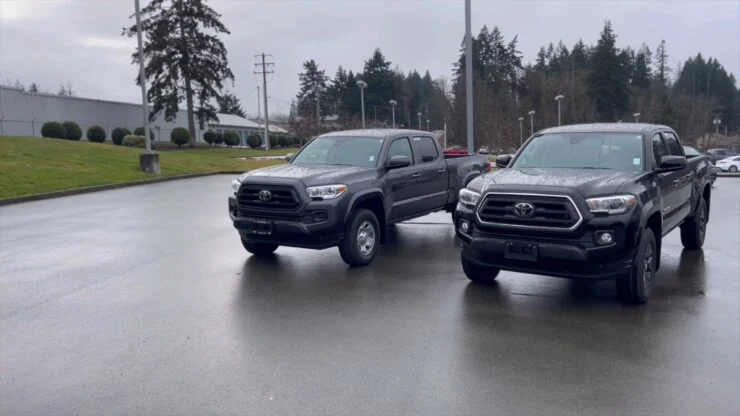

The midsize pickup truck segment remains one of the most fiercely contested arenas in the North American automotive market. Within this space, the Toyota Tacoma has long maintained a dominant position, prized for its durability, resale value, and rugged utility. For the 2026 model year, as prices across the industry continue to rise, budget-conscious buyers and fleet operators are increasingly scrutinizing the entry-level rungs of the Tacoma ladder.
At first glance, the entry-level Toyota Tacoma SR presents a compelling, highly sensible financial proposition. It represents the lowest barrier of entry to Tacoma ownership, sharing the same fundamental 2.4-liter turbocharged platform as its more expensive sibling, the SR5. However, a closer examination reveals that the price differential between the SR and the SR5 is defined by significant mechanical, functional, and qualitative distinctions.
Main Facts: The Entry-Level Tacoma Landscape
For the 2026 model year, the Toyota Tacoma SR establishes the baseline with a starting Manufacturer’s Suggested Retail Price (MSRP) of $32,445. The SR5 sits positioned immediately above it, commanding a premium of several thousand dollars. The precise financial delta between the two trims fluctuates depending on the buyer’s choice of cab configuration, bed length, drivetrain (two-wheel drive versus four-wheel drive), and regional destination charges.
+-----------------------------------------------------------------------------------+
|                            2026 TACOMA TRIM COMPARISON                            |
+----------------------+---------------------------+--------------------------------+
| Feature              | Tacoma SR                 | Tacoma SR5                     |
+----------------------+---------------------------+--------------------------------+
| Primary Role         | Fleet & Commercial Utility| Daily Driving & Multi-Use      |
| Auto Horsepower      | 228 hp                    | 278 hp                         |
| Auto Torque          | 243 lb-ft                 | 317 lb-ft                      |
| Wheel Type           | 17-inch Steel             | 17-inch Alloy                  |
| Rear Suspension      | Leaf Springs              | Multi-Link Coil (Double Cab)   |
| Standard Tech        | 8-inch Screen, TSS 3.0    | 8-inch Screen, Smart Key, TSS  |
+----------------------+---------------------------+--------------------------------+
While both vehicles utilize Toyota’s modern i-FORCE 2.4-liter turbocharged four-cylinder engine, their power outputs are far from identical:
- The Automatic SR is electronically detuned to produce 228 horsepower and 243 pound-feet of torque.
- The SR5 unlocks the standard output of the engine, delivering 278 horsepower and 317 pound-feet of torque when paired with the eight-speed automatic transmission.
Beyond the powertrain, the SR5 introduces a series of chassis and convenience upgrades. Most notably, Double Cab configurations of the SR5 swap the traditional rear leaf-spring suspension for a more sophisticated multi-link coil-spring setup. Additionally, the SR5 replaces the utilitarian styled steel wheels of the SR with alloy wheels and incorporates everyday conveniences such as proximity keyless entry, push-button start, and expanded options packages.
Chronology: The Evolution of the SR5 and the TNGA-F Platform
To understand the current relationship between the SR and SR5, one must examine the historical trajectory of Toyota’s light truck nomenclature and platform engineering.
[1970s–1980s: SR5 as Premium Trim] ──► [1995: Tacoma Nameplate Debuts] ──► [2024: Transition to TNGA-F Platform] ──► [2026: Clear Fleet vs. Retail Split]The Origins of "Sport Rally 5-Speed"
The "SR5" badge carries deep historical resonance for Toyota enthusiasts. Originating in the 1970s on models like the Hilux and Corolla, "SR5" originally denoted "Sport Rally 5-Speed," signaling a sportier, premium tier equipped with a five-speed manual transmission. Throughout the 1980s, an SR5 pickup was a highly desirable, top-tier consumer vehicle, immortalized in popular culture as the aspirational daily driver of the era.
The Tacoma Era and Trim Proliferation
When the Tacoma nameplate officially debuted in North America in 1995, the SR5 was gradually repositioned. Over the subsequent three generations, Toyota expanded its truck portfolio to cater to dedicated off-roading and lifestyle segments. The introduction of the TRD (Toyota Racing Development) Sport, TRD Off-Road, Limited, and eventually the ultra-premium TRD Pro and Trailhunter trims pushed the SR5 downward in the hierarchy. No longer the flagship, the SR5 transitioned into the volume-selling, middle-ground option for mainstream buyers.
The Fourth-Generation Shift (TNGA-F)
The launch of the completely redesigned fourth-generation Tacoma (beginning in the 2024 model year and continuing into 2026) marked a major technological shift. Built on the global TNGA-F body-on-frame platform shared with the Tundra and Land Cruiser, the Tacoma received a modern high-strength boxed steel chassis.
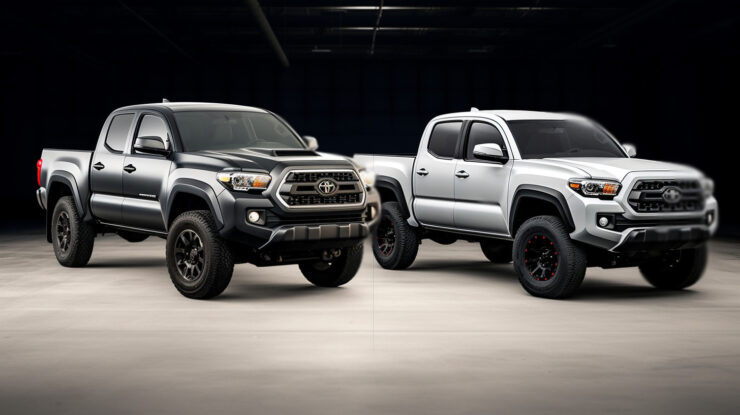
To maintain a low entry price for commercial buyers, Toyota retained the simplified, detuned SR trim. Simultaneously, they utilized the modularity of the TNGA-F platform to introduce coil-spring rear suspensions to the SR5 Double Cab, creating a wider mechanical chasm between the two entry-level models than had ever existed in previous generations.
Supporting Data: Technical and Performance Analysis
The differences between the Tacoma SR and SR5 are deeply rooted in engineering decisions that directly impact performance, ride quality, and daily usability.
Powertrain Dynamics and Electronic Mapping
The 2.4-liter i-FORCE turbocharged inline-four engine serves as the heart of both trims, yet their performance profiles are distinct.
The automatic SR’s output of 228 horsepower and 243 lb-ft of torque represents a conservative state of tune designed to maximize engine longevity and component thermal management under continuous commercial duty cycles.
Conversely, the SR5’s 278 horsepower and 317 lb-ft of torque alter the vehicle’s driving dynamics. The additional 74 lb-ft of torque is particularly critical, peak torque arrives lower in the rev range, allowing the SR5 to maintain highway speeds, execute passing maneuvers, and ascend steep grades with significantly less gear-hunting from the eight-speed automatic transmission.
Engine Torque Comparison (lb-ft):
=================================
Tacoma SR (Auto):   [██████████████████████░░░░░] 243 lb-ft
Tacoma SR5 (Auto):  [███████████████████████████] 317 lb-ft (+74 lb-ft)
An interesting anomaly exists within the SR line: buyers who opt for the rare six-speed manual transmission on selected SR configurations receive an engine tuned to 270 horsepower and 310 pound-feet of torque. This manual-transmission niche bypasses the severe power restriction of the automatic SR, though it remains a specialty choice representing a small fraction of overall sales.
Suspension Architecture: Leaf vs. Coil
The chassis engineering of these two trims dictates their road manners:
- Leaf-Spring Suspension (SR and XtraCab Models): The SR utilizes traditional leaf springs in the rear. Leaf springs are durable, simple to service, and highly effective at handling heavy static loads. However, when the truck bed is empty, leaf-spring setups tend to exhibit a firmer, more jittery ride, transmitting road imperfections directly into the cabin.
- Multi-Link Coil-Spring Suspension (SR5 Double Cab): The SR5 Double Cab transitions to a multi-link coil-spring rear suspension. By eliminating the friction inherent in leaf packs, coil springs allow the rear axle to articulate more fluidly over uneven pavement, highway expansion joints, and potholed city streets. This design substantially reduces back-end bounce, bringing the ride quality closer to that of a modern crossover without sacrificing midsize towing capacities.
Towing and Payload Realities
While Toyota advertises a maximum towing capacity of up to 6,500 pounds for properly equipped 2026 Tacoma models, this figure is highly configuration-dependent.
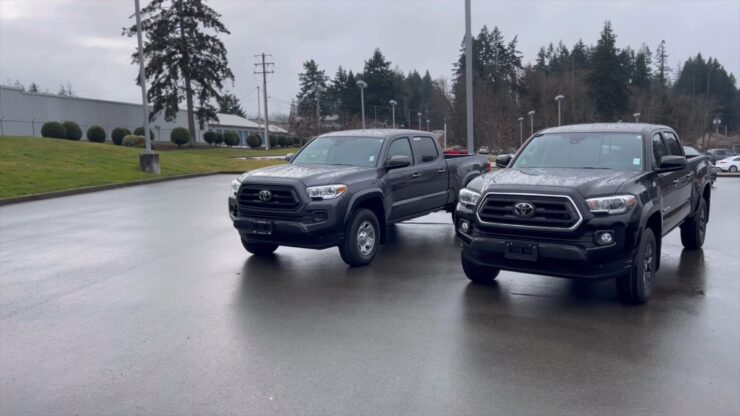
Because the SR5 possesses a significant torque advantage, it serves as a more competent and relaxed towing platform. However, buyers must account for the payload capacity of each specific truck. The tongue weight of a trailer, combined with passengers and bed cargo, can quickly exhaust the payload capacity of a lighter-duty midsize truck. The SR, particularly in its two-seat XtraCab configuration, offers a stripped-down curb weight that maximizes net payload capacity for raw hauling, whereas the SR5 offers a more balanced setup for towing light recreational trailers or recreational gear.
Official Responses: Manufacturer Strategy and Market Positioning
Toyota’s product planning division has designed the Tacoma lineup to serve two distinct buyer profiles. Automotive analysts and dealer network representatives shed light on how these vehicles are positioned in the marketplace.
Toyota’s Fleet and Commercial Focus
According to industry analysts, Toyota intentionally preserves the basic, de-contented nature of the SR to target fleet buyers, municipal governments, and commercial contractors. By offering the XtraCab configuration—which deletes the rear seats entirely in favor of an integrated utility storage space and a six-foot cargo bed—Toyota provides a direct successor to the utilitarian "work trucks" of the past. The inclusion of steel wheels and unpainted plastic trim elements is a deliberate choice; commercial operators actively prefer components that are cheap to replace and resistant to cosmetic damage.
Dealer Inventory and Option Pricing Realities
Reports from Toyota dealer networks indicate that base SR models with zero options are rarely stocked in high volumes for retail buyers. Dealerships typically order the SR5 in far greater numbers, as retail consumers overwhelmingly demand features like smart key access, alloy wheels, and advanced safety packages.
Furthermore, industry watchdogs warn of "option creep." When retail buyers attempt to configure an SR with accessory packages to match the convenience of an SR5, the price gap quickly narrows. Toyota’s packaging structure is designed to make the step up to the SR5 financially logical once basic comfort options are added.
Implications: Making the Right Buying Decision
The decision between purchasing a 2026 Toyota Tacoma SR or an SR5 carries long-term implications for operating costs, comfort, and residual value.
Total Cost of Ownership and Resale Value
The Tacoma historically commands some of the highest resale values in the automotive industry. However, depreciation curves differ between fleet-focused trims and consumer-focused trims:
- The Tacoma SR5 enjoys a much broader secondary market. Private buyers shopping for used trucks highly value alloy wheels, keyless ignition, and the improved ride comfort of the coil-spring suspension. Consequently, the SR5 tends to retain a higher percentage of its original MSRP on the used market.
- The Tacoma SR, while still highly valued for its reliability, appeals to a narrower slice of used buyers—primarily those looking for budget work trucks.
The Utility vs. Daily Driver Paradigm
Ultimately, the choice between these two trucks depends on how the vehicle will be used:
- The Case for the SR: The SR remains the optimal choice for buyers who view a truck strictly as a tool. If the vehicle’s primary duties involve transporting muddy equipment, hauling construction materials, or navigating active work sites, the SR’s rugged simplicity is an asset. For buyers seeking a manual transmission at the lowest possible price point, the manual SR offers an appealing package with a nearly full-power engine.
- The Case for the SR5: For the retail buyer whose truck must perform double duty as a daily commuter, weekend road-tripper, and family vehicle, the SR5 is the superior choice. The 50-horsepower and 74-lb-ft torque advantages make daily driving significantly less stressful. Combined with the refined ride of the coil-spring rear suspension and the inclusion of modern convenience features, the SR5 justifies its price premium by delivering a truck that is vastly easier to live with over years of ownership.