

















































Threads of Resilience: Hend Al-Mansour’s "Living Threads" Weaves Identity, Advocacy, and Art

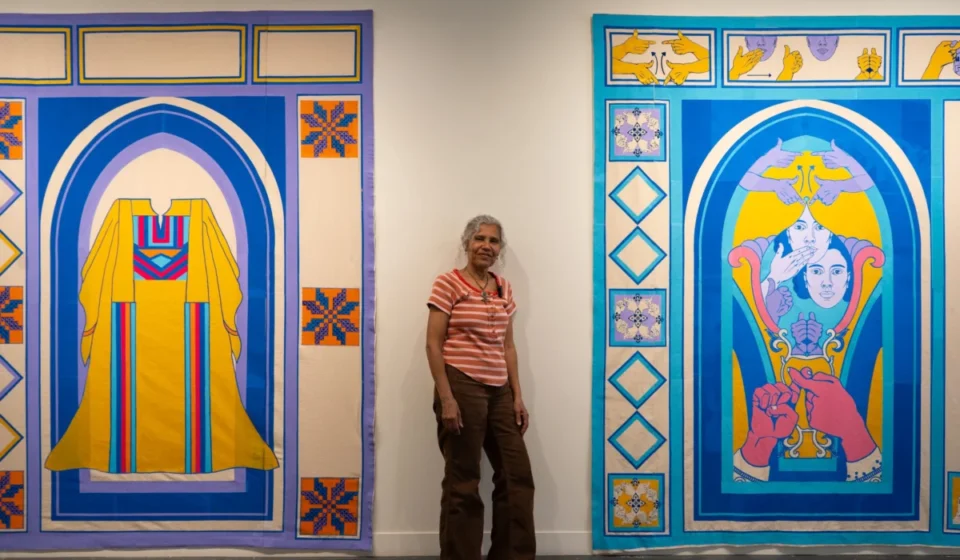
In the heart of Minneapolis’s vibrant arts district, Rosalux Gallery is currently playing host to a profound meditation on identity, displacement, and the unyielding power of the female spirit. "Living Threads," the latest immersive exhibition by St. Paul-based artist Hend Al-Mansour, serves as both a delicate tapestry of personal narrative and a bold statement on the resilience of Arab women. Through a meticulous and demanding screen-printing practice, Al-Mansour invites viewers into an intimate dialogue with the life and labor of Yara Omer, a Palestinian American poet and Deaf educator based in Minnesota.
The exhibition is not merely a collection of prints; it is an architectural and emotional investigation. By merging Islamic geometric motifs with American Sign Language (ASL) and the intricate, storytelling embroidery of the traditional Palestinian thobe, Al-Mansour crafts a visual language that transcends borders. It is a testament to the idea that, as Al-Mansour posits, "not only Arab women are powerful, but all women are powerful."
The Evolution of a Vision: From Medicine to Mosaics
The trajectory of Hend Al-Mansour’s life is as layered as the prints she creates. Born in Saudi Arabia, Al-Mansour’s initial professional life was defined by the rigors of medicine. In 1997, she arrived in Minnesota as a medical fellow at the world-renowned Mayo Clinic. However, the sterile environment of a medical career eventually gave way to a burgeoning need for creative expression.
Al-Mansour’s transition from physician to artist was not a pivot, but an evolution. Seeking a medium that could hold the weight of her cultural heritage and her personal history, she enrolled at the Minneapolis College of Art and Design (MCAD), eventually earning her Master of Fine Arts. Her work began to synthesize her background in science—characterized by precision and process—with the narrative traditions of her upbringing.

Her previous project, "Mihrabs: Portraits of Arab American Women," which debuted at the Minneapolis Institute of Art (Mia) in 2025, laid the groundwork for "Living Threads." In that installation, Al-Mansour created walk-in architectural structures inspired by the mihrab—a niche in a mosque wall indicating the direction of Mecca. By placing portraits of four local women within these structures, she successfully rooted individual identity within the historical and spiritual architecture of their culture. "Living Threads" narrows that focus, moving from a collective exploration to a singular, profound study of one woman: Yara Omer.
Chronology of Craft: The Making of "Living Threads"
The creation of "Living Threads" is a marathon of technical discipline. For Al-Mansour, the process is as significant as the final image. Because her screen-printing mesh stencils are limited to four-by-four-foot dimensions, each large-scale work is a puzzle of assembly.
- The Interview Phase: Before a single drop of ink is poured, Al-Mansour engages in a months-long period of deep listening. She meets with her subject, Yara Omer, in homes and coffee shops, transcribing not just facts, but the emotional cadence of her life—her fears, her triumphs as a Deaf educator, and her commitment to her community.
- The Negative Process: Al-Mansour meticulously cuts image negatives into six distinct sections, preparing a separate screen for each.
- The Layered Application: Working alongside William Noor, a queer Palestinian American writer who apprenticed under her, Al-Mansour inks one color at a time. Each stencil must be washed and re-aligned with surgical precision to ensure the final image retains its illustrative, pastel-hued clarity.
- The Synthesis: The final prints are a collage of signifiers: the rhythmic lines of ASL, the historical patterns of the Palestinian thobe, and the architectural geometry of Islamic art.
This collaborative aspect, particularly with Noor, highlights the communal nature of Al-Mansour’s work. By teaching a friend the craft, she ensures that the "living threads" of her narrative extend beyond the artist herself, weaving a network of support and shared history.
Supporting Data: Understanding the Cultural Fabric
To appreciate "Living Threads," one must understand the semiotics Al-Mansour employs. The use of the thobe is particularly poignant. In Palestinian culture, the embroidery on a thobe is more than aesthetic; it is a genealogical map. Patterns often indicate the village or family lineage of the wearer. By incorporating these motifs into the portrait of Yara Omer, Al-Mansour anchors Omer in a deep, historical time, even as she represents the modern, intersectional experience of a Palestinian American woman.

Furthermore, the integration of ASL is a direct response to Omer’s professional reality. By rendering the phrase "Life is better with friends"—a sentiment displayed in Omer’s own home—in ASL, Al-Mansour bridges the gap between spoken language and the visual-gestural language of the Deaf community. It is a deliberate choice to center the accessibility and the specific, supportive community that Omer has built for herself and her students.
Official Responses and Public Reception
The exhibition has already sparked significant discourse regarding the intersection of art and geopolitical tension. Al-Mansour is no stranger to institutional friction. Prior to her 2025 Mia exhibition, a separate project was postponed by the museum due to its depictions of the Prophet. Rather than retreating, Al-Mansour pivoted, focusing her lens on the resilience of women.
This resilience is not just thematic; it is a survival strategy. When asked about her departure from Saudi Arabia, where she lived under the strict surveillance of religious police, she describes the experience as living in a "prison." Her work serves as an antithesis to that confinement—a space of wide-open expression where the "piece of hair" that once triggered harassment is now a celebrated element of a free woman’s identity.
Critics and attendees have noted the "intentionally inviting" nature of the work. The pastel color palette, while seemingly cheerful, acts as a "Trojan horse" for heavier themes. The beauty of the prints invites the viewer in, only for them to be confronted with the reality of displacement, the struggle for identity, and the quiet, persistent activism of the women Al-Mansour profiles.

Implications: The Quest for Justice and Visibility
"Living Threads" is ultimately an exercise in humanization. In an era where the Palestinian experience is frequently reduced to headlines and conflict, Al-Mansour’s insistence on "presenting Palestinian people as normal people" is a radical act of empathy.
"I want to show their love of beauty, what they do, what they love, what are their hopes," she says. Her work forces a reconsideration of the "other." When viewers stand before the portrait of Yara Omer, they are not looking at a political statistic; they are looking at a teacher, a poet, a friend, and a bearer of a centuries-old culture.
The implications for the broader art world are clear: Al-Mansour is part of a growing movement of artists who use their platforms to reclaim the narrative from external, often reductive, perspectives. Her work suggests that the role of the artist is to be a bridge—not just between cultures, but between the personal and the political.
Her closing remarks on the exhibition carry the weight of her childhood memories: the neighbors who held the keys to homes they could not return to after the 1948 Nakba. "I hope one day they find peace and justice," she says. "I’m not sure they’ll have the land, but at least justice."

"Living Threads" is on view at the Rosalux Gallery through August 30. For those seeking to engage with the work in person, an artist talk is scheduled for August 15, providing a rare opportunity to hear directly from Al-Mansour about the intersection of her medical background, her artistic practice, and her hopes for the future of her community. Additionally, Al-Mansour’s intellectual contributions continue beyond the gallery walls; she has contributed an essay to the forthcoming anthology Nick of Time: Women Write about Art and Aging, set for publication by the University of Minnesota Press this October.
Through every print, every interview, and every brushstroke, Hend Al-Mansour is ensuring that these stories—fragile yet iron-willed—are not just remembered, but felt.