


























































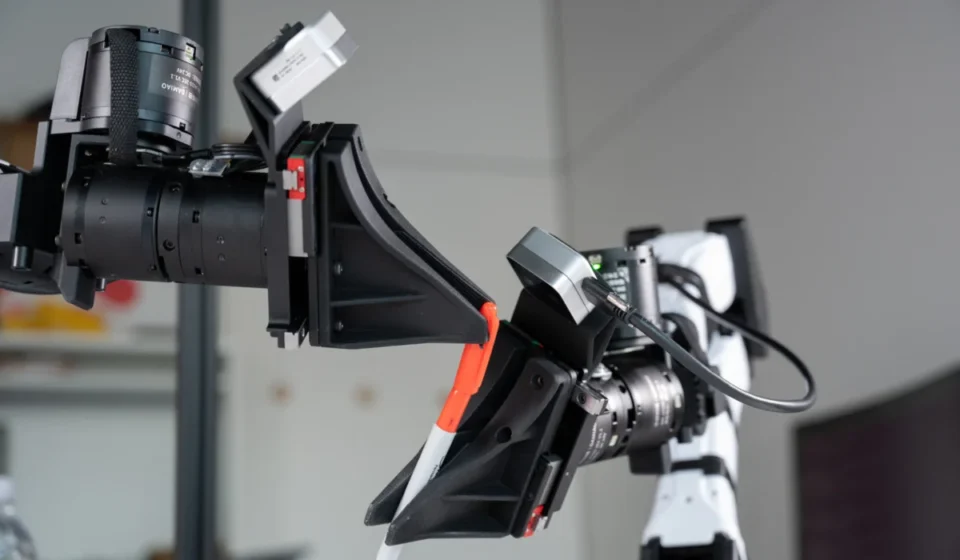

In the fast-moving landscape of artificial intelligence, the next great frontier isn’t digital—it is physical. As AI labs race to develop general-purpose robots capable of navigating the chaos of the human world, they have hit a significant roadblock: a severe lack of high-quality, real-world training data. Enter XDOF, a startup that has emerged from stealth with such velocity that it is already in late-stage talks to raise a Series B round at a valuation of approximately $1.2 billion, barely three months after its initial public emergence.
Led by 8VC, the deal underscores a frantic investor appetite for the "picks and shovels" of the robotics industry. While the startup—founded in 2024 by UC Berkeley researchers Philipp Wu and Fred Shentu—had not initially planned to return to the capital markets so soon after its $70 million Series A in June, its explosive commercial traction has made the current financing round an inevitability. With annualized revenue already approaching $50 million, XDOF has transitioned from a promising academic project to a critical pillar of the robotics supply chain.
The Genesis: From Academic Inquiry to Industrial Necessity
The roots of XDOF lie in the hallowed halls of UC Berkeley’s AI Research lab. As a PhD student, CEO Philipp Wu faced a persistent, frustrating barrier: he was building models for robots that learned from large datasets, but the datasets themselves were fundamentally inadequate. To teach a robot to perform a task as simple as folding a shirt or clearing a table, one requires massive quantities of high-fidelity, labeled, real-world movement data.
Recognizing that the internet, while a goldmine for text and images, could not provide the nuanced physics-based data required for dexterous manipulation, Wu teamed up with CTO Fred Shentu. Their collaboration resulted in the creation of "GELLO," a low-cost, high-performance teleoperation system. GELLO allowed human operators to control robotic arms remotely with precision, creating a seamless bridge between human intent and machine action. Their subsequent research paper became a cornerstone for the field, but it also highlighted a grim reality: robots could not become "general purpose" until they had access to the same scale of data that fueled the Large Language Model (LLM) revolution.
This realization birthed XDOF. The company is effectively positioning itself as the "Scale AI of the physical world." Just as Scale AI and similar firms provided the labeled datasets necessary to train LLMs, XDOF provides the infrastructure—the data pipelines, collection tools, and annotation systems—that frontier AI labs and robotics manufacturers are currently unable to build in-house.
Chronology of Rapid Expansion
- 2024: XDOF is founded by Philipp Wu and Fred Shentu following their successful academic research into teleoperation and robot learning.
- June 2026: The company emerges from stealth with a $70 million Series A round. Investors included high-profile names such as Thrive Capital, Andreessen Horowitz, Lux Capital, and Spark Capital.
- Late Summer 2026: Despite having sufficient runway, the company’s revenue growth catches the attention of top-tier venture capital firms. Annualized revenue reaches $50 million, driven by demand from 20 marquee customers, including several leading frontier AI labs.
- September 2026: Reports emerge that XDOF is in late-stage negotiations for a Series B round led by 8VC, aiming for a $1.2 billion valuation.
The Data Bottleneck: Why the Market is Buying
To understand why XDOF is worth over a billion dollars, one must understand the unique challenge of physical AI. Large Language Models are trained on the "static" internet—text, code, and images. Robots, however, must operate in the "dynamic" world. They must understand gravity, friction, the fragility of objects, and the unpredictable nature of human environments.
There is no "common crawl" for robot movement. Consequently, data collection has become the single most significant bottleneck in the industry. XDOF has tackled this by building a dual-pronged collection strategy:
- Teleoperation: Using sophisticated remote control systems to guide robots through tasks, capturing every nuance of the operator’s movement.
- Egocentric Capture: Employing human collectors who wear body sensors, allowing the system to record everyday tasks—folding clothes, flattening boxes, or navigating tight spaces—from a human-centric perspective.
This data is then processed through XDOF’s proprietary pipelines. The startup is currently working with UC Berkeley to release "ABC," which aims to be the largest, highest-quality collection of robot training data ever assembled. This initiative is not merely altruistic; it establishes XDOF as the gold standard for data quality in an industry that is still trying to define its benchmarks.
Supporting Data and Market Positioning
The financial metrics surrounding XDOF are staggering for such a young company. Achieving $50 million in annualized revenue within months of a Series A is a rare feat, suggesting that the company is solving an acute, expensive problem. Customers are not just paying for the data; they are paying for the speed at which XDOF can deploy these collection systems.
The startup faces competition from a diverse range of players. Traditional human-data platforms like Scale AI and newer entrants like Micro1 are expanding their portfolios to include physical robotics data. Additionally, niche startups like Mecka AI are exploring similar ground. However, XDOF’s academic pedigree and deep focus on the mechanics of teleoperation provide it with a distinct moat. By focusing on the "dirty, unglamorous work" of physical data acquisition, they have secured a position that is essential to the survival of the robotics startups they serve.
Official Responses and Market Skepticism
As of the current reporting, XDOF and 8VC have remained silent, declining requests for comment regarding the rumored Series B round. The lack of a formal statement is standard for late-stage, high-growth startups operating in the "stealthy" culture of Silicon Valley.
Industry analysts remain divided on the sustainability of such a high valuation. Some argue that $1.2 billion is a premium paid for the "AI hype cycle," while others suggest that if XDOF truly becomes the foundational layer for physical robotics, the valuation may eventually be viewed as a bargain. The uncertainty surrounding whether the new funding round includes the valuation or is additive, combined with the fact that deal terms are still subject to change, suggests that the market is watching the fine print closely.
Implications for the Future of Robotics
The rise of XDOF represents a pivotal shift in the AI industry. We are moving from the era of "AI that reads" to the era of "AI that acts."
The Commoditization of Robot Intelligence
If XDOF succeeds in its mission, it will effectively commoditize the "physical intelligence" layer of robotics. This would lower the barrier to entry for smaller robotics startups, who would no longer need to spend years collecting their own proprietary datasets. By outsourcing the data-supply chain, these smaller companies can focus on hardware design and specific use-case applications, potentially accelerating the arrival of general-purpose robots in the home and workplace.
Ethical and Labor Considerations
The reliance on human "data collectors" also raises significant questions. XDOF plans to scale its teams of global teleoperators and egocentric operators. This raises concerns regarding the nature of this work—is it a sustainable career path, or is it a new form of "digital sweatshop" labor? As these platforms grow, the industry will inevitably face scrutiny regarding wages, worker safety, and the long-term impact of having humans perform repetitive tasks specifically to train machines to replace them.
The "Data-First" Paradigm
XDOF’s success signals that the future of robotics is not just in the mechanical engineering of motors and joints, but in the software that orchestrates movement. The companies that own the data pipelines will, in many ways, hold the keys to the kingdom. If XDOF can successfully scale its operations while maintaining the high quality of its ABC dataset, it will become an indispensable partner to every major tech player entering the robotics space.
Conclusion
The trajectory of XDOF—from a university project to a billion-dollar data powerhouse—is a reflection of the current "Gold Rush" in artificial intelligence. By identifying the critical bottleneck in robot training and building a scalable solution to bypass it, XDOF has carved out a position of immense strategic importance. Whether this valuation holds or continues to climb, one thing is certain: the physical world is about to get a lot smarter, and XDOF is likely to be the one teaching it how to move.