






















































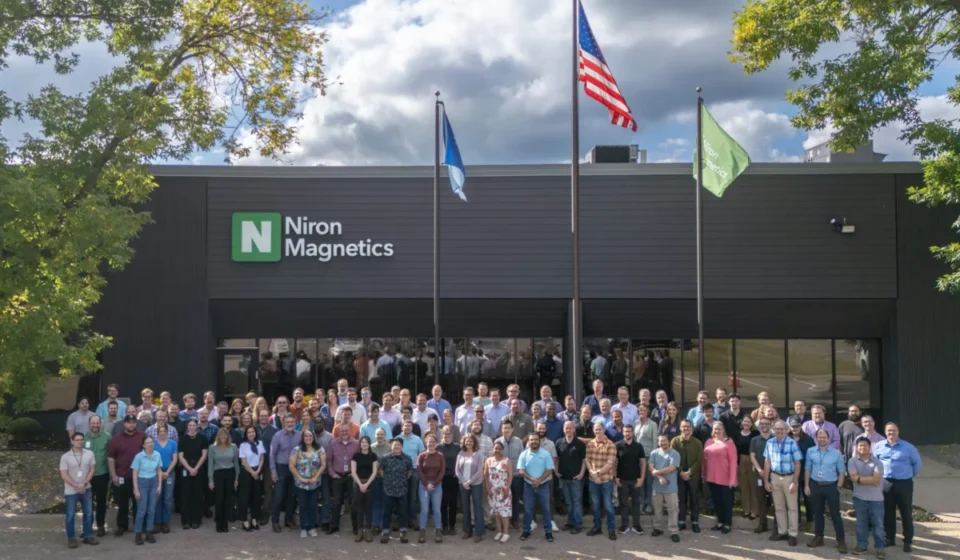

While the contentious debate over copper-nickel mining near the Boundary Waters Canoe Area (BWCA) dominates national headlines, a quiet, technological revolution is taking shape in Minnesota that could fundamentally alter the state’s industrial identity. Minneapolis-based Niron Magnetics is currently evaluating sites for its third—and most ambitious—production facility. The proposed $1.8 billion plant aims to breathe new life into the Minnesota Iron Range, promising to replace hundreds of jobs lost to the decline of traditional taconite mining while simultaneously addressing a critical vulnerability in the U.S. national security and manufacturing apparatus.
At the heart of this initiative is a proprietary, "secret-sauce" technology that creates high-performance permanent magnets using nothing more than iron and nitrogen. By bypassing the need for rare-earth elements—a sector currently dominated by China—Niron is positioning Minnesota to become the global epicenter for the next generation of electric motor manufacturing.
The Genesis of a Technological Breakthrough
The Niron story began not in a corporate boardroom, but in the laboratories of the University of Minnesota, where Professor Jian Ping Wang developed the foundational technology. Unlike traditional high-power magnets that rely on 17 distinct "rare-earth" minerals—mined and processed under environmentally taxing conditions—Niron’s Clean Earth Magnet™ utilizes a patented process to convert iron or recycled steel into a magnetic powder. By mixing this with a specialized chemical compound, the company can create magnetic force without the extreme heat or intensive chemical separation typically required in traditional metallurgy.
This innovation is not merely an academic exercise; it is a direct response to the global dominance of Chinese manufacturing. According to the Center for Strategic and International Studies, China currently controls up to 90% of the manufacturing capacity for rare-earth magnets, a strategic bottleneck that has long troubled U.S. policymakers. As electric vehicles, defense systems, and household electronics become increasingly reliant on these components, Niron’s mission is to provide an economical, domestic, and sustainable alternative.
Chronology of Expansion: From Pilot to Powerhouse
Niron’s growth has been rapid and methodical, marking a shift from a research-heavy startup to a serious manufacturing player.
- Foundation: The company established its headquarters and a pilot plant in Northeast Minneapolis, creating a hub for testing and refinement.
- The Sartell Milestone: Last year, Niron broke ground on its first commercial-scale production plant in Sartell, Minnesota. With a $10 million investment from the state, the plant is slated to employ 175 people and produce 1,500 tons of magnets annually.
- The Future Vision: Looking toward 2028 and 2029, the company has announced plans for a massive 1.6 million-square-foot facility. This project represents a $1.8 billion investment and is expected to create over 700 high-skilled manufacturing jobs.
- Global Reach: While Minnesota remains the primary focus for its domestic manufacturing, Niron is already setting its sights on international expansion, with plans to establish production capabilities in Europe and Asia to meet global demand.
Supporting Data: Why the Iron Range?
The Iron Range, which has faced decades of economic headwinds due to the rise of imported steel and more efficient, recycled-steel-reliant domestic mills, is now a primary candidate for the new facility. Economic development officials argue that the region is uniquely positioned to support Niron’s needs.
"The Iron Range offers the essential infrastructure, energy capacity, and a highly skilled, available workforce that we require," notes Ryan Malich, executive director of the Minnesota Department of Iron Range Redevelopment and Resources (IRRR).
The economic metrics are compelling:
- Investment: $1.8 billion in capital expenditure.
- Employment: 700+ direct jobs, with significantly more in indirect service and support roles.
- Scale: Production capacity is expected to reach 10,000 tons of magnets annually—a seven-fold increase over the output of the upcoming Sartell facility.
- Supply Chain: By utilizing Minnesota’s abundant iron ore, the company shortens its supply chain, significantly reducing the carbon footprint associated with transporting raw materials.
Official Responses and Strategic Alliances
The potential move to the Iron Range has garnered rare bipartisan support. Both the administration of Governor Tim Walz and the Minnesota congressional delegation—including Republican U.S. Rep. Pete Stauber—have aligned in their enthusiasm for the project.
"Minnesota has an opportunity to address this crisis and offer a transformative solution to U.S. commercial and defense manufacturers," Niron stated in a recent release. This sentiment is echoed by the Department of Employment and Economic Development (DEED). Deputy Commissioner Kevin McKinnon described the project as a "fabulous story" of successful academic-to-commercial translation, emphasizing that the state is actively working to make Minnesota the most compelling location for Niron’s next phase.
Niron has also secured a robust list of private-public partners, including the U.S. Department of Energy, GM Ventures, Volvo, Samsung Ventures, Stellantis, and Western Digital. These partnerships underscore the market’s confidence in Niron’s ability to replace traditional rare-earth magnets. As CEO Jonathan Rowntree noted during a congressional hearing, "Manufacturing permanent magnets from iron and nitrogen reduces the need for rare-earth mining, chemical separation facilities, and complex metallurgical processing."
The Competitive Landscape: Niron vs. Twin Metals
A critical aspect of this development is its potential to shift the narrative surrounding resource extraction in Minnesota. The controversial Twin Metals mining proposal—which seeks to extract copper and nickel near the BWCA—has long been the primary focus of environmentalists and legislators.
While Niron and Twin Metals occupy different market segments, the rise of Niron provides a stark contrast in development models. Niron utilizes existing, mature industrial zones and emphasizes sustainable, high-tech manufacturing, whereas the Twin Metals project remains locked in a high-stakes permitting and legal battle over concerns of watershed pollution.
For many stakeholders on the Iron Range, Niron represents a more palatable future: one that leans into innovation and environmental responsibility rather than the traditional, often destructive, models of extraction. By supporting the Niron expansion, the state can foster a new era of industrial growth that is compatible with the preservation of its natural resources.
Economic Implications and Future Outlook
Niron’s trajectory is currently fueled by approximately $300 million in private-public capital, but the company’s ambitions require significant scaling. With designs on reaching $1 billion in annual revenue, industry analysts suggest that a public offering of stock within the next two years is a strong possibility.
The implications for the American economy are profound. If Niron succeeds in scaling its production to the 10,000-ton level, the U.S. will have taken a massive step toward "supply chain resilience." By making the permanent magnet industry less dependent on geopolitical instability in China, Niron is effectively insulating American companies—from refrigerator manufacturers to defense contractors—from future export controls and trade wars.
As Niron moves forward with its site selection process, supported by the global commercial real estate adviser Savills, the company remains tight-lipped about the exact location of its future facility. However, the synergy between the Iron Range’s industrial heritage and Niron’s high-tech future is undeniable.
"We want to be on the frontside of technological development," says Malich. "All the elements seem to line up well for this potential development."
As the world pivots toward electrification, Minnesota is positioning itself not just as a source of raw materials, but as a hub of sophisticated, essential technology. Should the $1.8 billion plant find its home on the Iron Range, it will mark a definitive transition from the heavy-industry era of the 20th century to the high-tech, sustainable manufacturing era of the 21st.