
























































Beneath the Surface: The Persistent Crisis of Nitrate Contamination in Minnesota’s Private Wells

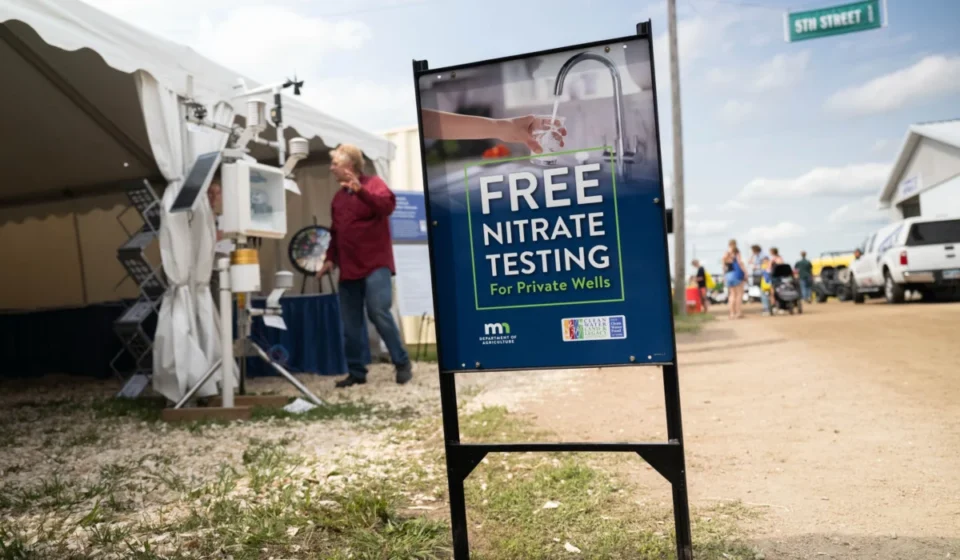
At the sprawling grounds of Farmfest in Morgan, Minnesota, the air is thick with the scent of deep-fried corn dogs, the hum of high-tech tractors, and the familiar, boisterous cadence of political campaigning. But tucked away from the main thoroughfare of agricultural machinery and stump speeches, a quieter, more urgent scene unfolds at a small, unassuming booth.
Here, Denton Bruening, an official with the Minnesota Department of Agriculture, operates a machine that looks like a standard office briefcase. It is a spectrophotometer, a device that uses ultraviolet light to peer into the chemical makeup of water. A visitor approaches, handing over a Ziploc bag filled with water drawn from their home well. Bruening transfers a sample into a clear tube, watches as the yellow-tinted liquid is scanned, and waits thirty seconds.
The screen flashes: 7.3.
For the homeowner, it is just a number. For public health officials, it is a warning. In the context of drinking water, 7.3 milligrams per liter (mg/L) is a significant concentration of nitrates. While the federal government sets the maximum safe limit at 10 mg/L, the reality of groundwater contamination is far more nuanced, and for many Minnesotans, far more dangerous than that single threshold suggests.
The Invisible Threat: Understanding Nitrate Contamination
Nitrate contamination is not a new phenomenon in the North Star State; it has been a persistent, mounting challenge for decades. Primarily driven by agricultural runoff—specifically nitrogen-based fertilizers and livestock manure—these chemicals infiltrate the soil, leaching into the groundwater that feeds the thousands of private wells scattered across the rural landscape.
The geography of Minnesota exacerbates this vulnerability. In regions such as the southwest, southeast, and central portions of the state, the soil is often porous, allowing surface water to travel rapidly into underground aquifers. For the approximately 93,000 Minnesotans who rely on private wells, this presents a significant challenge. Unlike public water systems, which are strictly regulated by the Safe Drinking Water Act and required to meet federal purity standards, private wells are largely left to the discretion of the owner.
When a well is contaminated, there is no municipal authority mandated to fix it. The burden of testing, monitoring, and remediation falls entirely on the individual, leaving many families to fend for themselves in an environment where the water coming from their kitchen tap may carry long-term health risks.
A Chronology of Concern: From Detection to Policy Stagnation
The Minnesota Department of Agriculture recognized the gravity of the situation as early as the 1990s, when they first began offering free nitrate testing clinics for rural residents. These clinics were designed to provide a "low-barrier" entry point for well owners to understand the quality of their water.
Over the decades, the data collected from these clinics has provided a clear, if troubling, picture of the state’s groundwater health. While the majority of wells test within safe limits, roughly 6% of the samples processed at these mobile clinics consistently exceed the 10 mg/L federal limit.
Despite this consistent data, efforts to implement more aggressive statewide regulations have faced intense headwinds. Environmental advocates have long argued that the 10 mg/L standard is outdated, pointing to research suggesting that even levels as low as 3.5 mg/L are linked to adverse health outcomes, including increased cancer rates and pregnancy complications. However, lowering this threshold would trigger a massive regulatory overhaul, one that many industry experts believe is politically untenable.
"That would just be a huge heavy lift," says Tony Runkle, lead geologist at the University of Minnesota’s Geological Survey. "There’d be a ton of opposition from the ag sector."
The Economic Engine vs. Public Health
The political landscape of Minnesota is inextricably linked to its status as an agricultural powerhouse. With $9.3 billion in annual exports, the state is the seventh-largest farming economy in the nation. This economic weight translates into significant political influence, a reality that is on full display at events like Farmfest, where candidates from both sides of the aisle prioritize agriculture-friendly platforms.

This creates a tension between the need for environmental protection and the desire to maintain the profitability of the state’s agricultural backbone. Bruening, who himself comes from a farming background, is cautious about pinning the entirety of the blame on producers. He notes that nitrates are ubiquitous, found in everything from nitrogen-rich fertilizers to common food items like spinach.
"If we get a farmer that comes into a water clinic, we talk about some of those [mitigation] tactics because a lot of times that well might be affected by his own practices," Bruening says.
The agency does promote best practices, such as the use of cover crops—plants grown during the off-season that trap nitrogen in the soil and prevent it from leaching into groundwater. Yet, the adoption of these practices is entirely voluntary. Without state mandates, the cost of implementing these strategies remains a barrier for many farmers, limiting the impact of current conservation efforts to only those with the financial means or the willingness to invest in long-term soil health.
The Cost of Clean Water: A Private Burden
For the well owner whose water tests at 7.3 mg/L, the immediate question is not about agricultural policy, but about personal survival. How does one clean the water coming into their home?
The most common, and effective, solution is a reverse osmosis (RO) system. However, the price of these systems ranges from a few hundred dollars to upwards of $5,000, depending on the complexity of the installation and the quality of the unit. For a rural family, this is a significant, often unexpected, household expense.
Some counties in southeastern Minnesota have recognized the inequity of this financial burden and have established programs to provide free reverse osmosis systems to households with high nitrate levels. However, these programs are rare. Most counties lack the tax base or the specific grant funding to replicate them. For others, the only remaining option is to drill a new, deeper well—a project that can cost tens of thousands of dollars, with no guarantee that the new water source will remain untainted by the regional plume of nitrates.
As a result, many families have simply opted for the most convenient, albeit expensive, alternative: bottled water. "Some people just drink bottled water," Bruening notes. "That’s kind of become a preference for a lot of people."
The Path Forward: Education and Advocacy
The Minnesota Department of Agriculture continues to urge well owners to test their water annually. Beyond the Farmfest booths, these tests are available through most Soil and Water Conservation Districts. The state even allows eligible community partners to borrow their equipment, hoping that increased accessibility will lead to better awareness.
"We want to make sure that people feel comfortable coming in and having their sample tested, and then we also want to make sure that they’re understanding why they may have high nitrates," Bruening explains.
Yet, as the state moves forward, the fundamental question remains: can Minnesota reconcile its status as an agricultural giant with the necessity of providing safe, clean water to all its citizens, particularly those living in the rural heartland?
The data suggests that the status quo—relying on individual testing and voluntary mitigation—is failing to address the root causes of the contamination. While clinics provide a vital service, they function as a bandage on a much larger, structural wound. Until there is a broader political consensus that bridges the divide between agricultural productivity and environmental health, families like the one at the Farmfest booth will continue to look at their test results with uncertainty, waiting for a solution that extends beyond the bottom of their water glass.
Claire Carlson is a Report for America corps member, covering drinking water for MinnPost and the Mississippi River Basin Ag & Water Desk. Report for America places talented journalists in local newsrooms to report on under-covered issues and regions.