





















































As Jamf marks its transition into a private entity, the company is wasting no time in signaling a bold new direction for the enterprise management of Apple hardware. At its annual Jamf Nation User Conference (JNUC) 2026 in Kansas City, the company unveiled a sweeping, platform-scale overhaul centered on a singular theme: artificial intelligence is no longer an optional add-on—it is the new operating layer for IT infrastructure.
For IT departments struggling to manage increasingly complex device fleets, Jamf’s latest announcements offer a glimpse into a future where "management" is replaced by "autonomous orchestration." Under the leadership of CEO Beth Tschida, the company is pivoting toward a paradigm where routine administrative burdens are offloaded to intelligent systems, allowing human IT professionals to pivot from ticket-closers to strategic architects.
The Core Philosophy: AI as an IT Imperative
The central narrative of this year’s JNUC is that AI is an inevitability that organizations can no longer afford to ignore. During her keynote address, Beth Tschida framed the integration of AI not merely as a technological upgrade, but as a survival mechanism for modern IT teams.
"IT teams are managing more endpoints and more complexity than ever," Tschida stated. "We want Jamf to handle more of that routine work automatically… because AI runs better on Apple, and Apple runs better on Jamf."
Tschida’s perspective, consistent with the company’s trajectory over the past year, is that the "Shadow AI" phenomenon—where employees use unauthorized AI tools—is a byproduct of IT departments failing to provide secure, governed alternatives. "AI is happening whether organizations know it or not," she noted. "That’s the problem. You can try to block it, but that’s very hard to do well. It’s far better to build visibility and governance around it."
Chronology of the Transformation
To understand where Jamf is heading, it is necessary to look at the recent evolution of their platform:
- Pre-2025: Jamf establishes its core competency in MDM (Mobile Device Management) for Apple, focusing on security and deployment efficiency.
- 2025 (JNUC): The company signals its intent to integrate AI into the management console, focusing on basic automation and predictive maintenance.
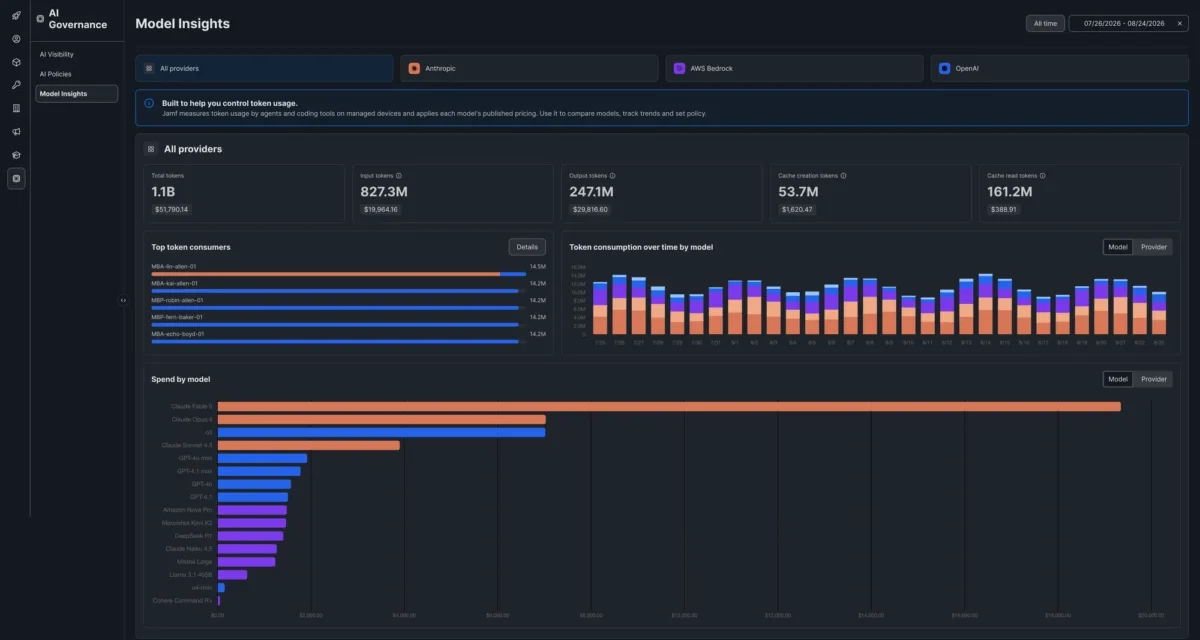
- Early 2026: Jamf launches its AI Governance suite, providing the foundational tools for tracking AI usage across corporate networks.
- Late 2026 (JNUC 2026): The current event marks the maturity of the "Autonomous Enterprise" vision, introducing self-service diagnostics, local inference engine support, and "Infrastructure as Code" capabilities.
- Looking Ahead (2027): Jamf plans to celebrate its 25th anniversary at JNUC 2027 in Anaheim, with a focus on fully realized automated ecosystem management.
Empowering the End-User: Self-Service Diagnostics
One of the most immediate impacts for the average enterprise employee is the introduction of an AI-powered self-service diagnostics system. Historically, a simple issue—such as poor video call quality—would require a support ticket, a wait time, and a back-and-forth dialogue with an IT technician.
Jamf’s new system changes this workflow entirely. Employees can now query their devices in natural language, asking, "Why are my video calls lagging?" The AI, having real-time visibility into the device’s network health, hardware utilization, and background processes, can provide an immediate diagnostic and offer a one-click fix. This shifts the burden of troubleshooting from the IT helpdesk to the user, mediated by an intelligent assistant that understands the specific nuances of Apple hardware.
The War on Shadow AI: Governance and Control
While productivity is a primary goal, security remains paramount. Jamf’s expanded AI Governance suite is a direct response to the risks posed by employees inputting sensitive corporate data into unvetted, personal AI models.
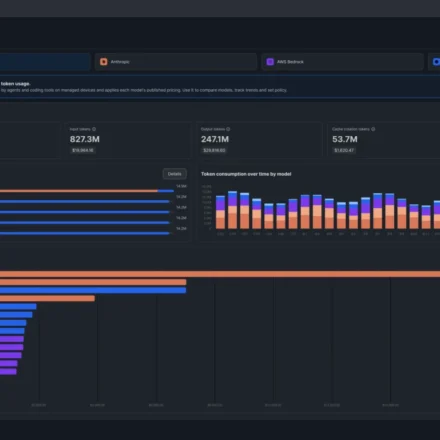
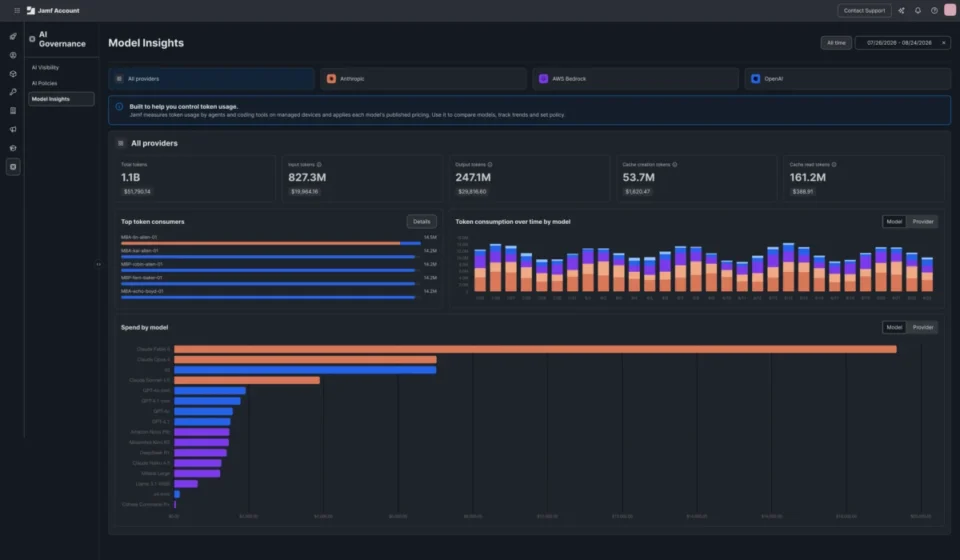
The newly introduced centralized AI control panel provides IT administrators with unprecedented visibility. It tracks which AI systems are active across the fleet and allows for the enforcement of strict usage policies. Perhaps most impressively, Jamf has extended this capability into the browser level—specifically Safari, Chrome, and Edge. Administrators can now block the upload of corporate documents to personal AI accounts, ensuring that proprietary data remains contained within the organizational perimeter.
Furthermore, Jamf is providing the infrastructure for companies to deploy "local inference engines." For security-conscious firms, this is a game-changer. By running AI workloads directly on Apple silicon, organizations ensure that prompts, data, and model interactions never leave the device, effectively neutralizing the data privacy concerns associated with cloud-based AI services.
IT as a Service: Infrastructure as Code (IaC)
Perhaps the most significant technical evolution announced at JNUC 2026 is the adoption of "Infrastructure as Code" (IaC) for Apple management. By introducing a new Platform API Gateway and a Terraform provider, Jamf is moving toward a "GitOps" model for IT.
In this model, managing a fleet of thousands of devices becomes akin to managing a software codebase. Changes are treated as peer-reviewed "pull requests." If a change to a security policy or a deployment script causes an unexpected issue, a rollback is as simple as a revert command. This professionalizes the role of the Apple admin, aligning them with the DevOps workflows that have become standard in modern cloud engineering.
Supporting Data and Technical Innovations
The event also highlighted several operational enhancements designed to streamline large-scale deployments:
- Jamf Tap: Utilizing NFC/RFID technology, this system allows frontline workers to simply tap an ID badge against an Apple device to authenticate and provision it instantly. This is particularly valuable in high-turnover environments like warehouses and retail.
- Ring Deployments: Moving away from "all-or-nothing" updates, this system allows IT to test software updates with a pilot group (a "ring") before pushing them to the wider fleet, significantly reducing the risk of widespread outages.
- Curated App Catalog: An automated service that maintains an updated library of essential Mac applications, ensuring that all devices are running the latest versions without manual intervention from IT staff.
Implications for the Industry
The implications of these changes are profound. We are witnessing the end of the "manual administrator" era. As AI takes over the routine tasks—patching, minor troubleshooting, and basic compliance checks—the role of the IT professional will evolve into that of an "Environment Orchestrator."
For organizations, this means that the total cost of ownership (TCO) for Apple fleets may decrease even as the complexity of the environment increases. By leveraging AI to manage AI, Jamf is enabling companies to scale their operations without scaling their headcount proportionally.
However, this transition also places a higher premium on strategic oversight. When the system handles the "how" of IT management, the human lead must focus on the "why." They must decide which AI models are appropriate for their industry, how to balance employee privacy with corporate security, and how to define the policies that the AI will autonomously enforce.
Conclusion: Looking Toward 2027
As the conference concluded, the focus shifted toward the future. The announcement that JNUC 2027 will take place in Anaheim to commemorate the company’s 25th anniversary serves as a reminder that Jamf has successfully navigated multiple computing eras—from the early days of Mac management to the current AI-driven enterprise landscape.
By embracing the complexity of the modern workplace and providing the tools to tame it, Jamf is positioning itself as the central nervous system of the Apple-powered enterprise. As AI continues to evolve, the distinction between "managing a device" and "managing an ecosystem" will continue to blur, and Jamf appears determined to lead that transformation.