





















































This story was originally reported by Kate Sosin of The 19th. Meet Kate and read more of their reporting on gender, politics and policy.
For Juniper Simonis, the memory of a warm summer night in 2012 remains as vivid as a cinematic frame. Cycling through Ithaca, New York, with the folk melodies of Mariee Siou pulsing through her headphones, Simonis felt a profound sense of liberation. That day, she had received an email that would permanently alter her trajectory: the Ithaca League of Women Rollers had voted to allow her to join their ranks.
"As somebody who played sports and was queer, but those were two very separate parts of my life, the promise and the opportunity to integrate those was very hopeful for me," Simonis reflects. As a transgender woman, being welcomed into an all-women’s athletic space was more than just a roster spot; it was a validation of her identity. "Getting a message that was like, ‘You are welcome,’ was, obviously, very uplifting."
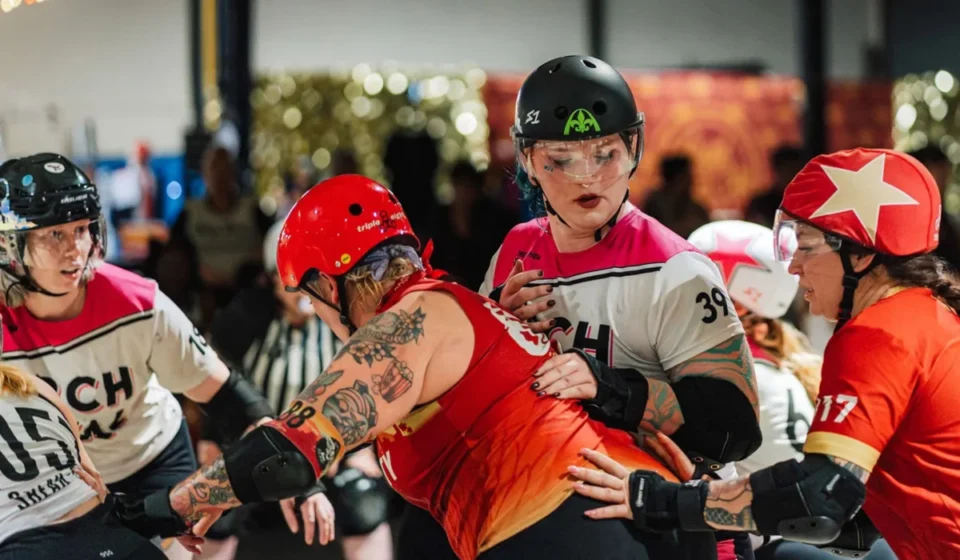
Years before the participation of transgender athletes became a flashpoint in national politics and a subject of intense legislative scrutiny, the high-contact, punk-rock-infused world of roller derby was already navigating the complexities of inclusion. While the sport’s history is not without its imperfections—transgender athletes and skaters of color continue to face discrimination—the roller derby community has consistently chosen a path of radical inclusion, often prioritizing human dignity over traditional gatekeeping.
The History of the Track: From Endurance to Counter-Culture
Roller derby’s origins are as chaotic and defiant as the sport itself. Tracing back to the 1930s, the sport began as an endurance race promoted by Leo Seltzer. According to the Smithsonian, even in its infancy, the sport was co-ed, though the gender pay gap was starkly evident from the start.
As the sport evolved into the 1960s and 80s, it transformed into a televised spectacle characterized by its high-contact nature. However, it was not until the early 2000s that the modern, DIY iteration of the sport emerged. A group of women in Austin, Texas, sought to provide structure to the burgeoning scene. This movement birthed a subculture that was "post-riot grrrl"—a direct rebuttal to the hyper-feminine pop culture of the era.
"There was definitely something really cool about a tough punk rock chick of that era," says Rachel "Rotten" Johnston, a derby veteran and Director of the Angel City League. "It was as much about the bar fights and the black eyes as it was about the skating. It was, ‘I get to wear this badass outfit that’s also kind of sexy.’ It was a direct rebuttal to the pop culture that was happening."
This counter-culture ethos fostered an environment where gender norms were treated as suggestions rather than mandates. In a landscape where most sports were designed by men and later adapted for women, derby was built by women, for women. This autonomy allowed for a culture that was explicitly queer-friendly, celebrating strength and diversity in a way that traditional athletic institutions rarely dared.
Chronology of Inclusion: From Vague Policies to Explicit Protections
As the sport exploded in popularity, transitioning from a grassroots movement to a global network under the Women’s Flat Track Derby Association (WFTDA), the question of how to define "women’s spaces" became inevitable.
In the early 2000s, the WFTDA lacked a formal, nuanced understanding of gender identity. Policies largely mirrored the Olympic standards of the time, requiring transgender women to undergo two years of hormone replacement therapy to be eligible for play.
However, as participants like Penelope "Fifi Nomenon" Nederlander discovered, the actual experience of joining was often more inclusive than the official policies suggested. When Nederlander tried out for the LA Derby Dolls in 2010, she braced herself for a difficult conversation. Instead, she found a community that prioritized her presence over her medical history. "It was the first group of friends who I met who only knew me as Penny, and that was huge," she recalls.

By 2015, the informal "case-by-case" tolerance gave way to a formal, industry-leading policy. The WFTDA updated its guidelines to welcome anyone of a marginalized gender, regardless of transition status or appearance. This policy did more than protect trans women; it provided a framework for nonbinary athletes and those assigned female at birth (AFAB) who were also undergoing medical transitions.
Drew "OMG WTF" Flowers, a nonbinary skater who has been involved in the sport since 2008, noted that this shift was initially terrifying. "I identified so hard with this being a female sport, a woman’s-only sport," Flowers explains. "I really kind of didn’t give the benefit of the doubt to my teammates, to my community, that they were going to be supportive of me." Yet, the community stood by them, proving that the culture of the sport was stronger than the anxiety of change.
Supporting Data and the Reality of Competition
The success of these policies is best measured by the skaters themselves. Nicole "Bonnie Thunders" Williams, frequently cited as the "LeBron James" of roller derby, has watched the sport mature over two decades. She argues that the fear surrounding the inclusion of trans women is often based on theoretical anxieties rather than the lived reality of the track.
"When I see, ‘protect women’s spaces,’ that feels so repressive," Williams says. "I don’t want to discount that women’s spaces are important. They are, but I don’t really identify with that in the way that I used to."
The data—in this case, the collective experience of hundreds of leagues across six continents—suggests that the inclusion of trans athletes has not compromised the competitive integrity of the sport. While critics often raise concerns regarding safety and fairness, derby participants argue that these concerns ignore the inherent nature of a full-contact sport.
"I think that people who are concerned about people getting hurt are missing the fact that we’re playing a full contact sport," says Johnston. "You’re going to get hurt no matter what. You know, life isn’t fair, and sports most certainly are not fair."
Internal Challenges: The Work Still Needed
Despite the progressive policy landscape, the sport is not a utopia. Donita "Blaxyl Rose" Green points out that the intersection of race and gender identity creates unique hurdles. "I’ve seen firsthand how much worse some of these microaggressions and problems happen when you are a dark-skinned Black skater," Green notes. "You add knowledge of trans identity, and it tends to be even worse."
Simonis, despite her early positive experiences, has faced physical assault for being transgender within the sport. These incidents serve as a stark reminder that policy, while necessary, is not a panacea for the broader societal prejudices that permeate even the most progressive communities.
Implications for the Future of Sports
Roller derby’s refusal to sacrifice its inclusive values to appease international governing bodies—such as its decision to forgo Olympic inclusion rather than adopt restrictive gender mandates—sets a precedent for other sports.
Nederlander advocates for a shift toward "honest" dialogue. She suggests that sports can acknowledge biological differences without resorting to exclusionary tactics. "I want to arrive at the same conclusion, but with honesty about it," she says. "In roller derby, there doesn’t seem to be an important difference. We really don’t have any complaints about trans skaters. So that’s awesome."
By prioritizing the participation of marginalized athletes, roller derby has maintained its soul as a "freaky feminist" counter-culture. As the rest of the world grapples with the inclusion of transgender athletes, the track remains a testament to the idea that sport can be a site of radical empathy. Whether in a local rink or on an international stage, the lesson of derby is clear: when you strip away the desire to categorize and control, what remains is the simple, powerful act of playing the game together.