




















































Suspended in West Hollywood: How Netflix Built a Living Billboard on Sunset Boulevard to Promote ‘The Last House’

WEST HOLLYWOOD, CA — For decades, the Sunset Strip has served as a canvas for Hollywood’s most ambitious outdoor advertisements. From hand-painted rock-and-roll billboards in the 1970s to massive, high-definition digital displays today, the historic thoroughfare is no stranger to visual spectacle. However, a recent installation near Selma Avenue has forced motorists and pedestrians alike to stop, stare, and question the boundary between advertisement and performance art.
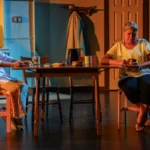
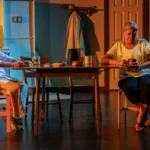
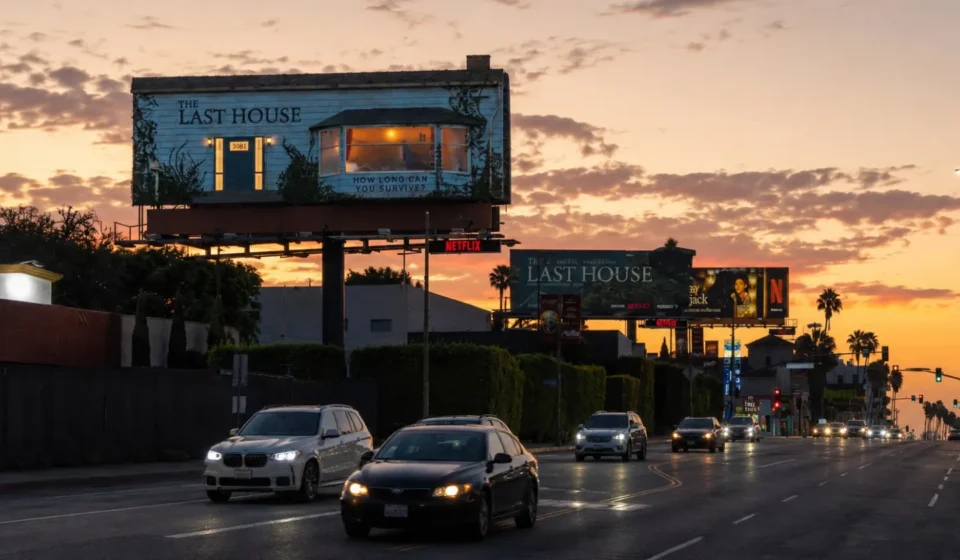
Suspended roughly 30 feet above the bustling traffic of Sunset Boulevard, a fully furnished, glass-fronted room has been integrated directly into a billboard. Inside, a lone male performer has taken up temporary residence, spending his days and nights reading, stretching, looking through binoculars, and sleeping in full view of the public.
The highly unusual installation is a guerrilla marketing campaign orchestrated by Netflix to promote its sci-fi thriller The Last House, which premiered on the streaming platform on August 7. Starring Greta Lee and Wagner Moura, the film explores the psychological horror of sudden, inexplicable confinement. By placing a real human being inside a transparent, elevated box, Netflix has translated the film’s claustrophobic premise into a highly visible, real-world public spectacle.
Main Facts: The Elevated Domesticity of a High-Concept Stunt
At first glance, the installation looks like a surrealist architectural anomaly. Rather than relying on a standard two-dimensional print or a digital screen, Netflix’s marketing team constructed a functional, three-dimensional micro-apartment cantilevered over the sidewalk.
The Anatomy of the Billboard Room
The suspended living space is meticulously designed to resemble a cozy, albeit highly exposed, suburban living room. The structural setup includes:
- Furnishings: A comfortable armchair, a side table, indoor houseplants, bookshelves stocked with literature, and framed art.
- Domestic Details: Functional curtains that the performer can draw, household items, and a pair of binoculars that the occupant uses to spy on the streets below.
- Communication Tools: Because the room is soundproofed and elevated far above street-level noise, the performer relies on a handheld dry-erase whiteboard to communicate with onlookers, writing custom messages to engage the crowd.
The performer inside the billboard behaves as though he is in his own private residence. Throughout the day, he can be seen eating meals, pacing the small floor plan, listening to music, and stretching. As night falls, the interior lights of the billboard illuminate the space, revealing the performer dressed in pajamas and a robe, preparing for sleep in a makeshift bed.
The contrast between the intimate, slow-paced domestic life of the performer and the chaotic, fast-moving traffic of Sunset Boulevard creates a striking juxtaposition that has turned the block into a temporary pedestrian bottleneck.
Chronology: 72 Hours in the Public Eye
The execution of the campaign was designed as a rapid, high-impact weekend activation, maximizing foot traffic and social media amplification over a short window.
+-----------------------------------------------------------------------------+
|                                CHRONOLOGY                                   |
+-----------------------------------------------------------------------------+
|                                                                             |
|  THURSDAY MORNING: Installation completed; performer moves in.              |
|  [========================================================>]                |
|                                                                             |
|  FRIDAY AFTERNOON: CBS LA covers the stunt; whiteboard interaction.         |
|  [========================================================>]                |
|                                                                             |
|  SATURDAY EVENING: Citizen App alert goes viral; crowd sizes peak.          |
|  [========================================================>]                |
|                                                                             |
|  SUNDAY NIGHT: Final evening of activation; performer departs.              |
|  [========================================================>]                |
|                                                                             |
+-----------------------------------------------------------------------------+
Thursday: The Activation Begins
In the early hours of Thursday, logistics crews finalized the structural integrity of the billboard and hoisted the performer into the space. By commute hour, West Hollywood residents were greeted by the sight of a man casually drinking coffee 30 feet in the air. Word-of-mouth began to spread online as commuters posted initial photos on Reddit and X (formerly Twitter).
Friday: Media Mobilization and Public Recognition
By Friday afternoon, local news outlets had caught wind of the spectacle. A news crew from CBS Los Angeles arrived on-site to film the performer. Noticing the television cameras below, the actor wrote a personalized greeting on his whiteboard, holding it up to the glass to acknowledge the broadcast crew. This interactive moment quickly transitioned the stunt from a local curiosity to a televised story, drawing broader attention across the Los Angeles basin.
Saturday: The "Citizen App" Effect
On Saturday, the installation reached peak viral status due to an unexpected digital catalyst. A user on Citizen—a mobile application that sends real-time safety alerts based on 911 dispatches—reported a "man living inside a billboard." The app pushed a notification to thousands of users in the West Hollywood and Hollywood area. Believing it might be a bizarre emergency or a high-altitude protest, curious locals drove to the intersection of Sunset and Selma to investigate, only to discover the highly coordinated marketing campaign.
Sunday: The Final Descent
The performer maintained his routine through Sunday night, marking the end of the scheduled promotional window. After 72 hours of continuous public exposure, the actor departed the structure, and crews began the process of deconstructing the interior elements of the billboard.
Supporting Data: The Narrative Connection to ‘The Last House’
To understand why Netflix opted for such an elaborate and logistically challenging campaign, one must look at the narrative core of the product it is promoting.
The Film’s Premise
The Last House stars Greta Lee (Past Lives) and Wagner Moura (Narcos) as a couple who, along with their family, find themselves suddenly and inexplicably trapped inside their suburban home. An invisible, impenetrable force has sealed them in, cutting off all physical contact with the outside world. The film focuses heavily on the psychological deterioration that occurs when the home—typically a sanctuary—becomes an inescapable prison, while the rest of society continues to function normally just beyond their windows.
Translating Narrative Themes to Out-of-Home (OOH) Advertising
The billboard stunt is a literal, physical manifestation of this plot. By placing a performer in a glass box, Netflix replicates the movie’s central tension:
- The Barrier: Like the characters in the movie, the performer is separated from the public by an invisible yet absolute physical barrier (the glass and the height).
- The Observation: The performer watches the free world through binoculars, mirroring how the family in the film watches the outside world continue without them.
- The Disconnect: While hundreds of cars zoom past on Sunset Boulevard, the occupant of the billboard remains entirely isolated, illustrating the profound loneliness of confinement amidst a crowd.
Netflix’s History of Unconventional Marketing
This is not the first time Netflix has leveraged physical, unsettling installations in West Hollywood to generate buzz. In 2018, to promote the cyberpunk series Altered Carbon, the company installed a highly realistic, lifelike mannequin wrapped in vacuum-sealed plastic inside a bus shelter on Santa Monica Boulevard. The mannequin appeared to "breathe" via an internal pneumatic system, mimicking a human clone in stasis.
While that campaign drew complaints from some commuters who found the lifelike figure disturbing, it succeeded in generating massive press coverage—a playbook that Netflix has refined with the Last House installation by replacing the synthetic mannequin with a living, breathing actor.
Official Responses and Public Reception
The reaction to the living billboard has highlighted the evolving relationship between city residents, digital surveillance tools, and corporate advertising.
Local Resident and Community Reaction
The intersection of Sunset and Selma became an impromptu gathering spot over the weekend. Speaking to local journalists, area resident Marcus Vance explained how he ended up at the site:
"I was sitting at home when my phone buzzed with a Citizen app notification saying there was a person trapped or living in a billboard nearby. Honestly, in LA, you never know what’s real or what’s a crisis, so I drove over. When I got here and realized it was a movie promotion, I wasn’t even mad. It’s actually brilliant. In a city where we are bombarded by giant flat advertisements every second, seeing a guy up there in his pajamas drinking tea actually makes you stop and think."
Other onlookers took to TikTok and Instagram, filming the performer as he went about his evening routine. The meta-nature of the stunt—watching a man who is watching you through binoculars—proved highly shareable, creating a self-sustaining viral feedback loop.
Industry Analysis: Breaking Through "Banner Blindness"
Marketing executives have praised the campaign for its ability to cut through modern consumer apathy. With the rise of ad-blockers and the saturation of digital screens, "banner blindness"—the tendency of consumers to unconsciously ignore banner ads and traditional billboards—has become a major hurdle for entertainment companies.
According to outdoor advertising analysts, the success of the Last House billboard lies in its kinetic and human element. A static image of Greta Lee and Wagner Moura looking scared would likely blend into the hundreds of other promotional boards lining the Sunset Strip. A real human being living in a suspended room, however, triggers a natural curiosity response in passersby, forcing them to seek out the context of the display and, ultimately, the title of the movie.
Implications: The Future of Experiential Advertising in Urban Spaces
The Last House campaign raises intriguing questions about the future of Out-of-Home (OOH) advertising, urban zoning, and the gig economy for actors.
The Rise of "Living" Advertisements
As streaming platforms compete fiercely for subscriber attention, the demand for "experiential" marketing is rising. We are likely to see an increase in campaigns that blur the line between public art, street theater, and corporate promotion. However, this trend brings unique challenges:
- Municipal Permitting: Securing permits for a temporary structural installation that houses a human being 30 feet above a major public roadway requires navigating strict safety, structural, and labor regulations.
- Labor and Safety Ethics: The logistics of keeping an actor safe, hydrated, and comfortable while suspended in the air for 72 hours requires careful planning, including climate control, waste management, and emergency egress protocols.
- Urban Distraction: As installations become more interactive and distracting, city planners may face pressure to regulate high-concept billboards to prevent traffic accidents caused by rubbernecking drivers.
Conclusion: A Masterclass in High-Concept Promotion
Ultimately, Netflix’s living billboard successfully turned a routine movie release into a localized cultural event. By transforming a static piece of West Hollywood real estate into a living, breathing stage, the campaign did more than just announce The Last House—it forced the public to experience, if only for a brief moment, the unsettling curiosity of watching someone trapped inside their own home. As the performer packs up his whiteboard and descends back to earth, the stunt leaves behind a blueprint for how modern media companies can still capture the undivided attention of a highly distracted world.