


















































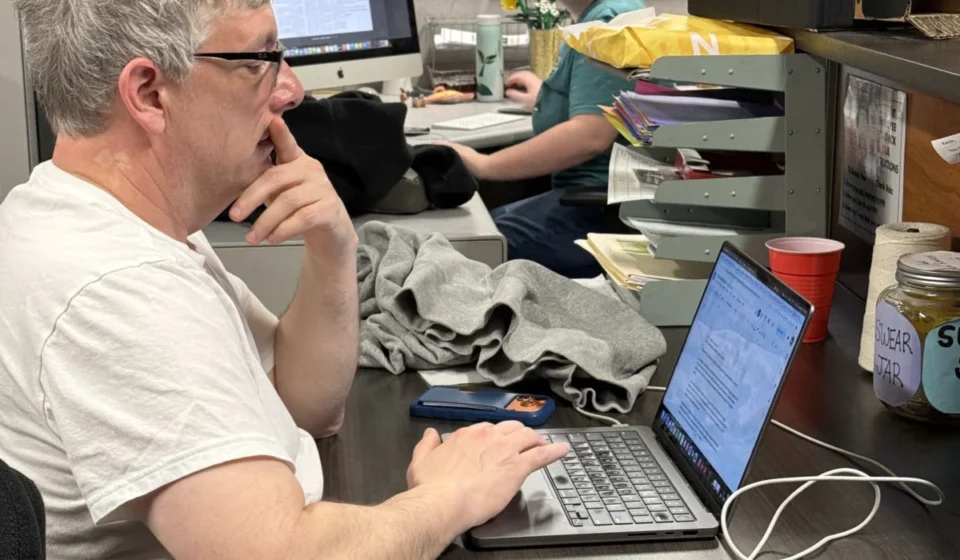

MANKATO, Minn. — An hour before the Monday night print deadline, the atmosphere inside the newsroom of The Reporter is one of focused, rhythmic precision rather than frantic chaos. Anahi Zuniga, editor-in-chief of the student newspaper at Minnesota State University (MSU) Mankato, sits with a calm demeanor, watching the clock tick toward 9 p.m.
For many, the image of a physical newspaper being assembled in the digital age feels like a relic. Yet, for Zuniga and her team, the process is a living, breathing exercise in civic engagement. As copy flows in, photos are color-corrected, and headlines are fine-tuned, the reality of their work is clear: they are the primary record-keepers of their campus community.
The Ritual of the Press
The process at The Reporter follows a time-honored tradition. By the time the final PDF files land in Zuniga’s digital folder, the gears of the local printing press are already warming up. Once the files are transmitted, the physical transformation begins—a journey that ends with stacks of newsprint arriving at campus kiosks by Tuesday morning.
When students across the MSU campus pick up that paper, they will see a lead story regarding a proposed 7% tuition hike. It is a hallmark of student journalism: the ability to translate complex, often dry administrative data into a narrative that impacts the daily lives of thousands of peers.
"It’s a satisfying feeling," Zuniga said, holding a fresh copy. "There is something irreplaceable about seeing the work materialize. It keeps history alive."
This ritual is not just about the final product; it is about the pedagogical journey. For Zuniga, the newsroom has been a crucible for personal growth. "I wasn’t very confident with who I was when I first enrolled," she reflects. "I feel so sure of myself now and who I want to be after graduation. I can use my words as a way to express what I feel and think is necessary."
A Century of Institutional Memory
The Reporter recently marked its 100th anniversary, a milestone that underscores its role as a bedrock of campus life. On March 24, the university hosted a centennial celebration, drawing alumni who have gone on to forge successful careers in the professional media landscape.
Among the guests was Myron Medcalf, a prominent ESPN college basketball writer and Star Tribune columnist, who served as the paper’s first African-American editor-in-chief in 2003. Addressing the current generation of student reporters, Medcalf emphasized that the skills honed in a student newsroom—accuracy, deadline management, and ethical responsibility—are the same ones required at the highest levels of national journalism.
"I learned the ins and outs of actually being on deadline, the accuracy that’s necessary in your reporting, the fact that you are communicating to an audience that’s much bigger than you are," Medcalf said during his keynote. "It’s not about you. It’s about the people who are going to pick up your story and read it."
Medcalf’s perspective provides a sobering reminder of the long-term importance of these publications. "One-hundred years from now, all of us are gone and what we will have left is what we contributed to this world," he noted. "A big part of that, no matter what anyone tells you, will be the written word. It’ll be the archives from the MSU Reporter and all of these publications."
The State of the Industry: Adaptation and Attrition
While The Reporter remains committed to a twice-weekly print cycle, the broader landscape of student journalism in Minnesota is undergoing a significant metamorphosis. The trend reflects the national decline of print media, with many institutions opting for digital-first or magazine-style formats.

The shifts are varied and often dictated by the specific needs and resources of each campus:
- Bemidji State University: The Northern Student has transitioned from a traditional newspaper to a magazine published quarterly.
- Minnesota State Moorhead: The Advocate has moved almost entirely online, supplementing its digital presence with a single print edition per semester.
- University of Minnesota (Twin Cities): The Minnesota Daily, once a robust daily print operation, now operates as a digital-first publication, updating its website in real-time.
- University of Minnesota-Duluth: The Bark maintains a hybrid model, publishing content daily online alongside a monthly print magazine.
Some campuses, however, have struggled to sustain the infrastructure required for a paper. Minneapolis College currently lacks a student newspaper, though discussions regarding its revival are reportedly underway within the student government.
Pedagogical Implications: Journalism Without the Degree
One of the most striking findings in the current landscape is that many of these newspapers exist independently of formal journalism departments. As universities across the country cut mass communication programs to save costs, the student newsroom has become an "accidental laboratory"—a place where students learn the trade by doing it, rather than by studying it in a lecture hall.
Doug Westerman, an advisor to The Winonan at Winona State University, notes that while student papers face constant turnover due to graduation, this "natural attrition" is actually a strength. "You still have to check sources, you still need to do research, whether it’s going on a printed page or going on a post," Westerman said.
Westerman, who often receives calls from employers inquiring about his former student staff, joked about the cyclical nature of the business. When asked if he would hire his best former editors back, he laughed: "Well, they graduated. I don’t think they’d want to come back."
On a more serious note, he emphasizes that the core tenets of the profession—integrity, curiosity, and the ability to synthesize information—remain the most valuable assets a student can take into the workforce, regardless of their major.
The Mechanics of Independence
At The Reporter, the editorial structure is designed to foster autonomy. While there is administrative support from university staff, such as business manager Jane Tastad and advertising design coordinator Dana Clark, the editorial decisions remain firmly in the hands of the students. The editorial team—including Addie Larson, Alexis Darkow, Isaac Rozwadowski, and Logan Schlosser—exercises complete independence in determining what stories matter to the student body.
This independence is crucial, as it allows the paper to hold the university administration accountable—a function of the press that is as vital on a college campus as it is in a state capitol.
Looking Ahead: The Future of the "Lens"
As the clock struck past the deadline, the team at The Reporter did not take long to celebrate. In the fast-paced world of journalism, the conclusion of one cycle is merely the beginning of the next. The editors huddled immediately into Zuniga’s office to map out the next edition, debating potential angles for upcoming campus events and investigative pieces.
For Zuniga, the value of the paper is best summarized not by the circulation numbers, but by the perspective it provides. By talking to classmates, interviewing faculty, and investigating policy, student reporters gain a "completely different lens on how you view the world."
In an era where information is often siloed and algorithmic, the student newspaper serves as a rare, shared space for a campus community to engage with the truth. Whether it is printed on newsprint or scrolling across a smartphone screen, the work continues. As long as there are students willing to ask questions and search for answers, the "ink" of the student press will not dry up—it will simply adapt, just as it has for the last 100 years.