

























































The Quiet Revolution: Why Apple’s On-Premises AI Strategy is Reshaping Enterprise Infrastructure

In the hyper-competitive landscape of artificial intelligence, the narrative has long been dominated by the cloud. For the past two years, enterprise leaders have been told that to achieve AI maturity, they must funnel their data into massive, remote server farms operated by cloud hyperscalers. However, a new report commissioned by Apple and conducted by research powerhouse Omdia, titled Rethinking Critical AI Infrastructure, suggests a paradigm shift. The findings indicate that the future of enterprise AI may not be in the cloud at all, but rather sitting right on the employee’s desk.
This report, based on insights from 1,500 enterprise technology leaders, highlights a growing disillusionment with the current cloud-only status quo. It argues that for security-conscious, cost-sensitive, and efficiency-driven organizations, on-device and on-premises AI solutions are no longer just an alternative—they are the new gold standard.
Main Facts: The Case for Localized Intelligence
The core thesis of the Omdia report is that the current reliance on cloud-based Large Language Models (LLMs) is failing enterprises on three fundamental metrics: cost predictability, data security, and latency.
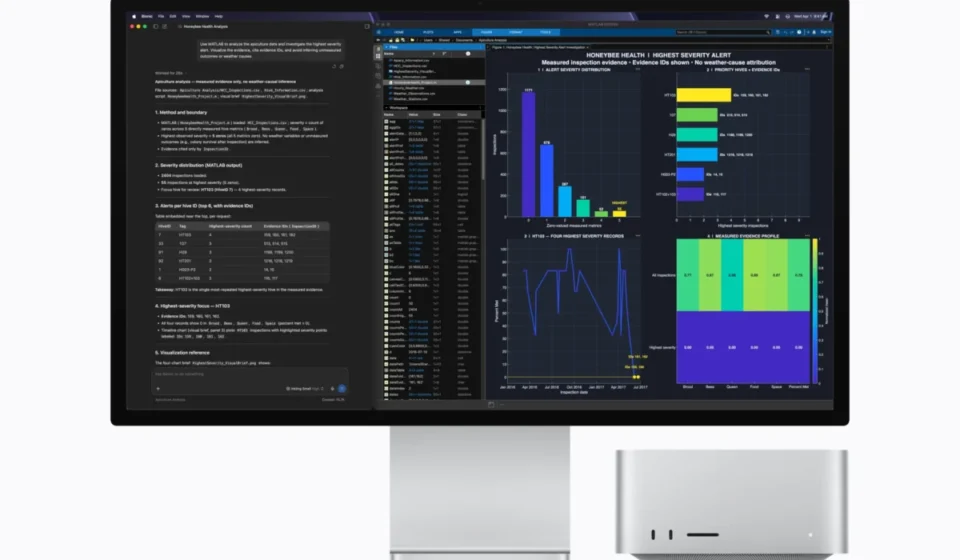
Most enterprises currently pay for AI on a per-token or per-query basis. As AI adoption scales, these costs become exponential and notoriously difficult to forecast. By contrast, an on-premises setup—utilizing hardware like the Mac Studio or MacBook Pro—operates on a "fixed-cost" model. Once the hardware is acquired, the marginal cost of running a query is effectively zero. This allows for unlimited experimentation, a luxury that CFOs are often hesitant to grant in a consumption-based cloud pricing model.
Furthermore, the "on-device" approach addresses the elephant in the room: data privacy. When sensitive proprietary data is processed locally, it never leaves the corporate firewall. This eliminates the risk of data leakage inherent in sending information to third-party cloud providers, satisfying the stringent compliance requirements of the finance, healthcare, and legal sectors.
Chronology of a Shift: From Cloud-First to Hardware-Native
The movement toward local AI didn’t happen overnight. It is the result of a multi-year convergence of hardware advancements and software optimization.
- 2020: The Silicon Transition: Apple’s transition to its own custom silicon (M1) marked the beginning of this shift. By integrating high-bandwidth Unified Memory with high-performance Neural Engines, Apple created a platform where the CPU, GPU, and NPU share a single pool of memory. This removed the bottleneck that previously hindered local AI performance.
- 2023: The LLM Explosion: As the industry grappled with the massive compute requirements of GPT-4 and similar models, researchers began focusing on "quantization"—the process of shrinking models without losing significant intelligence. This made it possible to run sophisticated models on hardware that didn’t require an entire data center.
- 2024: The Omdia Intervention: The publication of Rethinking Critical AI Infrastructure served as a formal validation of what many developers had already discovered: that Apple’s hardware was capable of handling the vast majority of enterprise AI workloads without ever touching the cloud.
- Present Day: We are seeing a "hybrid" model emerge. Enterprises are now using Macs to handle day-to-day, mission-critical AI tasks locally, while reserving the cloud only for the most gargantuan, specialized high-end models that require thousands of GPUs.
Supporting Data: The Scalability of Apple Silicon
The technical capabilities of Apple hardware in the context of AI are frequently underestimated. The Omdia report provides critical data points that challenge the assumption that "only the cloud can do AI."
According to the study, approximately 57% of the AI models currently deployed in enterprise environments contain fewer than 10 billion parameters. This is a crucial threshold. Modern Apple hardware is exceptionally adept at handling models within this range:
- The Mobile Edge: Even an iPad, often viewed as a consumer device, is capable of running 14-billion-parameter models with impressive efficiency.
- The Professional Desktop: A single Mac Studio can manage models up to 480 billion parameters, thanks to its massive Unified Memory capacity.
- The Cluster Advantage: For enterprises requiring even more power, a cluster of four Mac Studios—connected via off-the-shelf networking—can support models reaching 1.6 trillion parameters.
The report notes that organizations building their own AI solutions internally are adopting Mac hardware at nearly double the rate of organizations purchasing pre-packaged commercial solutions. This suggests that the people building the future of AI are "voting with their feet" by choosing hardware that provides them with the highest level of control and performance.
Official Responses and Industry Perspectives
While Apple commissioned the study, the industry response has been largely consistent with the report’s findings. Tech leaders have noted that while cloud providers are excellent at training massive, foundational models, they are often overkill for the "applied AI" that businesses actually need.
"Apple does not replace everything else," notes industry analyst Jonny Evans. "It becomes one of the pillars to build success with AI." The consensus among those interviewed for the report is that the "cloud-only" narrative was a temporary phase dictated by the limitations of early AI infrastructure. As models become "slimmer and more refined," the need to send data to the cloud for every trivial task diminishes.
However, the report also highlights a significant gap: management. While Apple has provided the hardware and the architecture to run powerful AI, it has yet to fully develop the suite of enterprise-grade tools for the management, deployment, and governance of these localized models. Enterprises are currently bridging this gap with third-party software, but there is an industry-wide expectation that Apple will need to provide more robust "AI-ops" tools to truly cement the Mac as a core pillar of the enterprise server room.
Implications: The Future of Enterprise AI Strategy
The implications of this shift are profound, both for businesses and for the broader tech industry.
1. The Death of the "Cloud-Everything" Mandate
For the past decade, the industry has been obsessed with moving everything to the cloud. The realization that local compute is not only viable but superior for many tasks will likely force a re-evaluation of IT budgets. Companies that have over-invested in cloud AI may find themselves with "AI-debt," realizing they are paying premium prices for tasks that could have been handled on their existing hardware fleet.
2. A Threat to Revenue Models
This shift poses a direct challenge to the business models of many AI startups. If businesses can run their own models on-premises, they are less likely to sign up for expensive, recurring subscription services that charge per-request. We may see a market bifurcation: massive "Frontier" models will remain in the cloud, while the "Applied" AI that runs the day-to-day business shifts to local infrastructure.
3. Sustainability and Control
Beyond cost, there is the issue of control. By keeping AI on-premises, companies maintain sovereignty over their model outputs and security. Furthermore, from an ESG (Environmental, Social, and Governance) perspective, processing AI on-device is significantly more energy-efficient than maintaining a constant, high-bandwidth connection to a remote, power-hungry data center.
4. The Need for New Skills
As enterprises move toward this decentralized, on-device approach, the role of the IT administrator will change. We will likely see a rise in "AI Infrastructure Engineers" who specialize in deploying, optimizing, and securing local models across a fleet of hardware. This will require a deeper understanding of hardware architecture, quantization, and local model orchestration.
Conclusion
The Omdia report serves as a wake-up call for the enterprise sector. The "cloud-only" era of AI was never intended to be the permanent state of affairs—it was merely the training wheels of the industry. As organizations move from the experimental phase to the operational phase of AI, the need for security, speed, and cost-efficiency will drive them toward on-device solutions.
Apple, by creating a hardware platform that treats AI as a first-class citizen rather than a cloud-dependent luxury, has positioned itself as the silent powerhouse of this transition. For the enterprise, the message is clear: the future of AI is not just in the cloud—it’s on your desk, in your bag, and ready to be put to work. The companies that realize this now will be the ones that gain the competitive edge in the years to come.