




















































A New Magnetic North: Niron Magnetics and the $1.8 Billion Quest to Transform Minnesota’s Iron Range

While the national spotlight remains fixed on the contentious battle over the Twin Metals mining project near the Boundary Waters Canoe Area (BWCA) watershed, a quieter but potentially more transformative industrial revolution is brewing in the heart of Minnesota. Minneapolis-based Niron Magnetics is currently evaluating the state’s historic Iron Range as the site for its third and largest production facility—a $1.8 billion "mega-plant" that could redefine the region’s economic identity and break the global stranglehold held by China over critical mineral supply chains.
The proposal represents more than just a capital investment; it is a convergence of academic innovation, geopolitical strategy, and environmental pragmatism. By utilizing iron and nitrogen rather than rare-earth minerals, Niron Magnetics aims to provide the "missing link" for the electric vehicle (EV) and defense industries, all while breathing new life into a region that has spent decades grappling with the decline of the taconite industry.
I. Main Facts: The $1.8 Billion Vision
Niron Magnetics’ expansion plan is an ambitious multi-stage roadmap designed to scale a breakthrough technology invented at the University of Minnesota. The company’s primary product, the "Clean Earth Magnet," is the world’s first high-performance permanent magnet that does not require rare-earth elements like neodymium or dysprosium.
The Scale of the Investment
The proposed third facility, slated for construction in 2028 and full operation by 2029, is a project of massive proportions:
- Capital Expenditure: Approximately $1.8 billion.
- Physical Footprint: A 1.6 million-square-foot manufacturing complex.
- Job Creation: Over 700 high-skilled manufacturing and engineering roles.
- Production Capacity: 10,000 tons of magnets annually.
The Iron Range Advantage
The Iron Range is being seriously considered for this facility due to its existing industrial infrastructure. Local officials and Niron executives have hinted that the project could involve "resurrecting" a shuttered taconite plant, utilizing brownfield sites that already possess the heavy power requirements and rail access necessary for large-scale manufacturing. Unlike the Twin Metals project, Niron’s proposed site would be located outside the sensitive BWCA watershed, potentially bypassing the environmental gridlock that has stalled hard-metal mining in the region for years.
II. Chronology: From Lab Bench to Industrial Giant
The journey of Niron Magnetics is a decades-long narrative of scientific persistence and strategic scaling.
2014–2020: The Foundation
The core technology was developed by University of Minnesota Professor Jian Ping Wang. His research focused on iron nitride, a material long known for its magnetic potential but notoriously difficult to stabilize for commercial use. Through patented chemical processes, Wang and his team successfully created a stable, high-performance iron-nitride magnet.
2021–2023: The Pilot Phase
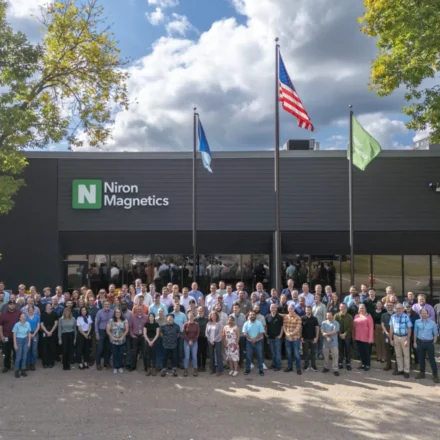
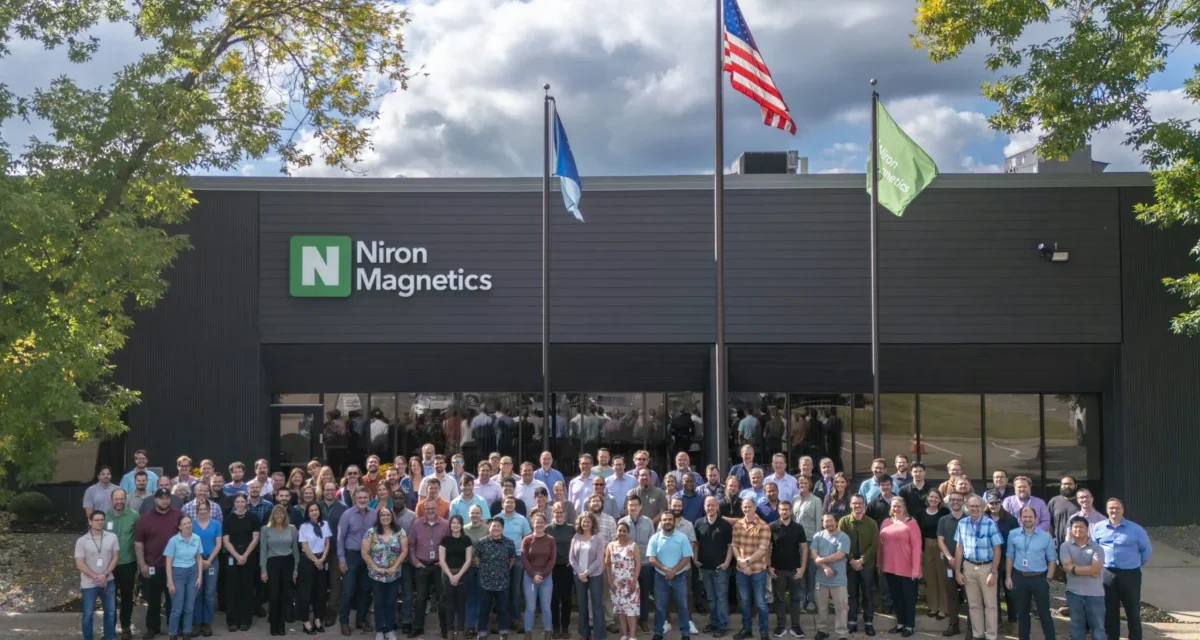
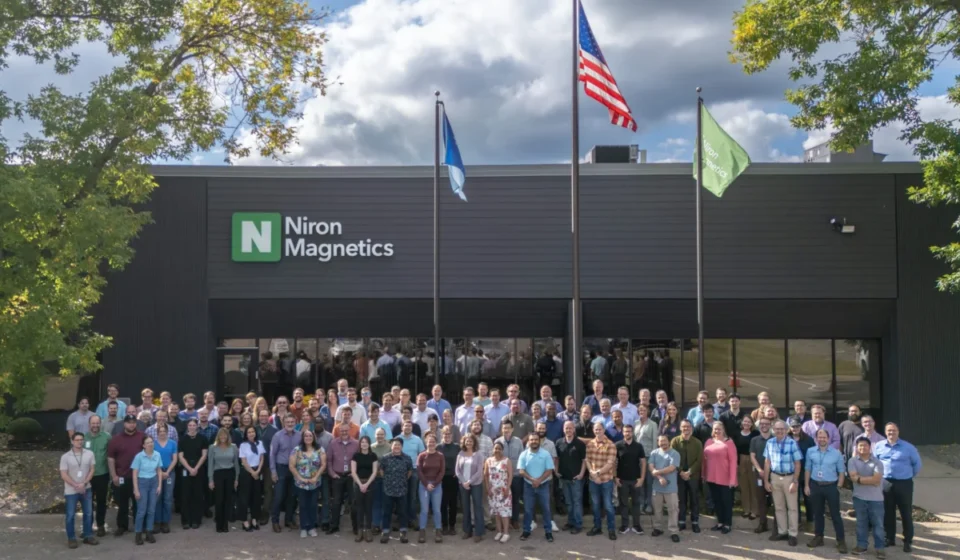
Niron established its headquarters and a pilot plant in Northeast Minneapolis. During this period, the company focused on refining its "secret sauce"—reducing iron or recycled steel to a fine powder and mixing it with nitrogen under specific conditions to increase magnetism without the extreme heat required for traditional rare-earth magnets. In 2023, the company broke ground on its first commercial-scale production plant in Sartell, near St. Cloud. This $10 million facility is expected to employ 175 people and produce 1,500 tons of magnets annually.
2024: Site Selection and Global Expansion
Earlier this year, Niron hired Savills, a global commercial real estate adviser, to lead the site selection process for its "Project 3." While Minnesota’s Iron Range is a top contender, the company is also considering other states that offer aggressive incentive packages and infrastructure alignment. Simultaneously, Niron has signaled plans for future manufacturing hubs in Europe and Asia to serve global automotive partners.
III. Supporting Data: Breaking the Rare-Earth Monopoly
To understand why Niron’s project is receiving such significant attention, one must look at the current state of the global magnet market.
The Geopolitical Bottleneck
According to the Center for Strategic and International Studies, China currently mines 70% of the world’s rare-earth minerals and controls nearly 90% of the manufacturing process for permanent magnets. These magnets are essential components in:
- Electric Vehicles: Powering the motors that drive EVs.
- Wind Turbines: Converting mechanical energy into electricity.
- Defense Systems: Guiding missiles and powering radar arrays.
- Consumer Electronics: Found in everything from smartphones to high-end headphones.
The Environmental and Economic Cost
Rare-earth mining is notoriously "dirty," involving complex chemical separation processes that produce toxic runoff. Furthermore, China’s recent implementation of export controls on rare-earth technologies has created a "supply chain crisis" for Western manufacturers.
Niron’s data suggests that its iron-nitride magnets are not only more environmentally friendly—relying on abundant iron and atmospheric nitrogen—but also more economical. By bypassing the volatile pricing of rare-earth commodities, Niron aims to reach $1 billion in annual revenue, supported by $300 million in private-public capital already raised from heavyweights like GM Ventures, Volvo, Samsung Ventures, and Stellantis.
IV. Official Responses: A Rare Bipartisan Consensus
In an era of deep political polarization, the prospect of a Niron Magnetics plant on the Iron Range has achieved a rare level of bipartisan support in Minnesota.
State Economic Development
Ryan Malich, executive director of business development at the Minnesota Department of Iron Range Redevelopment and Resources (IRRR), views the project as a natural evolution for the region. "These are the types of jobs that we’re trying to add to the area in evolving, innovative technologies," Malich said. "We want to be on the frontside of technological development. We have a highly skilled, available workforce. All the elements seem to line up well."
Kevin McKinnon, Deputy Commissioner of the Department of Employment and Economic Development (DEED), echoed this sentiment, noting that the state has already invested $10 million in the Sartell plant and is eager to secure the much larger third project. "The promise, the trajectory of where they are going is very exciting," McKinnon stated. "We believe Minnesota is a compelling location for such a project."
The Federal Perspective
The project has also garnered support from U.S. Rep. Pete Stauber, a Republican who has been a vocal advocate for the Twin Metals mine. While Stauber continues to push for traditional mining, he recognizes Niron as a critical component of national security. The administration of Governor Tim Walz, which has opposed Twin Metals on environmental grounds, is actively courting Niron, seeing it as a way to provide "green" industrial jobs without the environmental risks associated with copper-nickel mining in the BWCA watershed.
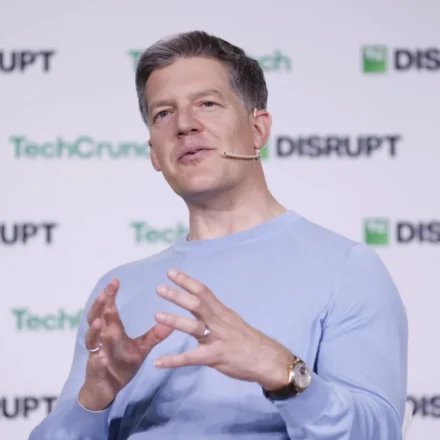
Jonathan Rowntree, CEO of Niron Magnetics, emphasized the strategic necessity of the partnership: "This process is about identifying a partner that shares our commitment to rebuilding U.S. manufacturing capability for technologies that are essential to the global economy."
V. Implications: A Paradigm Shift for the Northland
The potential arrival of Niron Magnetics on the Iron Range carries profound implications for the state’s economy, environment, and political landscape.
1. Economic Diversification
For over a century, the Iron Range has been tied to the boom-and-bust cycles of the steel industry. As modern domestic mills shift toward recycled steel feedstock, the demand for virgin taconite has dwindled. Niron offers a way to utilize the region’s core resource—iron—in a high-value, high-tech application that is insulated from the fluctuations of the global steel market.
2. Environmental De-escalation
One of the most significant implications is the potential to lower the temperature of the "Mining vs. Wilderness" debate. If Niron can provide 700+ high-paying jobs using iron sourced from existing mines or recycled materials, it may weaken the economic argument that hard-metal mining in the BWCA watershed is the only way to save the Range. This "middle path" allows for industrial growth while protecting the state’s most pristine natural resources.
3. National Security and Resilience
By establishing a domestic supply chain for permanent magnets, Niron is positioning Minnesota as a cornerstone of U.S. national security. Reducing reliance on Chinese imports for defense-critical components is a top priority for the Department of Energy and the Department of Defense, both of which have already invested in Niron’s development.
4. The Path to an IPO
With designs on $1 billion in revenue and the need for hundreds of millions in additional capital to build the 2029 facility, Niron officials have hinted at a public stock offering within the next few years. This would not only provide the capital needed for the Iron Range plant but would also mark the emergence of a new industrial titan born from Minnesota’s own research institutions.
As Niron Magnetics and its real estate advisers continue their site selection process, the stakes for Minnesota could not be higher. The decision will determine whether the state’s Iron Range remains a relic of the industrial past or becomes the engine of a cleaner, more secure technological future.