






















































The Paraquat Paradox: How Internal Corporate Secrets Kept a Controversial Weed Killer on U.S. Soil

For over four decades, a global consensus has been building against paraquat, a highly toxic, non-selective herbicide. While nations from Sweden to China have systematically dismantled its use due to mounting evidence linking the chemical to devastating neurodegenerative conditions like Parkinson’s disease, the United States remains an outlier. Newly unsealed internal documents from Syngenta—the long-time primary manufacturer of the chemical—now offer a chilling glimpse into the corporate strategies used to maintain the U.S. market, revealing a pattern of withheld safety data, manufactured "independent" science, and strategic lobbying that may have kept the public and regulators in the dark for years.
The Global Exodus: A Chemical Persona Non Grata
The alarm bells regarding paraquat were first rung in 1983, when Sweden enacted a landmark ban on the herbicide. This move ignited a domino effect across the globe. As scientific scrutiny intensified, the evidence became increasingly difficult to ignore: long-term exposure to paraquat was consistently associated with oxidative stress and the death of dopamine-producing neurons—the biological hallmark of Parkinson’s disease.
By 2016, even China, which owned Syngenta at the time, had conducted its own rigorous toxicological assessments. The results were so damning that the Chinese government implemented a phase-out, ultimately banning the chemical entirely. Today, more than 70 countries have prohibited the use of paraquat. In the U.S., however, the narrative has been starkly different. While recent actions by Vermont and a voluntary cessation of sales by manufacturers in California suggest a shifting tide, the federal Environmental Protection Agency (EPA) continues to authorize its use on millions of acres of American farmland.

Chronology of a Corporate Defense
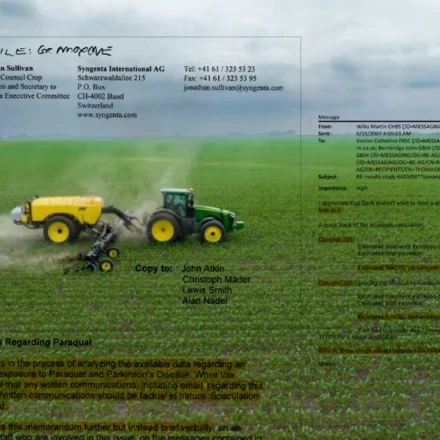
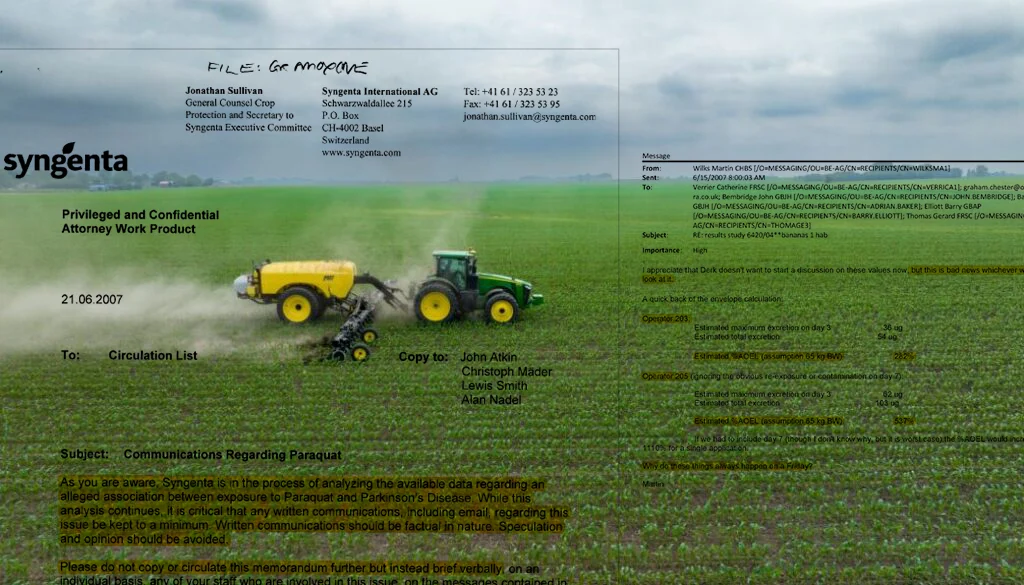
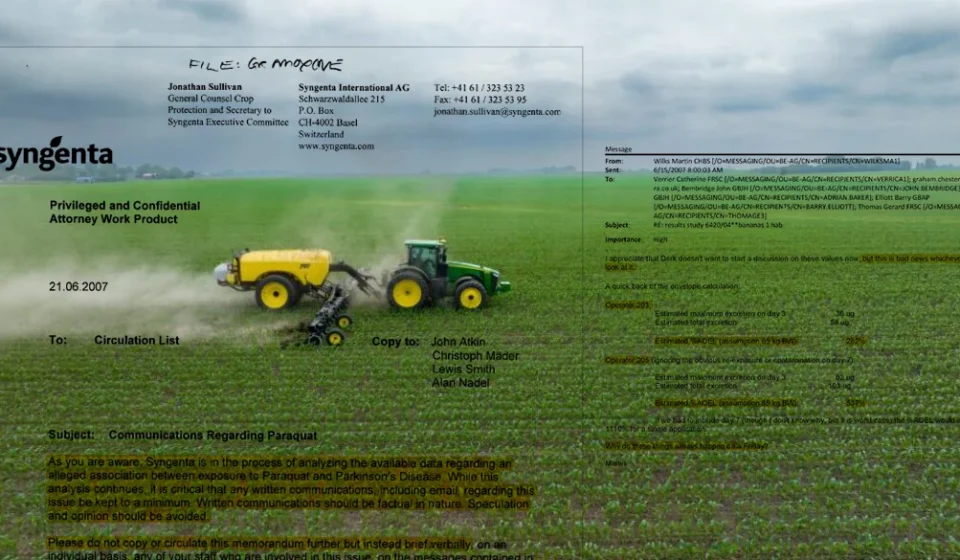
The history of paraquat in the U.S. is not merely a story of regulatory oversight; it is a case study in aggressive corporate defense. Internal records, now totaling over 3,700 pages and submitted as part of massive litigation in Pennsylvania, reveal that as international markets closed, Syngenta redoubled its efforts to secure its U.S. foothold.
- The 2000s: The Rise of Litigation and Strategy: As independent research began to solidify the link between paraquat and Parkinson’s, internal company emails from 2001 explicitly stated a strategy: "Our efforts will be to steer the focus of serious research away from paraquat… and on to other agents."
- The "Brush Aside" Campaign: By 2008, the company’s internal correspondence became increasingly focused on neutralizing outside science. One scientist famously noted the goal was to "brush aside 10 years of research by others and replace it with our own." The internal memos emphasized the need for "dead solid airtight" data that would hold up in court and satisfy regulators.
- The 2010s: The Era of "Independent" Reviews: Documents reveal that Syngenta commissioned and heavily influenced papers under the names of external scientists to provide a veneer of independence. In a 2011 exchange, scientists discussed "editorial changes" to a manuscript, noting that since it was meant to appear independent, "we cannot be seen to try to influence."
- 2021–2026: The Reckoning: Following a $187 million settlement in 2021 and thousands of subsequent lawsuits, Syngenta announced in early 2026 that it would cease global production. Despite this, other suppliers continue to operate, and the company maintains that the decision was driven by market factors rather than an admission of health risks.
Withheld Evidence: The Data Gap
The most damning revelations center on information that was legally required to be disclosed to the EPA under the Federal Insecticide, Fungicide, and Rodenticide Act (FIFRA). This law mandates that registrants report "unreasonable adverse effects" to the agency. Court records show a pattern of silence regarding critical safety data.
The Surfactant Secret
For decades, Syngenta recommended that farmers mix paraquat with surfactants to improve efficacy. However, internal company studies dating back to the 1970s—including tests on dogs—demonstrated that the addition of these surfactants significantly increased the rate at which the herbicide was absorbed into the bloodstream. This information was never relayed to the EPA. When confronted with these findings, the company argued that the specific surfactants used were selected to minimize absorption, a claim that contradicts their own internal historical concerns about "increased toxicity."

Hidden Analytical Results
The records also detail that Syngenta possessed internal sensitivity analyses of the government-funded "FAME" study (Farming and Movement Evaluation). While the FAME study reported a significant positive association between paraquat and Parkinson’s, Syngenta’s internal, unpublished analysis reached a similar conclusion regarding the study’s "robustness." Instead of providing this to the EPA, the company marked the report as "Attorney-Client Work Product" and kept it from regulators.
Official Responses and the EPA’s Defense
The EPA’s position has long been that there is "no clear link" between paraquat and Parkinson’s, citing an "extensive database of information." In response to the recent revelations, the agency stated that it "cannot speculate on how this additional information would impact EPA’s assessment," while simultaneously emphasizing that failure to submit required information is a "direct violation of federal law."
Critics, however, argue that the agency’s reliance on industry-provided data creates an inherent conflict of interest. Dr. Ted Schettler of the Science and Environmental Health Network notes that the paraquat saga illustrates the "public health risks of allowing the U.S. EPA to be the sole arbiter of pesticide safety."

Syngenta, for its part, remains steadfast. A company spokesperson stated: "Syngenta has never knowingly failed to provide regulators with relevant and required information." They argue that the documents in question were either irrelevant to U.S. regulatory standards or that the findings were mitigated by other, contradictory internal studies.
The Implications for Public Health and Regulation
The human cost of these corporate tactics is difficult to quantify but impossible to ignore. For the thousands of individuals currently suing the company, the narrative is clear: they were exposed to a chemical that the manufacturer knew was potentially dangerous, while the government was kept in the dark by the very entity it was meant to regulate.
The implications reach far beyond one herbicide. Wendy Wagner, a law professor at the University of Texas, points out that the U.S. regulatory system relies on a "good faith" reporting model that breaks down when companies choose to "substitute their own judgment" for the law. When critical safety information is suppressed, the EPA’s entire risk-assessment framework becomes a hollow shell, potentially leaving millions of Americans—from farmers and orchard workers to rural residents—vulnerable to long-term, irreversible health consequences.

As the legal battles continue to unfold, the "Paraquat Papers" serve as a grim reminder of the necessity for independent, transparent, and rigorous scientific oversight in the regulation of industrial chemicals. The story of paraquat is not merely a tale of a weed killer; it is a cautionary account of how systemic regulatory failure and corporate secrecy can intersect to jeopardize public health on a national scale.