























































Skyward Bound: How Airbound is Engineering the Future of Logistics with $37M in New Funding

In a bold move to revolutionize the logistics landscape, Bengaluru-based drone startup Airbound has secured $37 million in a Series A funding round. This latest injection of capital, led by Greenoaks with significant participation from heavyweights including DoorDash, Lachy Groom, Lightspeed, and Humba Ventures, underscores a growing investor appetite for autonomous aerial solutions.
The new funding brings the three-year-old startup’s total capital raised to nearly $50 million—a meteoric rise for a company that only months ago closed an $8.65 million seed round. As the logistics industry grapples with the inefficiencies of urban road congestion, Airbound is positioning itself not merely as a delivery service, but as a fundamental hardware provider capable of achieving cost parity with ground-based trucking.
The Engineering Philosophy: Rethinking Payload Efficiency
At the heart of Airbound’s mission is a radical rethinking of aircraft architecture. CEO and founder Naman Pushp argues that the primary hurdle for drone delivery has never been the concept itself, but the physics of current designs.
“Conventional aircraft spend a disproportionate amount of energy simply carrying their own weight rather than the payload,” Pushp explained. “If the machine is heavier than what it carries, the economics of delivery become unsustainable for the average consumer or business.”
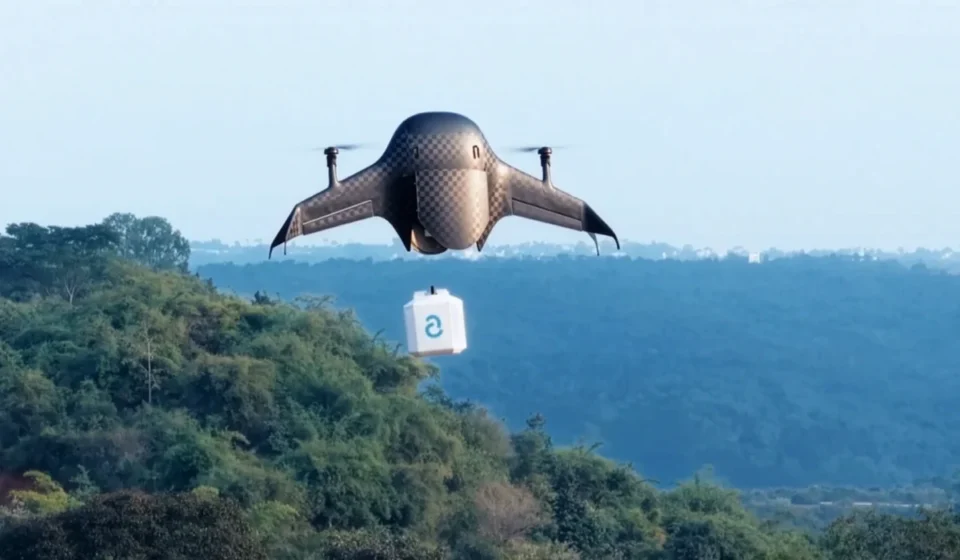
Airbound’s engineering solution is a pivot toward extreme lightweight design. Their current flagship drone, the TRT, weighs a mere 3.3 pounds while possessing the capability to carry a 2.2-pound payload. The next iteration currently in development aims to refine this ratio further: a 6.6-pound craft designed to lift up to 11 pounds of cargo.
By employing a "tail-sitter" design—reminiscent of rocketry—the drones take off and land vertically on their tails before transitioning to efficient horizontal flight. This vertical takeoff and landing (VTOL) capability is critical; it allows the drones to operate without the need for expensive or space-consuming runway infrastructure, effectively turning any small clearing into a logistics hub.
Chronology: A Rapid Ascent from Seed to Series A
Airbound’s journey has been defined by high-velocity growth and rigorous field testing. Founded in 2023, the startup quickly moved from theoretical design to active deployment.
- 2023: Airbound is founded in Bengaluru, focusing on autonomous flight software and proprietary airframe design.
- Early 2024: The company initiates extensive flight tests in Bengaluru and Guntur, accumulating over 13,000 autonomous flight hours.
- October 2024: Airbound secures $8.65 million in a seed round, drawing attention for its "one-cent delivery" goal.
- Early 2025: The company deepens its partnership with Narayana Health, moving beyond pilot programs to integrate drones into the daily infrastructure of hospital networks.
- Mid-2025: Closing of the $37 million Series A round, signaling a shift from R&D toward massive infrastructure scaling and regulatory lobbying.
Supporting Data: The Case for Aerial Logistics
The efficacy of Airbound’s model is best illustrated through its ongoing partnership with Narayana Health. In traditional hospital logistics, diagnostic samples are bundled and sent via road transport. This process is inherently reactive, often requiring three to five hours to account for batching delays and traffic.
Airbound’s drones, by contrast, operate on an on-demand basis. Flying a 2.5-mile route in approximately seven minutes, the drones eliminate the "batching" requirement entirely. This speed is not merely a convenience; in the medical field, it is a clinical necessity. The expansion of this service to Narayana’s new Banashankari facility—which was intentionally designed without an on-site laboratory—serves as a proof-of-concept for the "hub-and-spoke" model of the future. In this vision, physical space is no longer reserved for bulky labs; instead, labs are centralized, and the "last mile" is bridged by the air.
Furthermore, the company has set an ambitious target to establish a three-city drone network in Andhra Pradesh. The startup has entered into an agreement with the state government, aiming for 10,000 flights per day. To achieve this, Airbound estimates it will need to deploy between 250 and 1,000 aircraft. While the high end of that estimate accounts for redundancy and maintenance cycles, the company is confident that 250 aircraft will be the "sweet spot" for operational efficiency.
Official Perspectives: The "Boeing" Ambition
Naman Pushp is clear about his long-term vision for the company: he does not intend for Airbound to be a delivery company in the mold of a courier service. Instead, he views the company’s role as the manufacturer of the "aerial infrastructure" that will support the global economy.
"We want to build towards a world where everything has cost parity with trucking," Pushp stated. "We are aiming for the Boeing role—the aircraft that airlines everywhere rely on, not the airline itself."
This distinction is crucial for understanding the company’s manufacturing strategy. Airbound maintains a 43,000-square-foot facility in Bengaluru where the airframe, avionics, and core systems are engineered in-house. By controlling the hardware stack, Airbound avoids the "vendor lock-in" that often plagues logistics startups. If they can prove that their hardware is the most efficient, durable, and cost-effective, they expect to become the primary hardware supplier for logistics giants like DoorDash and others who have already invested in their potential.
Implications: The Regulatory and Economic Frontier
Despite the technological breakthroughs and the $37 million war chest, Airbound faces a landscape defined by significant, if not insurmountable, hurdles.
The Regulatory Bottleneck
The most pressing challenge remains the "Beyond Visual Line of Sight" (BVLOS) certification. Current aviation regulations globally, including in India, are largely designed for crewed aircraft or limited drone flight within the operator’s line of sight. Scaling to 10,000 flights a day requires the total automation of air traffic management, an area where regulatory bodies are moving with deliberate caution. Airbound is currently working closely with the Andhra Pradesh government to help draft the regulatory frameworks necessary to enable this, acting as both an innovator and a policy consultant.
Commercial Viability vs. Long-term Vision
The company remains broadly pre-revenue, a reality that would worry many traditional investors. However, with 150 employees and a massive capital reserve, Airbound is clearly playing a long game. Pushp is unapologetic about this strategy: "The goal is to be a giant in a few decades, not to make revenue as soon as we can."
This sentiment reflects the broader trend in the deep-tech sector, where the "move fast and break things" mantra of the software world is being tempered by the physics-based realities of hardware. For Airbound, the risk is not whether the drone can fly—they have already proven that with 13,000 successful flights—but whether they can navigate the legal and social complexities of turning the sky into a superhighway.
The Competitive Landscape
Airbound is not alone. Startups like Skye Air Mobility and TSAW Drones are aggressively pursuing similar market shares in India. Meanwhile, global players are watching the Indian market as a testbed for dense, urban drone operations. Airbound’s competitive advantage, they argue, lies in their focus on the "weight-to-payload" efficiency. By making the aircraft cheaper to operate than a diesel truck, they are attacking the fundamental unit economics of the logistics industry.
Conclusion: The Path Ahead
As Airbound transitions from a high-potential startup to an industrial-scale manufacturer, the next 24 months will be decisive. The focus will shift from successful test flights to the gritty reality of supply chain management, flight-hour reliability, and, most importantly, securing the regulatory permits that will allow their drones to operate autonomously over populated areas.
If Airbound succeeds, it will not just be a victory for a Bengaluru startup; it will represent a fundamental shift in how humanity moves goods. By stripping away the weight, cost, and complexity of traditional logistics, Airbound is betting that the most efficient road for the future of delivery is, in fact, no road at all.