

























































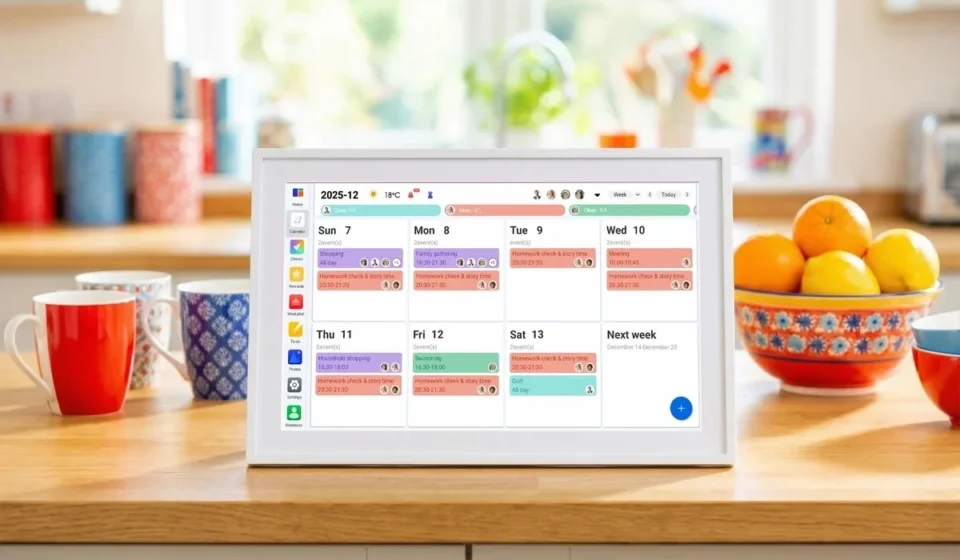

As the back-to-school season descends upon families across the country, the familiar "morning scramble" takes on a new intensity. For modern households, the logistics of managing work, academic calendars, extracurricular sports, medical appointments, and domestic chores have outgrown the capabilities of a traditional paper wall calendar. Enter Linkdaze, a smart digital hub that has quietly emerged as a serious contender in the home-automation space, offering a centralized touchscreen interface designed to manage the collective life of a household rather than a single individual.
Main Facts: The Digital Command Center
Linkdaze is a specialized touchscreen tablet designed for permanent wall mounting or countertop display. Unlike standard tablets, which are built for personal consumption—such as browsing social media or streaming video—Linkdaze is engineered specifically for "household orchestration."
The device’s primary function is to act as a master aggregator for disparate digital schedules. One of its most significant value propositions is its broad interoperability. The system synchronizes seamlessly with major calendar ecosystems, including Google Calendar, iCloud, Outlook, Yahoo, and specialized family-management apps like Cozi. By pulling data from these sources, Linkdaze creates a unified, color-coded visual dashboard. This eliminates the "silo effect," where family members remain unaware of each other’s commitments simply because they are tethered to different software platforms.
Launched in December, the hardware is currently available in two distinct form factors: a 15.6-inch model for large communal spaces and a 10.1-inch model for tighter quarters. Beyond scheduling, the device serves as a multipurpose tool for household management, handling everything from chore tracking and gamified reward systems to collaborative meal planning and shared shopping lists. When not actively in use, the display functions as a high-definition digital photo frame, allowing the utilitarian tool to blend into home decor.
Chronology: From Concept to Kitchen Wall
The evolution of the smart home has historically focused on security (cameras and smart locks) or entertainment (smart speakers and TVs). However, the "family management" sector—often referred to by tech analysts as the "Household Operating System" market—has seen a surge in interest over the last 24 months.
- Pre-2025: Families relied on a fragmented mix of paper calendars, dry-erase boards, and individual smartphone alerts. The frustration of missed appointments and misaligned schedules became a common pain point for dual-income households.
- December 2025: Linkdaze officially enters the market, positioning itself as a hardware-first solution to the digital clutter of modern life.
- Early 2026: Initial user feedback highlights the "Snap-to-Sync" AI feature as a primary differentiator. By allowing users to take photos of physical documents (like a school menu or a paper recipe), the device bridged the gap between the analog world and the digital dashboard.
- August 2026: With the return-to-school rush, the company sees a massive spike in adoption, particularly among parents and student roommates, cementing its position as a tool for more than just traditional nuclear families.
Supporting Data: The AI Advantage and Competitive Pricing
At the heart of the Linkdaze value proposition is its "Snap-to-Sync" technology. This AI-driven feature addresses the "data entry tax"—the time and cognitive effort required to manually input information into an app. By utilizing the tablet’s camera to capture text, the AI automatically categorizes items. A school lunch menu is converted into a structured meal plan, while a handwritten list of ingredients is instantly populated into a digital shopping list.
This feature places Linkdaze in direct competition with established players like Skylight. However, the economic model is where the companies diverge sharply. In an era where the "Software as a Service" (SaaS) model has pushed even hardware companies to rely on recurring subscription revenue, Linkdaze has taken a contrarian stance.
While competitors like Skylight offer premium features locked behind a $79-per-year paywall, Linkdaze has opted for a "no-subscription" model for its core features. This is a bold gamble. From a consumer perspective, it offers a lower barrier to entry; at $119.99 for the 10.1-inch model, it significantly undercuts the subscription-heavy competition. Industry analysts remain divided on whether this strategy will result in a sustainable business model or if the company will eventually be forced to introduce a tiered pricing structure to cover ongoing server and AI-processing costs.
Official Responses and Strategic Positioning
The leadership at Linkdaze has consistently framed the product not as a gadget, but as a "family peacekeeper." In internal marketing communications, the company emphasizes the psychological benefits of reducing the "mental load" that typically falls on one primary household manager.

By decentralizing the schedule—making it visible to everyone on a large, high-contrast screen—the device aims to turn household organization into a shared responsibility. Critics, however, have questioned the privacy implications of such a connected device. Linkdaze has responded by emphasizing local processing for certain tasks and robust encryption for calendar syncs, though they acknowledge that as the AI capabilities grow, more cloud-based processing will be required.
Market analysts note that Linkdaze’s aggressive pricing is a classic "land and expand" strategy. By getting the hardware into the home at a lower price point than competitors, they are establishing their ecosystem as the default interface for the kitchen—the "nerve center" of the home.
Implications: The Future of Household Logistics
The rise of the Linkdaze calendar signals a broader shift in how we conceive of "smart homes." We are moving past the novelty of voice-controlled lights and toward high-utility, collaborative interfaces.
The "Co-Living" Trend
While the product is marketed toward families, its utility is increasingly being recognized by college students and young professionals living in communal housing. The coordination of chores, rent deadlines, and shared kitchen responsibilities is a friction point in any shared living arrangement. Linkdaze’s ability to synchronize diverse calendars makes it an ideal tool for roommates who want to maintain autonomy over their personal lives while coordinating shared obligations.
The Death of the "Mental Load"
For working parents, the "mental load"—the invisible, exhaustive labor of remembering school events, extracurricular deadlines, and household needs—is a major source of stress. Devices like Linkdaze are essentially "external brains." By moving this information from a person’s memory to a wall-mounted display, the device changes the family dynamic from one person managing the schedule to the family managing it together.
Sustainability and Hardware Longevity
A major question facing the industry is e-waste and longevity. If Linkdaze refuses to charge a subscription fee, how will they maintain the software updates and AI advancements necessary to keep the device relevant five years from now? If the hardware becomes obsolete, the "no-subscription" benefit is negated by the need for premature replacement. Consumers are currently betting on the company’s ability to remain profitable through hardware sales alone, a feat that is notoriously difficult in the consumer electronics industry.
Conclusion: A Necessary Evolution
Whether you are a parent managing a complex web of school runs or a professional juggling a high-stakes career with a busy home life, the "Linkdaze model" represents the next logical step in personal productivity. It recognizes that in a hyper-connected world, the biggest challenge isn’t accessing information—it’s synthesizing it.
By providing a single, communal source of truth, Linkdaze is doing more than just displaying dates on a screen. It is helping to facilitate better communication, reducing the friction of daily life, and perhaps, giving families back the one thing they need most: time. As the market continues to evolve, it is likely that the "smart wall calendar" will become as ubiquitous in the modern kitchen as the refrigerator itself. For now, Linkdaze stands at the forefront of that transition, challenging the industry to prove that a sustainable, helpful, and user-friendly household management tool can exist without the perpetual weight of a monthly subscription.