

























































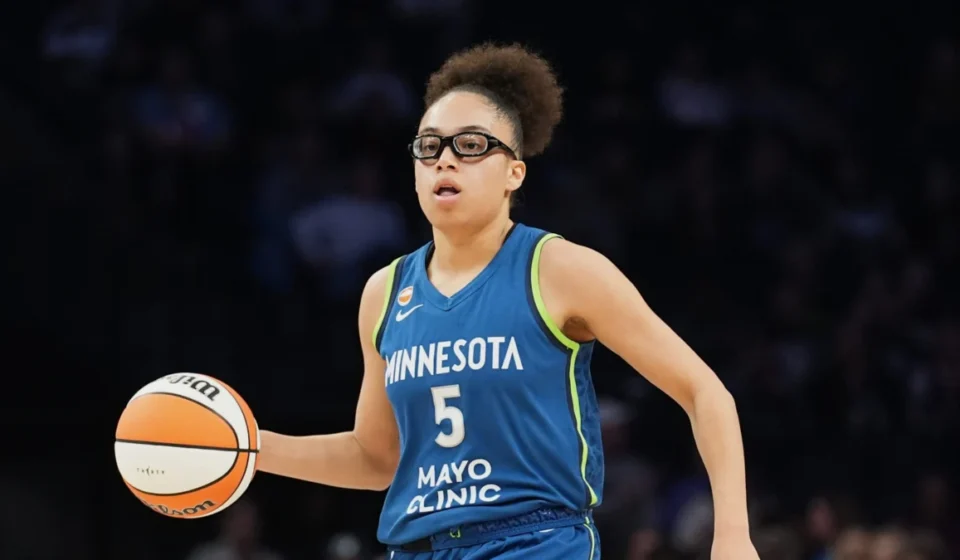

In the high-stakes environment of the WNBA, where the gap between collegiate brilliance and professional dominance is often measured in years of painful adjustment, Minnesota Lynx rookie Olivia Miles has bypassed the learning curve entirely. Seven games into her career, the young point guard from New Jersey is not merely surviving; she is dictating the tempo of the league’s most efficient offense.
Miles arrived at the Target Center press room last week with the casual air of a veteran strolling through her own living room. After a sharp observation about the arena’s temperature—which she likened to a supermarket dairy aisle—she settled in next to teammate Natasha Howard, playfully tugging at the veteran’s ear. It was a scene of youthful exuberance that belied the clinical, high-IQ basketball she had been displaying on the hardwood. In the WNBA, where the pressure to perform is suffocating, Miles operates with an uncanny, relaxed confidence that has turned the Lynx into early-season title contenders.
A Meteoric Rise: The Chronology of an Impact Player
The narrative of Miles’s debut season is one of rapid escalation. Her professional journey began with an Opening Night performance that forced the league to take notice immediately. Registering 21 points and eight assists, she drew an instant comparison from teammate Courtney Williams, who dubbed the rookie “a little baby Chelsea Gray”—a nod to the legendary floor general’s craftiness and poise.
This was no fluke. Miles proceeded to score in double figures for her first 10 consecutive games, eclipsing a franchise rookie record previously held by Naismith Hall of Famer Seimone Augustus. While legends like Maya Moore had set the standard for Lynx rookies in the past, Miles established a new benchmark for consistency.
The inflection point of her early career arrived in Phoenix just five nights after her Target Center appearance. In a 111-77 demolition of the Mercury, Miles showcased the full breadth of her toolkit. She erupted for 11 points in the first quarter alone, shooting a perfect 4-for-4 from the field. By the final buzzer, she had tallied 19 points, 10 assists, four rebounds, and three steals. According to team analytics, she became the only rookie in the league—besides the highly-touted Caitlin Clark—to hit that specific stat-line threshold this season.
Her progression reached a fever pitch against the Golden State franchise, where she shattered the league rookie record for three-pointers in a single game with eight, finishing with a career-high 28 points. This performance was a stark departure from her early-season struggles, where she had connected on only two of her first 18 attempts from deep, signaling a rapid adaptation to the professional arc.
Supporting Data: The Statistical Blueprint of a Playmaker
As of the latest standings, Miles is not just leading the rookie class; she is influencing winning basketball at a rate rarely seen from a first-year player. Entering a high-profile home game against Seattle, she led all WNBA rookies in several key categories:
- Scoring: 17.0 points per game
- Assists: 6.4 per game
- Steals: 1.5 per game
- Minutes: 30.4 per game
Beyond the raw numbers, her "net rating" impact has been profound. The Lynx currently hold the league’s best record at 8-2 and a dominant 13.0 net rating. This success is particularly remarkable given the team’s off-season turnover. With stars like Alanna Smith and DiJonai Carrington departing and Napheesa Collier navigating injury concerns, many analysts projected a rebuilding year. Instead, the team’s decision to draft Miles—over other high-profile prospects like UCLA’s Lauren Betts—has proven to be a masterstroke of roster construction. Miles provides the connective tissue that allows veterans like Williams, McBride, and Howard to operate in their most comfortable, natural roles.
Official Responses: The Coaching and Peer Perspective
The internal reaction to Miles’s play has been one of genuine awe. Lynx head coach Cheryl Reeve, known for her high standards and meticulous attention to detail, has granted Miles a rare degree of autonomy.
“I want her to be herself, her confident, authentic self,” Reeve told reporters. “If there’s something we don’t like, then we’ll share it, but we want her to go.”
Assistant coach Lindsay Whalen, whose own legendary career as a Lynx point guard remains the gold standard for the franchise, expressed a level of admiration that borders on professional jealousy. “I think she’s a better passer than I was, especially a lot of those windows she’s able to find,” Whalen noted. She specifically pointed to Miles’s ability to navigate the paint—a part of the game that often stifles rookies due to the superior speed and athleticism of professional post players.
This sentiment is echoed by peers around the league. Sandy Brondello, the head coach of Toronto, labeled Miles a “generational point guard,” citing her sophisticated command of the pick-and-roll. “We haven’t had many like her for a while,” Brondello added. “She sees the whole floor. She’s a great young talent to build around.”
The Chemistry of Success: Miles and Howard
The symbiotic relationship between Miles and veteran forward Natasha Howard has been the tactical engine of the Lynx offense. For Howard, a 13-year veteran, playing with Miles is reminiscent of her time alongside legends like Sue Bird and Sabrina Ionescu.
“She sees things before they happen,” Howard remarked. “I’ve got to make sure my hands are ready at all times. I never know when she’s going to pass it.”
Miles attributes this chemistry to a shared, intuitive understanding of the game. “She’s just cerebral,” Miles said of Howard. “You don’t really have to tell her where to screen or how to screen. It’s just kind of a natural energy.” This lack of ego, according to Miles, has made her transition from college to the professional ranks significantly easier than she had anticipated. She arrived at camp concerned about "stepping on toes," but found a locker room that prioritized winning over individual accolades.
Implications: A New Era for Minnesota Basketball
The implications of Miles’s rapid emergence are significant for both the franchise and the league at large. For the Lynx, she represents the "missing piece" that has allowed the team to remain a championship-caliber contender without the need for a massive free-agent overhaul. By filling the point guard vacancy with such a savvy operator, the team has been able to maximize the potential of its veteran wing players.
For the WNBA, Miles’s presence is a reminder of the depth of talent entering the league. While the media spotlight is often captured by a few high-profile names, Miles represents the quiet, technical excellence of a floor general who makes everyone around her better.
As the season progresses, the questions surrounding the Lynx have shifted from “Can they survive this transition?” to “How far can this group go?” With Miles at the helm—displaying her signature no-look passes, audacious drives to the rim, and a relentless, confident intensity—the answer seems to be that the sky is the limit.
In a league defined by parity and physical toughness, Miles has introduced a brand of play that is as fun to watch as it is difficult to defend. She is not just a rookie; she is a centerpiece, and the rest of the WNBA is now scrambling to figure out how to stop the momentum she has single-handedly generated in Minnesota. As Coach Reeve succinctly put it: “You can call her a rookie if you want to. She’s just always ready for the moment.”