

























































OpenAI, the organization synonymous with the generative AI revolution, has officially crossed the threshold from software powerhouse to hardware manufacturer. Last week, the company unveiled "Micro," a bespoke, artisanal keypad designed to serve as a tactile gateway to the ChatGPT ecosystem. Developed in collaboration with niche peripheral manufacturer Work Louder, the device is a bold—if polarizing—statement in an industry currently fixated on screen-less interfaces and ambient computing.
However, the launch of Micro arrives at a precarious time. OpenAI is currently locked in a high-stakes legal confrontation with Apple, which has accused the AI giant of trade secret theft. As the company attempts to diversify its product portfolio, the Micro keypad serves as a microcosm of OpenAI’s current struggle: navigating the transition from a research lab to a consumer-facing hardware entity while battling existential legal threats.
The Hardware: A Study in Tactile Minimalism
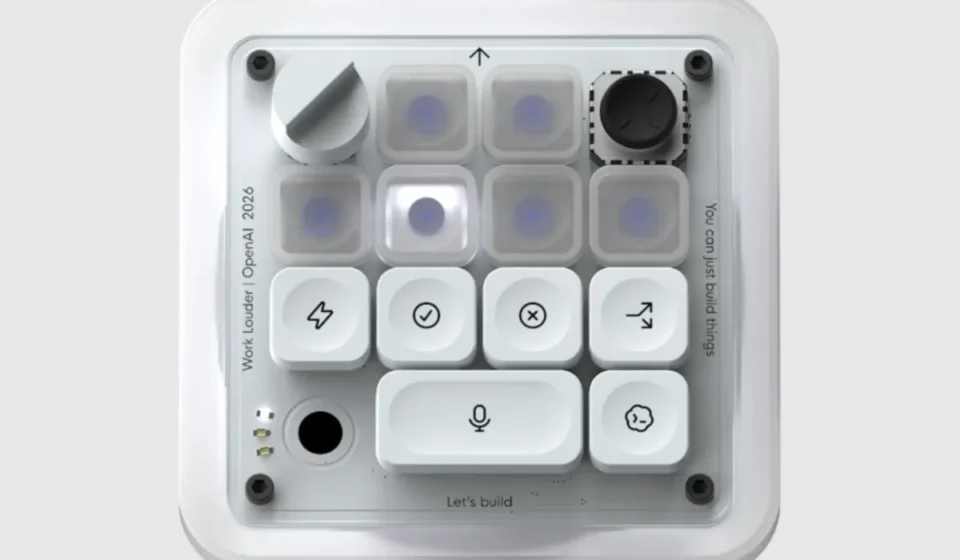
The Micro keypad is a compact, sturdy device that feels less like a mass-market accessory and more like a high-end mechanical keyboard component. It features six "agent" keys—frosted, backlit buttons that can be mapped to specific tasks within ChatGPT or OpenAI’s agentic coding environment, Codex. Below these sit six command keys, designed to navigate the software interface.
The device is built for connectivity, supporting both Bluetooth and USB-C configurations. Integration is handled directly through a dedicated tab within the ChatGPT interface, where users can manipulate the device’s aesthetics—such as LED brightness—and assign specific workflows to individual keys. A notable feature is the integrated voice dictation button, which allows users to bypass the keyboard for natural language input, effectively turning the peripheral into a physical bridge between human speech and AI processing.
A Chronology of Conflict and Expansion
The path to the Micro launch has been anything but smooth. The timeline of OpenAI’s hardware ambitions is inextricably linked to its increasingly complex relationship with Silicon Valley incumbents.
- Mid-2026: Reports begin circulating that OpenAI is aggressively recruiting hardware talent, specifically targeting former Apple engineers.
- July 2026 (Early): Apple officially files a lawsuit against OpenAI, alleging the unauthorized acquisition of proprietary trade secrets related to AI integration and hardware design. This litigation is widely expected to be a multi-year legal slog.
- July 2026 (Mid): Simultaneously, news breaks regarding another hardware project—a screen-less, motion-capable smart home speaker. This device, rumored to be the product of an "Apple-exodus" engineering team, signals that Micro is likely just the first of many hardware attempts.
- Late July 2026: The Micro keypad is officially released to the public, drawing immediate comparisons to Apple’s minimalist design language—a irony not lost on industry observers who have noted the striking similarities in packaging and industrial aesthetic.
Supporting Data and User Reception
Despite the craftsmanship, the reception from the technical community has been frosty. For a device marketed toward "code monkeys" and power users, the barrier to entry is high.
The Cost-to-Utility Ratio
At a price point of $230, Micro sits in an uncomfortable middle ground. Independent reviewers, including the tech outlet Aftermath, have noted that the device struggles to justify its cost when compared to open-source, DIY macro-pads that can be built for a fraction of the price. The consensus among serious developers is that the device adds a layer of abstraction that, for many, complicates rather than simplifies their existing workflow.
The Learning Curve
Efficiency is the primary value proposition of any macro-pad, yet Micro introduces a significant cognitive load. The device utilizes a color-coded feedback system:
- White: Idle agent.
- Blue: Processing/Thinking.
- Green: Task completion.
- Red: System error.
Users must not only memorize the physical mapping of their projects but also interpret these light patterns in real-time. For a professional coder already accustomed to high-speed keyboard shortcuts and CLI commands, this adds a layer of "gamification" that many find disruptive to deep-work states.

Industry Implications: Why Hardware?
The launch of Micro raises a fundamental question: Why would a company focused on Large Language Models (LLMs) care about physical buttons?
The Shift to Agentic AI
The move suggests that OpenAI is betting heavily on the "agentic" future—a paradigm where AI does more than just answer questions; it performs tasks. By providing a physical interface for these agents, OpenAI is attempting to make AI feel more like a tool or a companion rather than a browser-based chatbot. It is an effort to bring AI "out of the tab" and into the physical workspace.
The Apple Parallels
The "Apple-coding" of the product is deliberate. By adopting a premium, sleek aesthetic, OpenAI is positioning itself as a lifestyle brand. However, this strategy is risky. By moving into hardware, OpenAI is shifting from a B2B and SaaS model to a direct-to-consumer hardware model. This exposes them to supply chain complexities, hardware support overhead, and the intense scrutiny of the consumer electronics market—a field where Apple remains the undisputed master.
Official Responses and Strategic Pivot
OpenAI has maintained a tight-lipped stance regarding the litigation and the specific design origins of the Micro device. However, internal messaging suggests that the company views hardware as a necessary extension of its platform. A spokesperson for the company emphasized that "Micro is an experiment in how we interact with the next generation of AI agents," framing the device as a beta test for future, more sophisticated hardware.
The company’s decision to partner with Work Louder, an established designer in the mechanical keyboard space, is a strategic hedge. It allows OpenAI to tap into the "enthusiast" market without needing to build an entire manufacturing and logistics chain from scratch. It is a "lean" hardware strategy that protects the company from the massive capital expenditure typically associated with launching consumer devices.
The Verdict: A Luxury or a Necessity?
For the average user, the Micro keypad is a difficult sell. If you are not a daily, heavy-duty user of ChatGPT, the device will likely serve as little more than a "fancy paperweight" on your desk. The learning curve, the $230 price tag, and the necessity of remapping one’s mental muscle memory make it an accessory for the curious rather than a tool for the productive.
Yet, for the AI enthusiast, there is something undeniably alluring about the physical act of "summoning" an agent with a click. As the legal battle with Apple intensifies, Micro serves as a defiant, albeit minor, signal of intent. OpenAI is no longer content to simply build the software that powers the world; they are actively seeking to occupy the physical space on your desk as well.
Whether the device succeeds or fails as a commercial product is arguably secondary to its role as a strategic probe. It is a signal that the age of "screen-only" AI is drawing to a close. Whether that transition is powered by OpenAI, or by the companies currently suing them, remains the most compelling narrative in the tech world today. For now, the "code monkeys" remain unconvinced, but the march toward integrated AI hardware has officially begun.