























































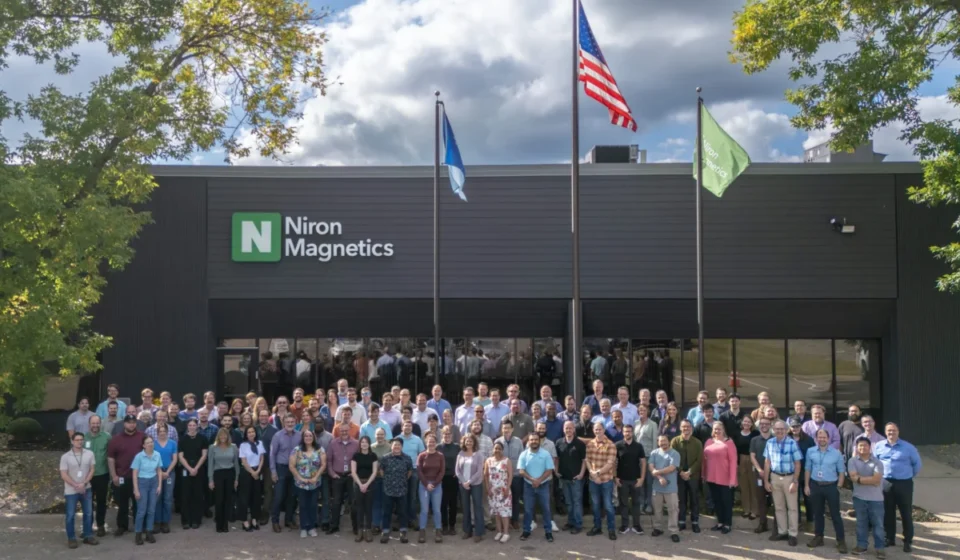
The Iron Range’s New Frontier: How Niron Magnetics Could Redefine Minnesota’s Industrial Future

While the high-stakes, politically charged debate over copper-nickel mining near the Boundary Waters Canoe Area (BWCA) continues to dominate headlines, a quieter but potentially more transformative industrial revolution is taking root in Minnesota. Minneapolis-based Niron Magnetics is currently evaluating the state’s historic Iron Range for its third, and most ambitious, production facility—a move that could herald a new era for a region long dependent on the volatile iron-ore industry.
By utilizing a proprietary, University of Minnesota-developed technology that creates high-power magnets from iron and nitrogen, Niron aims to break the global reliance on Chinese-controlled rare-earth minerals. For the Iron Range, a region that has faced decades of economic contraction as steel production shifted, Niron’s proposed $1.8 billion facility represents more than just a factory; it represents a pivot toward the cutting-edge of the clean-energy supply chain.
The Technological Breakthrough: Magnetism Without Rare Earths
At the heart of Niron’s mission is a fundamental shift in materials science. Modern electric motors, wind turbines, and defense technologies rely heavily on permanent magnets, which historically require rare-earth elements such as neodymium and dysprosium. The global supply chain for these elements is currently dominated by China, which controls up to 90% of the manufacturing and a significant portion of the extraction.
Niron’s patented "secret sauce," invented by University of Minnesota Professor Jian Ping Wang, bypasses this dependency entirely. The process involves reducing iron—or recycled steel—to a specialized powder and integrating it with nitrogen. This creates a powerful magnetic force without the need for extreme heat or the environmentally taxing chemical separation processes required for traditional rare-earth mining.
"Manufacturing permanent magnets from iron and nitrogen reduces the need for rare-earth mining, chemical separation facilities, and complex metallurgical processing," Niron CEO Jonathan Rowntree told a congressional committee last November. "A single integrated facility transforms commodity iron ore and atmospheric nitrogen into finished magnets that automotive powertrains, headphones, and refrigerators need."
A Chronology of Growth: From Lab Bench to Industrial Scale
Niron’s journey from a research project to a potential billion-dollar manufacturer has been rapid and calculated:
- Foundation: The technology is born from years of research at the University of Minnesota by Professor Jian Ping Wang.
- Pilot Phase: The company establishes a headquarters and pilot plant in Northeast Minneapolis to refine the iron-nitride magnet process.
- Sartell Expansion: Niron begins construction on its first major production plant near St. Cloud, a project supported by a $10 million state investment. This facility is expected to employ 175 people and produce 1,500 tons of magnets annually.
- The Future Vision: By 2029, Niron aims to bring a massive, 1.6-million-square-foot facility online. With an estimated price tag of $1.8 billion, this plant would dwarf the Sartell operation, employing over 700 workers and targeting an annual production of 10,000 tons of magnets.
- Site Selection: In early 2024, Niron engaged Savills, a global commercial real estate firm, to begin the rigorous process of selecting a site for this third facility. While the company is scouting multiple states, the Iron Range has emerged as a frontrunner, with speculation centered on the potential repurposing of shuttered taconite facilities.
Supporting Data: Why the Iron Range Fits the Bill
The Iron Range is not merely an emotional or historical choice for Niron; it is a strategic one. As the company looks to scale, it requires a specific set of industrial prerequisites: robust energy capacity, reliable transportation infrastructure, and a skilled workforce accustomed to heavy industrial manufacturing.
"It’s a massive opportunity that fits agency priorities," said Ryan Malich, executive director of business development at the Minnesota Department of Iron Range Redevelopment and Resources (IRRR). "These are the types of jobs that we’re trying to add to the area in evolving, innovative technologies. We want to be on the frontside of technological development."
The economic data supports this enthusiasm. With the decline of traditional iron-ore mining—largely a result of international steel competition and a move toward recycled feedstock in domestic mills—the Iron Range has a surplus of experienced labor. For a company like Niron, which requires workers familiar with high-temperature processing and large-scale facility management, the transition from taconite to high-tech manufacturing is a logical evolution.
Official Responses and Strategic Alliances
The political support for Niron is rare in its bipartisanship. The administration of Governor Tim Walz has been vocal in its support for the company, viewing it as a cornerstone of Minnesota’s future economic development. Simultaneously, the state’s bipartisan congressional delegation has championed Niron’s mission, recognizing its strategic importance to national security.
"Niron is a fabulous story about technology developed at the University of Minnesota and commercialized over several years," says Kevin McKinnon, Deputy Commissioner of the Minnesota Department of Employment and Economic Development (DEED). "The promise, the trajectory of where they are going is very exciting. We believe Minnesota is a compelling location for such a project."
Niron’s corporate partners further underscore the legitimacy of its technology. The company has successfully raised approximately $300 million in private and public capital, with backing from industry giants including General Motors (GM Ventures), Volvo, Samsung Ventures, Stellantis, and Western Digital. Additionally, the U.S. Department of Energy has taken a keen interest, viewing Niron’s domestic production capabilities as a vital solution to the "rare-earth crisis."
Implications: The Great Divergence in Minnesota Mining
The rise of Niron Magnetics introduces a fascinating narrative arc to the state’s mining debate. While the Twin Metals project near the BWCA has faced years of legal, environmental, and public opposition, Niron offers a path to industrial growth that does not conflict with the preservation of the watershed.
The proposed Niron facility would be located outside the sensitive BWCA watershed. While the two projects operate in different sectors—Twin Metals focused on raw hard-metals extraction and Niron on finished-product manufacturing—the contrast is stark. Environmentalists and state officials who have long fought the Twin Metals proposal as a threat to Minnesota’s water quality see Niron as a "best-of-both-worlds" scenario: high-paying industrial jobs paired with a sustainable, non-polluting manufacturing process.
National Security and Supply Chain Resilience
Beyond the local economic impact, the implications for the United States are profound. The Chinese government’s tight control over the rare-earth supply chain has long been a vulnerability for Western manufacturers. By creating a domestic alternative, Niron is effectively insulating American manufacturers from future export controls or trade volatility.
"The Chinese put export controls in place around rare earths, and that’s been a great benefit to us," Rowntree noted in a recent interview. "Niron seeks to solve this problem for western companies as quickly as possible."
A Future-Proof Economy
As Niron prepares for a potential public offering of its stock within the next few years, the company’s trajectory is clear. With plans to expand into Europe and Asia, Niron is positioning itself not just as a Minnesota success story, but as a global player in the green-energy transition.
For the Iron Range, the prospect of hosting a $1.8 billion facility could be the catalyst needed to modernize the regional economy. By pivoting from the commodities of the 20th century to the high-tech components of the 21st, the region may finally find a sustainable, innovative way to secure its place in the global market. As the site selection process continues, all eyes remain on the Iron Range—not for what it can dig out of the ground, but for what it can build for the future.