






















































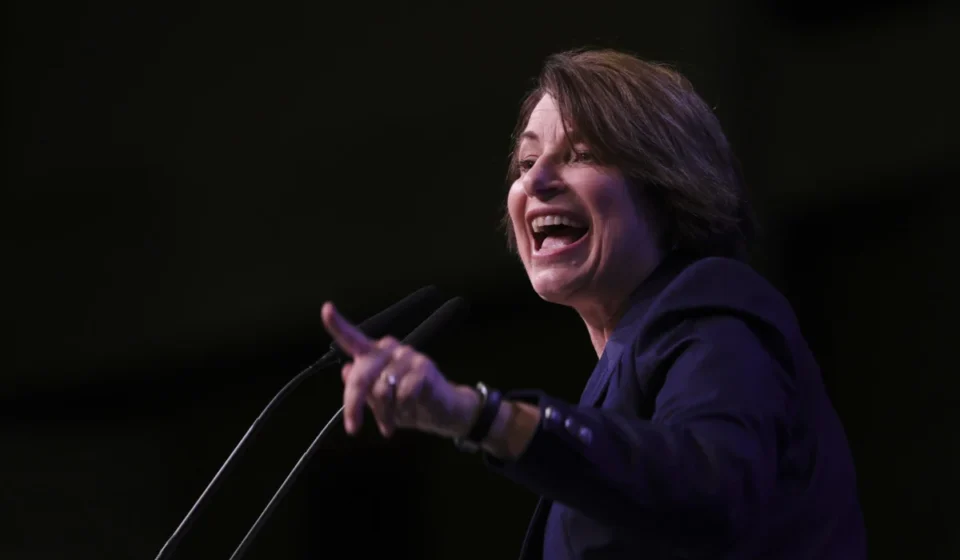

WASHINGTON D.C. – In a political maneuver that has reshaped Minnesota’s electoral landscape and sent ripples through Washington, U.S. Senator Amy Klobuchar, a formidable figure in national Democratic leadership, has answered the urgent call to run for governor of her home state. Her decision to leave a powerful position in the U.S. Senate signals a profound commitment to addressing Minnesota’s challenges directly, a move that has been met with widespread anticipation and strategic political calculation.
Klobuchar’s entry into the gubernatorial race, sparked by an unexpected turn of events from incumbent Governor Tim Walz, positions her as the overwhelming favorite to become Minnesota’s first female governor. Her campaign is already distinguished by a clear strategy: to chart a course independent of Walz’s legacy and to aggressively tackle systemic issues within state government, underscored by a sweeping 40-point reform plan.
"I truly do love my job in the Senate, but I love my state more than any job and I believe that we can get to a better place," Klobuchar declared, articulating the profound personal and political calculus behind her decision. Her impatience with the status quo is palpable: "I don’t like the status quo. Patience is a virtue, but it’s one I don’t have." This sentiment captures the energetic and results-oriented approach that has defined her career and now fuels her gubernatorial ambition.
The Call to State Service: A Senator’s Unexpected Turn
The political earthquake began in early January when Governor Tim Walz, after weeks of speculation, reversed course and announced he would not seek a third term. This decision, delivered with just a day’s notice to Senator Klobuchar, created a sudden vacuum at the top of Minnesota’s Democratic-Farmer-Labor (DFL) ticket. The party, facing the prospect of losing a critical statewide office, quickly turned to its most recognizable and electable figure.
Calls poured in from both state DFL leaders and national Democratic strategists, urging Klobuchar to consider the gubernatorial race. Her prominence as a senator, coupled with her history of strong electoral performances, made her the undeniable choice to "keep Minnesota in the ‘blue’ column." The urgency of the situation underscored the DFL’s belief that only a candidate of Klobuchar’s stature could guarantee a smooth transition and maintain the party’s hold on the governorship.
A Decisive Moment for Minnesota
Klobuchar, at 66, brings decades of public service experience, a national profile, and a reputation for pragmatic effectiveness to the gubernatorial contest. Her potential ascension to the governorship is not merely a change in political leadership but a historic moment for Minnesota, promising a transformative era under its first female chief executive. This aspect of her candidacy resonates deeply across the state, adding another layer of significance to an already high-stakes election.
Her declared intention to distance herself from the current administration of Governor Walz suggests a recognition of public sentiment and a strategic move to present a fresh vision. While the precise nature of this distancing remains to be fully articulated, it implies a readiness to critically assess current state operations and propose substantial changes. The centerpiece of this fresh approach is her ambitious 40-point plan, targeting comprehensive reforms across state government – an indication of her deep-seated desire to overhaul and improve public administration.
Declared Intentions and a Vision for Change
Klobuchar’s campaign platform, though still in its nascent stages, emphasizes governmental reform, accountability, and a proactive response to the state’s pressing issues. Her promise to "crack down on any allegations of fraud" and her broader commitment to "restoring people’s trust in our government again" speak to a public increasingly wary of political institutions. This focus on integrity and efficiency forms the bedrock of her appeal, aiming to bridge political divides by demonstrating tangible improvements in governance.
Her emphasis on rapid "transformation" rather than incremental adjustments underscores her impatience and her belief in the urgency of the moment. This approach, while potentially challenging, aligns with her public persona as a driven and results-oriented leader. It also signals a departure from what she perceives as an unsatisfactory "status quo," promising a dynamic and decisive administration if elected.
A Calculated Departure: The Chronology of a High-Stakes Decision
The timeline of Klobuchar’s decision reveals a strategic deliberation, despite the suddenness of Walz’s announcement. Governor Walz’s declaration that he would not seek re-election caught many by surprise, including Klobuchar herself, who noted, "I’d been saying, ‘Maybe you could wait two weeks.’" This brief window for consideration highlights the immediate pressure and complex calculations involved in shifting from a national to a state-level political ambition.
Walz’s Surprise Announcement and Klobuchar’s Deliberation
While Walz’s decision to step aside was unexpected, Klobuchar, a veteran politician, did not rush her formal announcement. She waited two weeks before officially filing as a gubernatorial candidate, a period likely used to gauge support, organize a campaign structure, and consult with key stakeholders. This brief delay, as she hinted, allowed for a more measured approach to a pivotal career decision.
During this period, Klobuchar acknowledged significant internal and external pressure. "There were a lot of people in the Senate that made the case for me to stay there," she revealed. Her position as the No. 3 spot in Senate Democratic leadership, chairing the Steering and Policy Committee, represented a significant accumulation of power and influence. Leaving such a perch is not a decision made lightly, particularly for a senator who has "through seniority and grit climbed the ranks." However, Klobuchar maintained, "But I think people understood the unique moment we were in as a state and why I made that decision." This "unique moment" refers to both the political opening and the confluence of crises facing Minnesota, which she felt compelled to address more directly.
From Senate Leadership to Gubernatorial Candidate
Klobuchar’s career trajectory has been marked by a steady ascent. From her early days as Hennepin County attorney to her consistent re-election to the U.S. Senate since 2007, she has built a reputation as a pragmatic, effective legislator. Her bid for the White House in 2020 further solidified her national profile, showcasing her policy expertise and Midwestern appeal. This background provides her with a robust foundation for a gubernatorial campaign, immediately positioning her as a frontrunner with unparalleled experience.
The transition from a federal legislative role to a state executive one is substantial. As Senator John Hoeven, R-N.D., who has worked closely with Klobuchar, observed, she had to weigh "Do I stay and see how that plays out or do I go back to Minnesota?" This encapsulates the strategic crossroads she faced, choosing the direct executive power of the governorship over the legislative influence of the Senate.
Unpacking the Rationale: Frustration and a Drive for Direct Action
Beyond the immediate political opportunity, Klobuchar’s decision appears to be deeply rooted in a combination of legislative frustration and a profound sense of responsibility toward her home state. Her candid remarks about disliking the "status quo" and her lack of "patience" hint at a broader dissatisfaction with the pace and effectiveness of federal governance.
The Stifling Grip of the Senate Filibuster
Political science professor Tim Lindberg of the University of Minnesota Morris offers a crucial perspective on Klobuchar’s motivation. He suggests that she may have experienced "some frustration working in a closely divided Senate." The realities of Washington, particularly the filibuster rule that often demands 60 votes for major legislation, can be incredibly limiting for even the most skilled legislators. "Whether the chamber is controlled by Democrats or Republicans, the filibuster rule that requires much legislation to have the support of at least 60 senators has impeded many initiatives from moving forward," Lindberg explained.
In contrast, the governorship offers a more direct pathway to impact. "Being governor allows her to be in a power position where she can do things and make big changes," Lindberg noted. This executive authority, coupled with the ability to set a clear agenda and implement it with fewer legislative roadblocks, presents a compelling appeal for a politician known for "getting things done." For Klobuchar, the governorship represents an opportunity to bypass the gridlock and directly address the issues she cares about most for Minnesota.
Responding to Minnesota’s Deepening Crises
Klobuchar also cited a series of recent "horror" events in Minnesota as a significant influence on her decision to run. These include the tragic murders of former Minnesota House Speaker Melissa Hortman and her husband, the mass shooting at Annunciation Catholic School, and the deaths of Renee Good and Alex Pretti during the federal "Operation Metro Surge." These incidents, profoundly affecting the state, appear to have deepened her resolve.
"I’ve always believed that we could get to higher ground and it’s been one thing after another that’s made that hard in Minnesota," she reflected. This statement underscores a personal connection to the state’s struggles and a conviction that her leadership can steer Minnesota toward a more secure and prosperous future. Her willingness to acknowledge these tragedies as a driving force behind her candidacy adds a layer of emotional resonance and urgency to her campaign.
The Klobuchar Campaign Machine: Strategy and Early Dominance
From the moment she announced, Amy Klobuchar’s gubernatorial campaign has demonstrated the formidable strength expected from a candidate of her caliber. Her long-standing presence on the state and national stages has endowed her with unparalleled advantages in fundraising, name recognition, and campaign infrastructure.
Assembling the Team: Schierer as Lieutenant Governor Pick
A crucial early step in any gubernatorial campaign is the selection of a running mate. Klobuchar’s choice of former Fergus Falls Mayor Ben Schierer as her lieutenant governor candidate reflects a strategic effort to build a balanced ticket and broaden her appeal across the state. Schierer’s background in local government and his connection to greater Minnesota offer a valuable complement to Klobuchar’s statewide and national profile, reinforcing her commitment to addressing the diverse needs of all Minnesotans.
Financial Muscle and Political Acumen
Klobuchar’s campaign finance figures speak volumes about her political power. She has already "raised more than $7 million in campaign cash," a sum that "far outpac[es] her political rivals." This financial dominance is a direct result of her extensive political network, cultivated over years in the Senate and significantly expanded during her presidential bid. As Jacob Rubashkin of Inside Elections noted, she possesses "a nationwide fundraising base from her time in the Senate and presidential run, and an existing statewide infrastructure that she can redirect to her gubernatorial contest." This financial advantage allows her to invest heavily in outreach, advertising, and ground operations, giving her a substantial head start over her opponents.
Her "universal name ID" is another critical asset. Few, if any, Minnesota politicians command the same level of recognition across every corner of the state. This is partly due to her own distinguished career, but also, as the article notes, initially due to her father, Jim Klobuchar, a prominent and admired sports and politics reporter for the Star Tribune. Now, she is "by far the best-known Klobuchar in the state," and her name at the top of the ballot is expected to create a "coattail effect," boosting the fortunes of other DFL candidates down the ticket. Rubashkin succinctly summarized her strength: "she has universal name ID and a track record of being the strongest DFL statewide candidates over the past decade."
A Legacy of Legislative Effectiveness: Klobuchar’s Senate Record
Klobuchar’s 17 years in the U.S. Senate have been characterized by a pragmatic approach and a consistent focus on achieving tangible results. Her reputation as a "workaholic" on Capitol Hill, though acknowledged to sometimes wear out her staff, is a testament to her dedication. This tireless work ethic, combined with an ability to forge bipartisan alliances, has allowed her to navigate Washington’s often-gridlocked corridors effectively.
Bridging Divides: A Bipartisan Approach
A key differentiator for Klobuchar has been her willingness and ability to find common ground with Republicans to pass legislation. Senator Tammy Baldwin, D-Wis., praised Klobuchar’s effectiveness: "When she’s trying to persuade a colleague on an issue, she’s really prepared. She also has the instinct to know where an agreement can be forged." This capacity for consensus-building is a rare commodity in contemporary politics and highlights a skill set that would be invaluable in a gubernatorial role.
Political analyst Tim Lindberg describes Klobuchar’s bipartisanship as "politically palatable," noting that "she does not embrace GOP initiatives but finds ways to work with Republicans that share common interests with her." A prime example of this is her partnership with Senator Ted Cruz, R-Texas, which led to the "Take it Down Act." This landmark legislation criminalizes the non-consensual sharing of AI-generated images and mandates that social media platforms remove such content within 48 hours. Klobuchar championed this bill, even leveraging her position as chairman of the Joint Congressional Committee on Inauguration Ceremonies to successfully lobby President Donald Trump for his support. "It’s a model (to take down) other inappropriate things on platforms," she stated, underscoring its broader implications for online safety.
Championing Consumer Protection and Digital Safety
Beyond the "Take it Down Act," Klobuchar has carved out a niche as a moderate who is nonetheless willing to take on powerful interests. She has been a consistent voice for consumer protection, particularly in scrutinizing industries like pharmaceuticals and tech giants. While her approach has been described as "limited way" by some, her efforts to promote competition, safeguard privacy, and hold corporations accountable have been a hallmark of her Senate tenure.
Her dedication extends to direct engagement with her constituents, a trait admired by colleagues like Senator Baldwin: "She visits every single county in Minnesota every year. That means to me she knows every corner of the state and she has her finger on the pulse." This relentless commitment to understanding and representing the diverse interests of Minnesota has built a deep reservoir of goodwill and trust across the state, further bolstering her gubernatorial prospects.
The Electoral Landscape: Minnesota’s Political Chessboard
Klobuchar’s entry into the gubernatorial race has dramatically altered the electoral calculus, transforming what could have been a hotly contested open seat into a seemingly clear path for the DFL. Minnesota’s recent political history provides important context for this assessment.
Primary Challenges and Anticipated General Election Battle
Klobuchar is expected to easily win the Democratic primary in August against her progressive challenger, Kobey Layne. Her overwhelming fundraising advantage, name recognition, and party establishment support make her nomination a near certainty.
The general election in November, however, presents a different set of challenges, albeit ones Klobuchar is well-equipped to handle. She will face one of three Republicans vying for their party’s nomination in their August primary: House Speaker Lisa Demuth, former healthcare executive Kendall Qualls, or My Pillow CEO Mike Lindell. Each candidate brings a different profile and set of strengths and weaknesses to the race. Demuth offers legislative experience, Qualls a business background, and Lindell a strong connection to the populist wing of the Republican Party and former President Trump.
A DFL Juggernaut in a Crucial State
Klobuchar’s campaign strategy for the general election is already taking shape, even without a definitive Republican opponent. She is focusing on national issues, particularly hitting former President Trump on "a variety of issues – including the reflecting pool fiasco," and aligning with the Democrats’ national "affordability" mantra as inflation impacts daily life. Her fundraising appeals, however, often specifically target Mike Lindell, whose prominent support for Trump’s false claims about the 2020 election has made him a lightning rod for controversy and a recognizable, albeit divisive, figure.
Regardless of who emerges from the Republican primary, the historical context strongly favors Klobuchar. Republicans have not won a statewide seat in Minnesota in 20 years, a streak that underscores the DFL’s structural advantage and Klobuchar’s formidable electoral track record. This makes the GOP nominee a decided underdog, facing an uphill battle against a political titan.
The Senatorial Void: Implications of Klobuchar’s Departure
While Klobuchar’s move to the governorship promises a new era for Minnesota, it simultaneously creates a significant void in Washington. Her departure from the Senate, if successful, would mean the loss of a senior, influential legislator whose seniority and skills have directly benefited her home state for years.
Federal Funding and Legislative Influence at Stake
Among Klobuchar’s most tangible contributions has been her ability to direct billions of federal dollars to Minnesota. Her deep understanding of the legislative process, combined with her relationships across the aisle, has made her an effective advocate for critical state projects.
Senator Baldwin highlighted one such achievement: working with Klobuchar to secure "more than $1 billion to replace the 60-year-old Blatnik Bridge," a vital link between Duluth, Minnesota, and Superior, Wisconsin. This project, greenlit by former President Joe Biden’s infrastructure bill, faced uncertainty after the election of President Trump for his second term. However, Klobuchar and Baldwin successfully lobbied Transportation Secretary Sean Duffy, a northern Wisconsin native, to ensure its continued funding.
Similarly, Klobuchar’s working relationship with Senator Hoeven, R-N.D., was forged through a joint effort to secure federal funding for a "U.S. Army Corp of Engineers flood prevention project along the Red River." This massive $3.2 billion public-private partnership required "a lot of legislation," a testament to Klobuchar’s capacity to navigate complex federal funding mechanisms for her state’s benefit. Replacing this level of influence and the intricate network of relationships she has cultivated will be a significant challenge for any appointed successor.
The Search for a Successor: A National Ramification
If Klobuchar wins the governorship, her Senate seat would become vacant, requiring an appointment by the new governor (Klobuchar herself, assuming she wins) until a special election can be held. This process has national implications, particularly given the often-delicate balance of power in the U.S. Senate. The appointed individual, and eventually the elected senator, would face the daunting task of matching Klobuchar’s "clout" and effectiveness, especially in securing federal resources and legislative wins for Minnesota. It is a challenging prospect to quickly replicate the seniority and experience she brought to the role.
A New Chapter for Minnesota: The Promise of Klobuchar’s Governorship
Ultimately, Klobuchar’s decision reflects a deep-seated belief that she can achieve more for Minnesota as its chief executive than as a legislator in Washington. Her vision for the state is one of renewed trust, accelerated transformation, and direct action on pressing issues.
A Blueprint for Reform: The 40-Point Plan
Her 40-point plan for reforming state government is not merely a campaign talking point but a detailed blueprint for an ambitious agenda. While the specifics of all 40 points are yet to be fully revealed, it signals a comprehensive approach to governance, likely encompassing everything from fiscal accountability to bureaucratic efficiency, public safety, and economic development. This level of detailed planning underscores her serious intent to "change the status quo and not just accepting things and restoring people’s trust in our government again."
Restoring Trust and Driving Transformation
Klobuchar’s commitment to "stay[ing] together as a state, despite the political divides" is a crucial element of her appeal. In an increasingly polarized political climate, her reputation for bipartisanship and pragmatic problem-solving could be a unifying force. Her governorship would likely be characterized by a focus on tangible outcomes, driven by her acknowledged impatience and tireless work ethic.
As Senator Hoeven, a former Republican governor himself, aptly put it, "Governor was the better job. I am deeply honored to be in the Senate, but as governor you can set your agenda and work with people to achieve it and Amy would really like that." This sentiment from a former peer encapsulates the essence of Klobuchar’s calculated move: a desire for the executive authority to directly shape her state’s future, free from the legislative constraints that often frustrate ambition in Washington.
Conclusion: A Defining Moment for a Political Veteran
Senator Amy Klobuchar’s pivot from the national stage to a gubernatorial bid is a defining moment for her political career and a potentially transformative one for Minnesota. Driven by a deep love for her state, frustration with federal gridlock, and a fierce commitment to direct action, she has positioned herself as the clear frontrunner in a high-stakes race. Her unparalleled experience, formidable campaign machinery, and a clear vision for reform promise a dynamic and decisive governorship. While Minnesota stands to gain a powerful and experienced leader, Washington will undoubtedly feel the void left by a senator renowned for her legislative prowess and bipartisan effectiveness. As the campaign unfolds, all eyes will be on Minnesota to see if Klobuchar can successfully translate her national stature into state executive power, ushering in a new chapter for the North Star State.