









































The Geography of Memory: Andy DuCett’s "Home(town)" at the Minnesota Marine Art Museum

A Displaced Masterpiece: The Rocco’s Pub Loan
At Rocco’s Pub and Pizza, a beloved institution in Goodview, Minnesota, a conspicuous void has appeared on the wall near the jukebox. For decades, patrons enjoyed their thin-crust pizza under the watchful gaze of "Coming In" (1972), an idyllic landscape painting by the late artist Ron Hunt. The work, depicting a tranquil marshy riverbed teeming with ducks, was a gift from Hunt to Tom Barth, the restaurant’s founder.
Today, that void is marked by a rectangle of discolored paint—a ghostly silhouette of the missing artwork. In its place hangs an official, institutional sign bearing the logos of both the restaurant and the Minnesota Marine Art Museum (MMAM) in nearby Winona. The sign serves as a bureaucratic placeholder, informing patrons that the work is currently on loan. This act of displacement is not a theft or a loss, but a central, calculated maneuver in a sprawling, immersive installation by Minneapolis-based artist Andy DuCett.
The exhibition, titled "Home(town)," transforms the MMAM into a repository of both real and imagined histories, using the actual booth seats and tables from Rocco’s to recreate the atmosphere of a neighborhood pub within the quiet, sterile walls of a world-class art museum.
Chronology of a Civic Mythos
The genesis of "Home(town)" lies in DuCett’s long-standing fascination with the intersection of institutional power and personal memory. His practice has often flirted with the concept of "fictional agencies," a theme that surfaced prominently in 2024 with his contribution to the museum’s "Fluid" exhibition. In that instance, DuCett presented "On Loan" (2019), a kinetic sculpture that mocked the gravity of traditional maritime museums by placing a rocking, gilded landscape painting in an illusionary ship’s cabin, complete with a reference to the non-existent "South London Museum of Maritime Kinetics."
"Home(town)," which opened in late 2026, represents the maturation of this concept. Rather than pointing toward a far-off, fictional London, DuCett has turned his lens on his own origins. Over the course of months, he engaged in a collaborative process, weaving together the disparate threads of Winona’s civic fabric. By pulling objects out of their native environments—the booth from a local pizza joint, a working Zamboni from a regional rink, and the lore of a multi-generational ice cream shop—DuCett has created a "mythogeography" that blurs the lines between reality and narrative.
Anatomy of the Installation: Objects as Artifacts
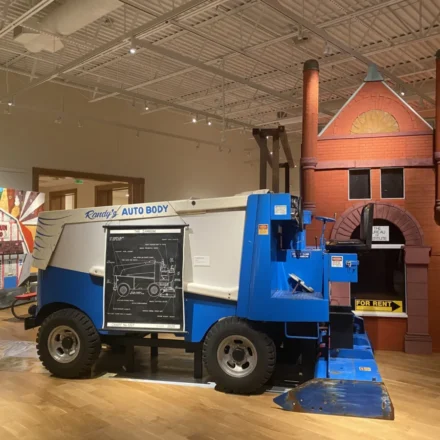
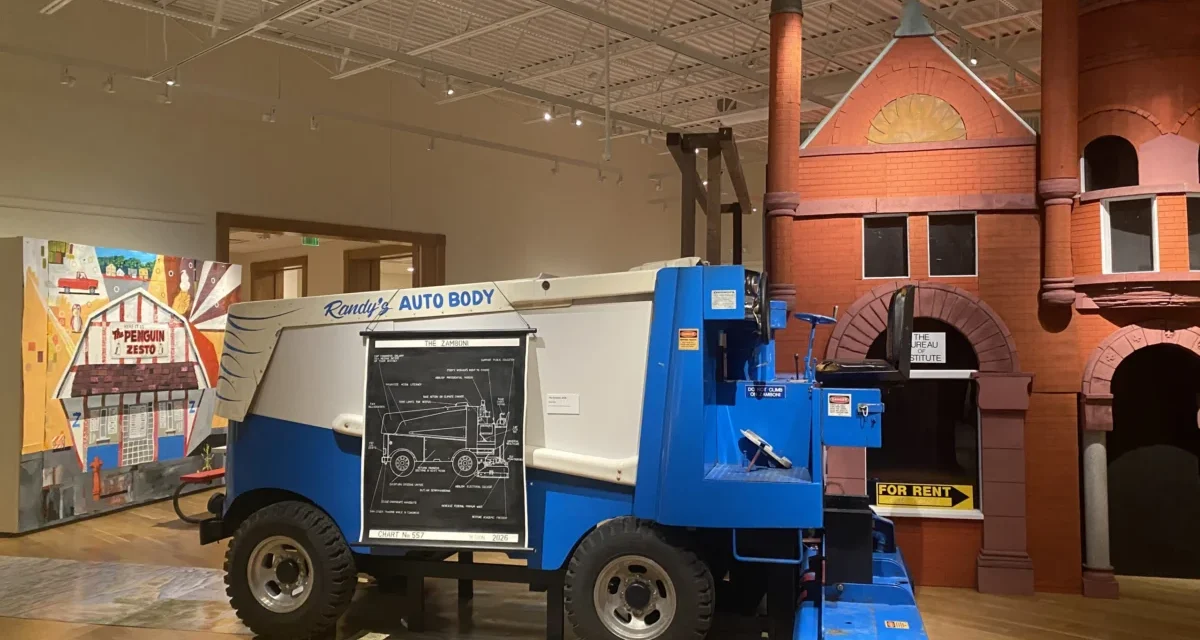
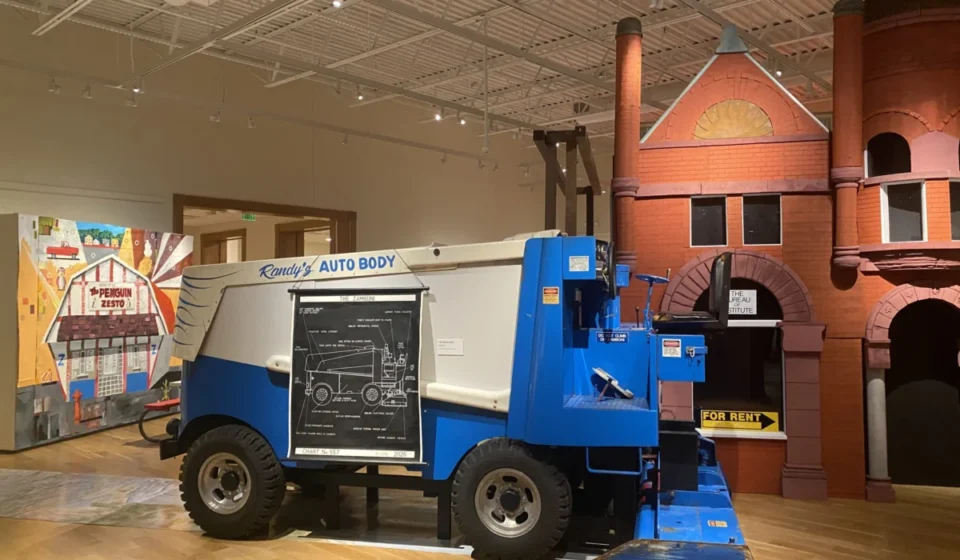
The exhibition begins with a jarring, surreal encounter: a fully functional Zamboni, positioned squarely in the gallery space. The machine, synonymous with the harsh winters and leisure culture of the Upper Midwest, acts as the anchor for a sprawling cartographic project.
The Zamboni and the Map of Aspirations
The Zamboni is not merely a static sculpture; it is an active agent in the exhibition. It appears to be "polishing" a hand-drawn map by artist Allen Brewer, which charts an impossible, whimsical route from Winona to the headwaters of the Mississippi at Lake Itasca.

Flanking this machine is a diagram created by collaborator Mark Dion. The diagram serves as a satirical instruction manual for modern governance, labeling the parts of the ice-resurfacing machine with radical political imperatives. A tire is marked "Overturn Citizens United," while other components bear instructions like "Abolish Electoral College" and "Term Limits for SCOTUS." The juxtaposition of a mundane, local utility vehicle with high-stakes national political rhetoric encapsulates DuCett’s approach: taking the "home" and elevating it to the level of the "state."
The Bureau of Institute and Local Lore
Adjacent to the Zamboni stands a structure mimicking the architecture of downtown Winona. Adorned with a "For Rent" sign, the structure houses the "Bureau of Institute," a nonsensical, administrative entity that serves as a playful jab at the bureaucratic structures that often govern—or stifle—local development.
The installation is designed to be fluid; the "For Rent" space is intended to host rotating businesses throughout the exhibition’s run, mimicking the precarious but resilient nature of small-town commerce. This section of the exhibit serves as a bridge between the physical reality of Winona and the speculative future the artist hopes to evoke.
The Rocco’s Corner: A Study in Coziness
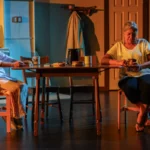
Perhaps the most effective space in the gallery is the recreated section of Rocco’s Pub and Pizza. Complete with the original blue-gray booth seating, a neon Miller Lite sign, and the now-transplanted Ron Hunt painting, the space offers a visceral sensory experience. The "official" sign, with its institutional weight, transforms the simple act of dining into a curated museum experience, forcing the visitor to confront the inherent artificiality of preservation.
Collaborative Narratives: Penguin Zesto and Beyond
DuCett’s work is rarely a solo endeavor. By incorporating the contributions of other artists, he expands the reach of the exhibition into the collective consciousness of the community. A standout example is the homage to Penguin Zesto, a local institution famous for its "rockets"—dipped ice cream treats.
Artist Carolyn Swiszcz contributed a zine and a mural detailing the history of the shop, including its former giant ice cream sculpture. These elements provide a human scale to the exhibit, grounding the broader themes of the show in the shared, sugar-coated memories of Winona’s residents. During a recent visit, the resonance of these objects was clear: they are not just "art," but vessels for the stories that make a place a home.
Official Perspectives and Institutional Implications
The Minnesota Marine Art Museum has long been in a period of self-reflection. Traditionally focused on maritime history and water-based imagery, the institution has increasingly challenged the boundaries of what constitutes "marine art."

By hosting "Home(town)," the museum is explicitly asking: Who gets to write the history of a place? By inviting an artist to curate the "stuff" of daily life—the booths, the Zambonis, the local pizza paintings—the museum is validating the idea that civic history is not just found in textbooks or maritime logs, but in the diners and the local ice rinks.
The museum’s willingness to participate in the "loan" of the Rocco’s painting, complete with the discolored paint left behind on the restaurant wall, represents a profound commitment to the project. It acknowledges that the act of bringing an object into a museum changes its meaning. The "archaeological" look of the wall at Rocco’s serves as a constant reminder that for every artifact placed in a display case, a space in the real world has been left hollow.
The Future of the "Home(town)" Project
The energy within "Home(town)" is a volatile mix of nostalgia, satire, and sincere affection. DuCett does not merely document Winona; he reconfigures it. He uses the tools of the museum to ask questions about time, place, and the sustainability of community identity in a changing world.
As the exhibition continues, the "Bureau of Institute" and the rotating displays promise to keep the installation in a state of flux. This is perhaps the most vital aspect of the project: it refuses to let the community become a static, finished thing.
For those who wish to engage with the artist directly, the museum is hosting a series of events, including a "Meet the Artist" session with Andy DuCett on October 3. As part of the "Fall Look Weekend," these events are designed to further the dialogue between the community and the institution.
Conclusion: A Mad Kind of Love
Andy DuCett’s "Home(town)" is an audacious, complex, and deeply personal investigation into what it means to belong. By elevating the mundane to the level of the monumental, he manages to capture the essence of a town that is both firmly rooted in the past and desperately searching for its future.
Whether one is looking at the hand-drawn maps of the Mississippi or sitting in the borrowed booths of a neighborhood pub, the underlying message is clear: the history of a place is a collective creation. It is a work in progress, written in the language of neon signs, ice cream treats, and the quiet beauty of a marshy riverbed. In this "mad kind of love," DuCett has succeeded in transforming the Minnesota Marine Art Museum into something far more important than a repository of objects—he has made it a mirror for the community itself.