

























































Beyond the Shire: How Zephyr Theatre’s ‘The Hobbit’ Reimagines Myth for the Modern Era

In an age defined by digital fatigue and a persistent, gnawing uncertainty regarding the state of the world, audiences are increasingly turning toward the mythic. From the monumental scope of Christopher Nolan’s cinematic explorations to the intimate, grounding nature of live stage productions, the cultural zeitgeist suggests a collective hunger for escapism that simultaneously mirrors our own reality. It is within this landscape that the Zephyr Theatre has unveiled its latest production: a bold, outdoor reimagining of J.R.R. Tolkien’s The Hobbit.
Staged against the rustic backdrop of Aamodt’s Apple Farm in Stillwater, Minnesota, the production is more than a mere adaptation of a fantasy staple; it is a meditation on civic duty, gender identity, and the power of communal storytelling.
A Question of "Why Now?"
For Reed Sigmund, the Zephyr Theatre’s newly appointed artistic director and a seasoned veteran of the Children’s Theatre Company, the decision to mount The Hobbit was driven by a specific, urgent inquiry: "Why this show, and why now?"
The answer, Sigmund discovered, lay in the reluctant heroism of Bilbo Baggins. At the heart of Tolkien’s classic is a comfort-loving homebody forced to choose between the safety of the status quo and the moral imperative of joining a struggle that, on the surface, is not his own. This dilemma resonates profoundly with the modern Minnesotan experience, particularly in the wake of the community-driven mobilization seen during the recent winter’s "Operation Metro Surge."
The production posits that apathy is a luxury we can no longer afford. As one character poignantly observes during the performance, "A wrong that is silently seen will not fix itself." By centering Bilbo’s transition from a sedentary observer to an active participant, the Zephyr Theatre bridges the gap between Middle-earth and the contemporary civic landscape.
Chronology and Creative Vision: A Minimalist Approach
Unlike Peter Jackson’s sprawling, decade-defining film trilogy—often critiqued for its bloated pacing and excessive CGI—Greg Banks’ stage adaptation is a study in efficiency. The narrative moves with a brisk, surgical precision, hitting essential plot beats without the indulgence of unnecessary exposition.
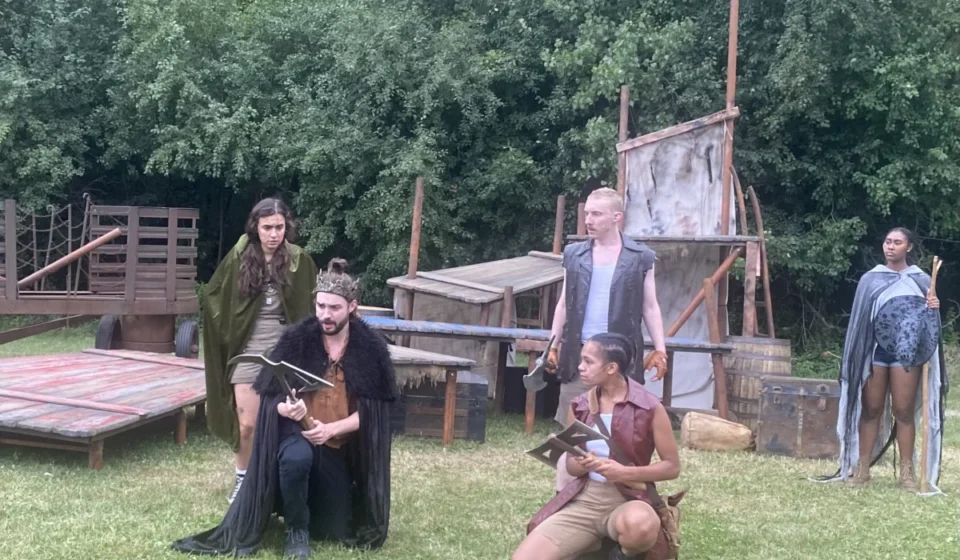
Sigmund’s directorial hand is light and playful, favoring physical theater and the "theater of the mind" over the high-budget spectacle typical of fantasy blockbusters. The production intentionally strips away the trappings of big-budget theatrics. In the absence of live horses, the cast utilizes the cadence of galloping footsteps and the rhythmic clatter of imaginary hooves to evoke the journey. This minimalist aesthetic requires a high degree of audience buy-in, transforming the viewer from a passive observer into an active participant in the illusion.
A New Gender Paradigm
Perhaps the most striking departure from the source material is the gender-blind casting. In this production, the iconic roles of Bilbo Baggins (Grace Hillmyer), the wizard Gandalf (Antonisia Collins), and the dwarf Balin (Anya Naylor) are occupied by women.
This is not merely a cosmetic change; it fundamentally shifts the tone of the narrative. Antonisia Collins brings a savvy, grounded composure to Gandalf, while Grace Hillmyer imbues Bilbo with a vulnerable empathy that makes her eventual bravery feel earned rather than inevitable. When Hillmyer’s Bilbo declares, "I’m here because right now it’s the right time to do what’s right," the line lands with an earnestness that feels both timely and necessary.
By deconstructing the male-dominated archetype of the fantasy adventurer, the production creates a more inclusive, nuanced narrative space. This shift also offers a poignant alternative for audiences seeking to distance themselves from franchises like Harry Potter, particularly given the recent controversies surrounding author J.K. Rowling’s stated intent to utilize proceeds from her media empire to fund anti-trans advocacy. For those looking for an immersive, mythic experience that aligns with progressive values, the Zephyr’s Hobbit serves as a welcoming, ethical sanctuary.

Supporting Data: The Mechanics of the Ensemble
The success of this production relies heavily on the ensemble’s physical versatility. With only five performers tasked with inhabiting a vast array of characters, the show functions like a finely tuned machine.
Jeffrey Nolan’s performance is a standout of technical prowess. As he cycles through the gruff, suspicious dwarf Kili, the iconic and wretched Gollum, and the haughty, dragon-like Smaug, he utilizes subtle costume shifts to distinguish between personas. His Smaug, in particular, is a masterclass in impish, devilish comedy, proving that a mask and a posture can be more effective than a thousand frames of motion-capture technology.
The production design—much like the acting—is economical. The wood-elves’ wine barrel escape is rendered with a handful of plain cylinders, and the goblin masks are delightfully simple, relying on the actors’ physicality to sell the menace.
However, not every choice succeeds. The production’s musical accompaniment, curated by Sophia Schott, feels disjointed. While Schott’s individual vocal talent is undeniable, the inclusion of folk standards by Peter, Paul and Mary, Simon and Garfunkel, and John Denver creates a jarring tonal dissonance. While "Puff the Magic Dragon" serves as a literal nod to the genre and "Country Roads" attempts to mirror the theme of travel, these songs feel grafted onto the story rather than woven into its fabric. A more cohesive, original score might have better served the production’s otherwise tight narrative.
Implications: A Community-Centered Escape
The venue itself, Aamodt’s Apple Farm, provides a quintessential Minnesota backdrop that enhances the production’s communal spirit. Located away from the hustle of the city, the outdoor stage overlooks a wooded area that feels plucked directly from the pages of Tolkien’s journals.
Before the curtain rises, attendees are encouraged to engage with the farm’s offerings—from Saint Croix Vineyards to Thor’s Hard Cider. The integration of local food, such as apple brats and Honeycrisp apple salsa, creates an environment that is as much a community gathering as it is a theatrical performance. This intersection of "dinner and a show" is a growing trend in the Twin Cities, one that prioritizes the holistic experience of the evening.
The Broader Landscape: Dinner and Drama
For those who wish to extend this theatrical experience, the Guthrie Theater in Minneapolis offers a compelling counterpoint. With the recent opening of Sean Sherman’s Indígena by Owamni on July 4, the Guthrie has finally bridged the long-standing gap between high-caliber drama and quality post-show dining.
Following a viewing of Noël Coward’s Private Lives—a sharp, albeit dark, comedy—patrons can now head to the bar for elevated indigenous cuisine, such as maple and sumac glazed venison skewers or smoked whitefish tostadas. While Private Lives itself invites complex conversations regarding its dated depiction of domestic conflict, the ability to process such a production over a thoughtful, locally sourced meal represents a significant maturation of the Minneapolis cultural scene.
Final Thoughts on Performance
As the Zephyr Theatre continues its run of The Hobbit through early August, it stands as a testament to the power of stripping away the excess to reach the heart of a story. Whether it is the bold gender-swapped leads or the inventive, low-budget staging, the production proves that the most effective "special effects" are those fueled by human ingenuity and a clear-eyed understanding of the contemporary human condition.
For those interested in witnessing this transformation of Tolkien’s world, performances are scheduled through August 2 at the Aamodt’s Apple Farm. As the world outside continues to churn with its own, non-fantasy problems, the opportunity to spend a few hours in a woods-side theater, reflecting on the necessity of "doing what is right," is a journey worth taking.