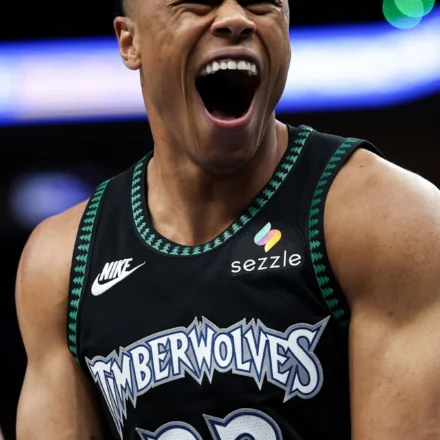























































As the Minnesota Timberwolves prepare for a high-stakes campaign, the focus has shifted from internal chemistry to the integration of new, pivotal personnel. In the third installment of an extensive 80-minute interview with MinnPost, Head Coach Chris Finch provided a detailed diagnostic of his roster, specifically addressing the arrival of Jonathan Kuminga and the delicate balancing act required to manage a deep, multi-faceted bench.
With the team looking to solidify its defensive identity and maximize offensive efficiency, Finch is not merely managing players; he is architecting a system designed to elevate high-upside acquisitions while squeezing every ounce of value from his rotation staples.
The Kuminga Mandate: A "Prove It" Opportunity
The most significant change to the Timberwolves’ starting lineup is the addition of Jonathan Kuminga, who is penciled in as the team’s starting power forward. For Finch, the acquisition is a calculated gamble on both sides—the team is betting on Kuminga’s physical tools, and Kuminga is betting on the Timberwolves’ culture to facilitate his growth.
"It is his job to lose," Finch stated bluntly. The coaching staff’s expectations are high, but they are focused on the "little things" rather than empty box-score statistics. When asked how Kuminga can secure his role, Finch pointed to a clear mandate: defensive excellence.

"The way that he wins it most rapidly is by solidifying our defense into elite," Finch explained. "He’s going to fit right in because he has the same problem we all have: he fouls too much. So, let’s get that under control team-wide."
Beyond defense, Finch highlighted rebounding as a critical area where Kuminga can provide an immediate "shot in the arm" for the team. Offensively, the coaching staff is still in the experimental phase. While Kuminga’s transition play and off-ball cutting are viewed as natural fits next to playmakers like LaMelo Ball, the challenge lies in the "shot selection in the flow of our offense."
Finch noted that Kuminga could serve as a new barometer for the offense. "Is he getting enough touches? And when he does get those touches, does he not feel the need or pressure to do something for himself all the time?" By moving away from the rigid, established structure Kuminga faced during his tenure in Golden State, the Timberwolves are hoping to provide the environment where his natural instincts can flourish without the burden of over-analysis.
Bench Synergy: The Roles of Shannon and Dosunmu
A major theme of the upcoming season is the management of the second unit, particularly the pairing of TJ Shannon and Ayo Dosunmu. Finch views both players as essential, though they bring different skill sets to the floor.

"They are probably going to share the floor a lot together," Finch said. "So they are going to have to develop a fast chemistry."
For Shannon, the growth area is self-regulation. Finch describes him as an "underrated passer" who often gets his "engine running so hard" that he forgets to kick the ball out to open shooters, opting instead to force a finish at the rim. The goal for the coaching staff is to temper Shannon’s intensity with better decision-making.
Dosunmu, by contrast, is viewed as a high-IQ, "simple and repeatable" player. Finch expressed little concern about his integration, praising his ability to play alongside high-usage stars and his knack for making the "right play." While the team needs increased playmaking from both players, Finch believes that if Dosunmu continues to focus on simple, efficient reads and Shannon learns to harness his aggression, the duo will be the engine of the bench.
Defensive Nuance: The Growth of Jaylen Clark
Jaylen Clark continues to be a favorite of the coaching staff, largely due to his rare ability to disrupt plays in the transition between offensive and defensive possessions. Finch described this as a "knack and a feel" that cannot be taught.

However, for Clark to earn consistent minutes, he must move past his "kryptonite": the tendency to defend all opponents with the same approach. "You can’t guard them all the same," Finch noted, emphasizing that while such a strategy works against secondary options, guarding number-one options requires the kind of study and nuance that the team expects from defensive specialists.
Finch remains confident in Clark’s trajectory, noting that he is a "very coachable" player who understands his identity. The primary goal for this season is to see that consistency reflected on the offensive end, where Clark needs to trust his three-point shot more frequently rather than defaulting to his floater.
The "Bones" Hyland Mentality
Bones Hyland finds himself in a similar position to Clark—fighting for a cemented spot in the rotation. For Hyland, the path to playing time is twofold: physical defensive resilience and an aggressive offensive mindset.
Finch emphasized that the Western Conference is dominated by physical guards who "put their shoulder down." Hyland must prove he can stand up to that physicality. Offensively, the coach wants to see a "let-it-fly mentality." Finch observed that Hyland often turned down open shots last season, likely out of a desire to create for others, which actually ended up hurting the team by disrupting the flow. "He’s confident," Finch said. "He just has to have more of a let-it-fly mentality."

The Trey Lyles Factor
With the arrival of Kuminga, the path to minutes for veteran forward Trey Lyles has become more obstructed. However, Finch refuses to rule him out. Lyles occupies the "skilled big" category, a role that has become increasingly important following the departure of Naz Reid.
While Finch doesn’t envision a 22-minute-per-night role, he noted that Lyles provides versatility as a small-ball center and a floor spacer who can attack close-outs effectively. "He understands who he is as a player and just keeps leaning into that," Finch said, acknowledging that Lyles’ experience—including his stint in Spain—has matured his game significantly.
Implications: Building a "Winning DNA"
The overarching theme of Finch’s comments is a focus on "winning DNA"—a phrase he repeats when discussing how the team wants its players to be perceived by the league. By emphasizing defensive accountability, selfless playmaking, and situational awareness, Finch is attempting to shift the culture of the team from one of individual potential to collective success.
The coaching staff’s willingness to let players gamble on their instincts—such as allowing Clark to take risks on defense or giving Kuminga the green light for certain isolations—suggests a philosophy of empowerment. However, this freedom is strictly tied to the team’s performance metrics.

As the team moves into the preseason, the "prove it" contracts and the depth-chart battles are more than just training camp storylines; they are the fundamental building blocks of a team that believes it has the talent to compete with the best in the West. Whether this mix of high-upside youth and seasoned vets can find the necessary chemistry remains the biggest question of the 2026-2027 season, but for Chris Finch, the blueprint is clear: stay disciplined, stay aggressive, and, above all, play for the next man.
The fourth and final part of this interview series will be published later this week, covering further insights into the team’s overarching strategic goals and final roster considerations.