













































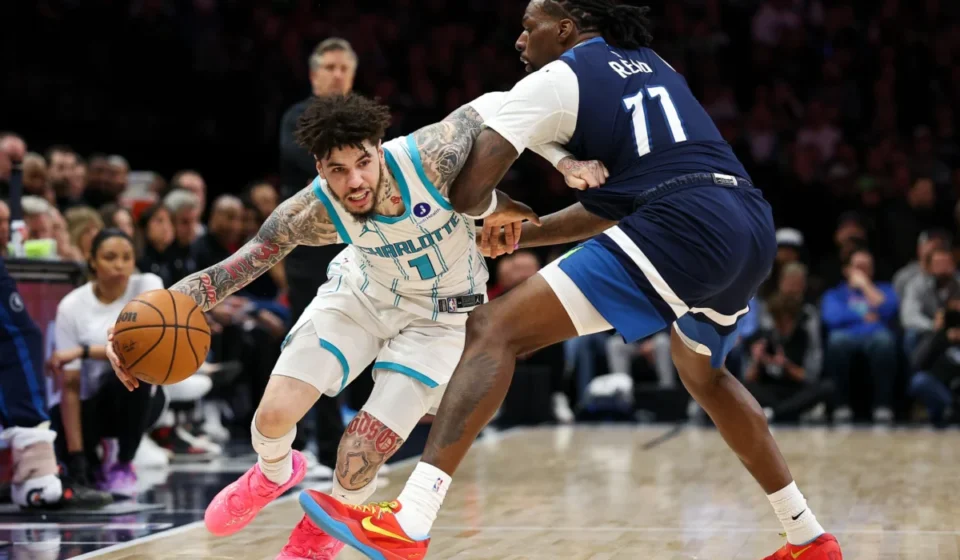

In the high-stakes boardroom of Minnesota Timberwolves basketball, President of Basketball Operations Tim Connelly has once again opted to set the status quo ablaze. In a move that has sent shockwaves through the NBA landscape, the Timberwolves have acquired electrifying point guard LaMelo Ball from the Charlotte Hornets. The cost? A king’s ransom of draft capital and the departure of Naz Reid, a player whose presence in Minnesota transcended mere box-score statistics to become a genuine cultural phenomenon.
For the Minnesota faithful, this is the latest in a series of "summer jubilees"—a term often used to describe Connelly’s penchant for orchestrating tectonic roster shifts that leave observers reeling. Just as the dust settled on the Julius Randle departure, Connelly has pivoted again, signaling that in his world, stagnation is the only true failure.
The Chronology of a Blockbuster
The events of the past 72 hours have been nothing short of a whirlwind. On Tuesday, the front office moved to clear significant salary-cap space by offloading Julius Randle and his $33-million contract. The move initially appeared to be a strategic clearing of the decks, a path paved for Naz Reid—the team’s longest-tenured player and a beloved fan favorite—to finally ascend to the starting power forward role he had been primed for through seven years of disciplined growth.
However, the "Naz Reid Era" as a starter was cut short before it began. On Thursday, Connelly stunned the league by including Reid in the package to Charlotte. To secure LaMelo Ball and veteran wing Josh Green, Minnesota effectively emptied its draft cabinet. The Timberwolves surrendered their first-round pick in 2033—the earliest available selection they could legally trade—along with a complex web of draft swap rights for 2028, 2029, and 2030, plus second-round picks in 2029, 2032, and 2033.
This follows a distinct pattern established by Connelly since his arrival: the 2024 trade of Karl-Anthony Towns and the earlier blockbuster for Rudy Gobert. Connelly is not building for the long-term draft horizon; he is building for the immediate, volatile window of Anthony Edwards’ prime.
The Analytical Case for LaMelo Ball
LaMelo Ball arrives in Minneapolis as a polarizing but undeniably talented floor general. At 25 years old—just 17 days younger than Anthony Edwards—Ball boasts an elite pedigree as a playmaker. His career assist percentage ranks fourth among all active players, placing him in the rarified air of Luka Dončić and Trae Young.
The strategic logic behind the trade rests on the "Ant-centric" offensive model. Data from NBA.com’s analytics guru John Schuhmann highlights a critical inefficiency in the Timberwolves’ previous setup: Anthony Edwards, while a lethal catch-and-shoot threat (49.6% accuracy last season), was forced to operate primarily as a pull-up shooter (35.3%) due to his heavy ball-handling responsibilities.
By bringing in a pure distributor like Ball, the coaching staff intends to move Edwards off the ball. In the 2025-26 season, while Ball led a struggling Charlotte squad, his presence transformed the team’s offensive rating from a dismal 101.5 when he sat to a scorching 118.4 when he played. The hope is that by pairing Ball with a perimeter engine like Edwards, the Wolves can unlock a level of offensive fluidity that was absent during their second-round exit last season.
Official Stances and the Philosophy of Risk
Tim Connelly has made his philosophy clear, regardless of the criticism. Five weeks ago, following a bitter playoff exit against the San Antonio Spurs, he articulated a stance that borders on nihilistic bravery: "The thing about risk, it is all self-induced pressure. Like, if you don’t win, what’s the risk? I’d rather get fired than sit here being in job-survival mode."
Connelly’s mantra is simple: "If we mess up, we will mess up loudly." He has rejected the path of incremental improvement in favor of high-variance, high-reward gambles. He believes that by the time the draft picks he traded away lose their value in 2033, the organization will either have a championship banner hanging in the rafters or will have long since moved on to a different management regime.
Defensive Synergy and the "Gobert Effect"
Critics of the trade point to Ball’s defensive lapses, a recurring theme during his tenure in North Carolina. However, Connelly’s front office argues that the Minnesota environment is fundamentally different. Ball has never played behind a rim protector of Rudy Gobert’s caliber.
The defensive infrastructure in Minnesota is designed to funnel attackers into the paint, where Gobert waits. If Ball can leverage his 6’7” frame to provide competent on-ball resistance, the team believes the defensive drop-off will be negligible. Conversely, the offensive benefit of the Ball-Gobert pick-and-roll could be transformative. Ball is arguably the most creative lob initiator Gobert has worked with in Minnesota, potentially reinvigorating the center’s offensive contributions and keeping him engaged for all four quarters.
Implications: The Character Equation
While the tactical fit is promising, the intangible risks remain significant. The departure of Naz Reid—the "folk hero" whose name is inked on the skin of hundreds of fans and whose promotional towels fetch triple-digit prices on the secondary market—creates a void in team culture. Reid represented continuity, grit, and the "Wolves Way."
Furthermore, LaMelo Ball’s durability is a glaring red flag. He has surpassed 70 games in a season only twice in his six-year career, with injury-plagued campaigns becoming an unfortunate trend. If Ball cannot stay on the court, the loss of draft capital and a high-character player like Reid will haunt the organization for the better part of a decade.
There is also the question of leadership. With an extremely young core—featuring 11 players aged 26 or younger, including Jaden McDaniels, Josh Green, and rookie Isaiah Evans—the team lacks veteran stabilizers. The onus falls squarely on Anthony Edwards. Can he transition into the "best two-way guard in the NBA" that coach Chris Finch envisions? Or will the team’s tendency toward defensive indifference continue to undermine their talent?
The Future: A High-Wire Act
Connelly has essentially bet the farm on a singular timeline: the rise of Anthony Edwards. By stockpiling athletic wings and high-ceiling, high-risk players, he has modeled the Timberwolves after the aggressive blueprints seen in Oklahoma City and New York. However, unlike those teams, Minnesota has limited "cushion." They lack the future draft assets to fix mistakes and the proven track record of collective, two-way commitment.
If this experiment succeeds, the 2026-27 season could be the year the Timberwolves finally claim the Western Conference. If it fails—if Ball’s health falters or if the chemistry fails to ignite—the trade will be remembered as one of the loudest, most expensive mistakes in modern NBA history.
For now, the fan base is left in a state of suspended animation. The "finger painting" of Tim Connelly’s roster remains a work in progress, a vibrant, chaotic, and undeniably bold vision of what he believes a championship team should look like. The balls have stopped bouncing for the summer, but in Minnesota, the fever dream of the front office is just beginning to take shape. Whether it ends in a trophy or a rebuild, one thing is certain: it will be loud.