
















































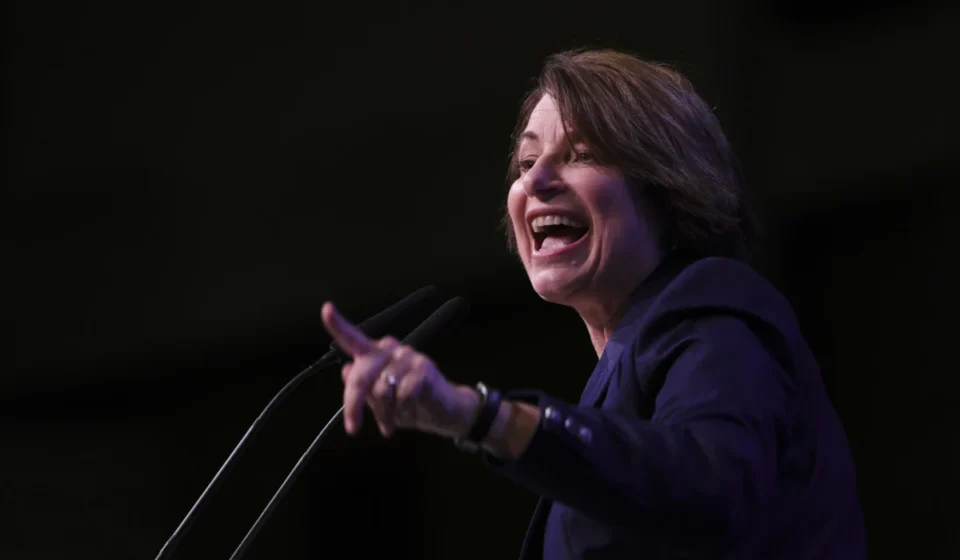

WASHINGTON D.C. – In a political move reverberating from the halls of the U.S. Capitol to the heart of Minnesota, veteran U.S. Senator Amy Klobuchar has announced her decision to relinquish her influential Senate seat and run for governor of her home state. Her declaration comes at a critical juncture for the Democratic-Farmer-Labor (DFL) Party, which sought a formidable candidate to safeguard Minnesota’s gubernatorial office within the "blue" column. Klobuchar, a figure of national prominence and deep local roots, has answered that call with characteristic resolve, signaling an intent to rapidly transform the state’s political landscape.
"I truly do love my job in the Senate, but I love my state more than any job and I believe that we can get to a better place," Klobuchar stated, her words underscoring a profound commitment to Minnesota. "I don’t like the status quo."
Heavily favored to become Minnesota’s next governor and, if successful, the first woman to hold the state’s highest executive office, Klobuchar is not merely entering the race; she is defining it. Her strategy is multifaceted, aiming to delineate her vision from that of incumbent Governor Tim Walz while simultaneously introducing a comprehensive 40-point plan designed to reform state government and aggressively address any allegations of fraud. Her impatience for change is palpable. "Patience is a virtue, but it’s one I don’t have," she asserted, setting a tone of urgent action for her campaign.
A Swift Pivot: Answering the Call to Serve
Klobuchar’s entry into the gubernatorial contest was both sudden and strategic, precipitated by an unexpected turn of events. In early January, Governor Tim Walz reversed his prior intentions and announced he would not seek a third term, leaving the DFL with a significant void at the top of the ticket. Klobuchar, 66, revealed she received only a day’s notice of Walz’s decision, prompting immediate calls from both state DFL leaders and national Democrats urging her to consider the gubernatorial run.
"I’d been saying, ‘Maybe you could wait two weeks,’" Klobuchar recalled, highlighting the rapid timeline that unfolded. Despite the initial scramble, Klobuchar herself took a measured two weeks before officially filing as a gubernatorial candidate, allowing for internal deliberation and consultations. The decision was not made lightly, as she acknowledged considerable pressure from her colleagues in Washington. "There were a lot of people in the Senate that made the case for me to stay there," she admitted, underscoring the weight of her leadership position in the nation’s capital.
However, Klobuchar ultimately concluded that the unique challenges and opportunities facing Minnesota demanded her direct involvement. "But I think people understood the unique moment we were in as a state and why I made that decision," she explained, signaling a deeper sense of obligation that transcended her senatorial duties. Her long-standing record of public service, which began as Hennepin County Attorney before her election to the U.S. Senate in 2007, has consistently demonstrated a pragmatic, results-oriented approach. This reputation, combined with her deep understanding of Minnesota’s diverse communities, positions her as a compelling figure ready to tackle the state’s pressing issues.
The Governor’s Mandate: A Vision for Minnesota
At the core of Klobuchar’s gubernatorial campaign is her bold pledge to initiate rapid and substantial change. Her "40-point plan aimed at reforming state government" serves as the foundational document for her vision. While specific details of each point are still emerging, the overarching theme is one of heightened transparency, increased accountability, and streamlined efficiency across state agencies. This comprehensive approach is designed to restore public trust in government institutions, a sentiment Klobuchar has repeatedly emphasized as paramount.
Her stated intention to "distance herself from Gov. Tim Walz" is not necessarily a critique of his tenure, but rather a strategic maneuver to signal a fresh, more assertive approach to governance. It implies a departure from what she perceives as the "status quo," a term she uses to encapsulate a range of issues she believes require more immediate and decisive action. Klobuchar’s political brand has always been about "getting things done," and this pledge to break from the past administration’s perceived pace is consistent with her established persona.
Adding strategic depth to her ticket, Klobuchar last month selected former Fergus Falls Mayor Ben Schierer as her lieutenant governor candidate. Schierer, known for his work in local governance and community development, brings a valuable perspective from Greater Minnesota, potentially broadening the ticket’s appeal beyond the state’s metropolitan centers. His inclusion reinforces Klobuchar’s commitment to addressing the needs of all Minnesotans and building a diverse coalition.
Klobuchar’s decision to run for governor was also profoundly influenced by a series of recent "horror" events that have shaken Minnesota. She cited the murders of former Minnesota House Speaker Melissa Hortman and her husband, the tragic mass shooting at Annunciation Catholic School, and the deaths of Renee Good and Alex Pretti at the hands of federal agents during Operation Metro Surge as catalysts for her urgency. These incidents, deeply impacting the state’s sense of security and well-being, fortified her conviction that Minnesota needs a leader with a fresh perspective and an unwavering commitment to public safety and community healing. "I’ve always believed that we could get to higher ground and it’s been one thing after another that’s made that hard in Minnesota," she lamented, framing her candidacy as a direct response to these societal challenges.
Navigating the Senate’s Gridlock: A Catalyst for Change?
Klobuchar’s departure from the Senate, where she had ascended to the No. 3 spot in Democratic leadership as chair of the Steering and Policy Committee, prompts questions about her motivations beyond the call of her home state. Political observers suggest that the often-paralyzing gridlock of the U.S. Senate may have played a significant role in her decision.
Tim Lindberg, a political science professor at the University of Minnesota Morris, highlighted the inherent frustrations of working in a closely divided legislative body. "Being governor allows her to be in a power position where she can do things and make big changes," Lindberg observed. This perspective resonates deeply with the operational realities of Washington D.C., where the filibuster rule frequently demands 60 votes to advance significant legislation, often impeding even broadly supported initiatives. For a politician known for her drive and desire for tangible results, the executive authority of a governorship offers a more direct path to implementing policy and effecting change.
Sen. John Hoeven, R-N.D., a colleague who has collaborated closely with Klobuchar on regional issues and himself a former governor, offered a similar insight. He suggested Klobuchar might have been weighing the limits of her upward mobility in the Senate. "She had to weigh, ‘Do I stay and see how that plays out or do I go back to Minnesota?’" Hoeven commented, acknowledging the allure of executive power versus the often incremental progress of legislative work. Klobuchar’s reputation as a workaholic with a focus on "getting things done" suggests that the prospect of directly shaping state policy, free from the constant threat of a legislative blockade, could be a powerful draw.
A Seasoned Campaigner: Strengths and Strategy
Klobuchar’s gubernatorial bid is underpinned by a formidable political profile, built over decades of public service. As a Yale Law School graduate who served as Hennepin County attorney, authored several policy books, and even mounted a bid for the White House, she possesses unparalleled name recognition and a robust political infrastructure. Early in her career, some of her recognition stemmed from her father, Jim Klobuchar, a beloved sports and politics reporter for the Star Tribune. Today, she is unequivocally the most recognized Klobuchar in the state, a political heavyweight whose presence at the top of the DFL ballot is expected to create a significant "coattail effect," lifting the fortunes of other DFL candidates down-ballot.
Jacob Rubashkin of Inside Elections affirmed Klobuchar’s electoral strength, noting, "She has universal name ID and a track record of being the strongest DFL statewide candidate over the past decade." He further elaborated on her campaign advantages: "She has a nationwide fundraising base from her time in the Senate and presidential run, and an existing statewide infrastructure that she can redirect to her gubernatorial contest." Indeed, Klobuchar has already demonstrated this financial muscle, having raised over $7 million in campaign cash, far outpacing her political rivals.
Her political brand is defined by a moderate stance coupled with a willingness to challenge powerful interests, albeit with a pragmatic approach. She has notably taken on the pharmaceutical industry and tech giants, demonstrating a capacity for both advocacy and legislative action. Her distinguished ability to forge common ground with Republicans to pass legislation is a key asset, particularly in a state that, while trending blue, still values bipartisan cooperation. "I’ve always focused on getting things done," Klobuchar reiterated, emphasizing her dedication to practical outcomes. "There’s this moment in time that is not going to be like any other where we’ve been facing hard things and I want to make sure that we stay together as a state, despite the political divides and changing the status quo and not just accepting things and restoring people’s trust in our government again."
A prime example of her bipartisan effectiveness is the "Take it Down Act," which she co-sponsored with Sen. Ted Cruz, R-Texas. This landmark legislation criminalizes the non-consensual sharing of AI-generated images and mandates that social media platforms remove such content within 48 hours. Klobuchar saw it as a model for broader online safety: "It’s a model (to take down) other inappropriate things on platforms." She even leveraged her position as chairman of the Joint Congressional Committee on Inauguration Ceremonies, fostering a relationship with then-First Lady Melania Trump, to successfully lobby President Donald Trump for his support of the bill, showcasing her strategic acumen and ability to bridge partisan divides for policy objectives.
Sen. Tammy Baldwin, D-Wis., who worked with Klobuchar on various regional initiatives, attested to her colleague’s preparedness and strategic thinking. "When she’s trying to persuade a colleague on an issue, she’s really prepared," Baldwin said. "She also has the instinct to know where an agreement can be forged." Beyond her legislative skills, Klobuchar is renowned for her tireless campaigning and deep connection with voters. "She visits every single county in Minnesota every year," Baldwin highlighted, underscoring Klobuchar’s intimate knowledge of the state and her finger-on-the-pulse understanding of its citizens’ concerns. This relentless work ethic, which Hoeven noted often means "no more than six hours of sleep," is a hallmark of her career.
The Road Ahead: Primary and General Election Dynamics
Klobuchar is widely expected to win the Democratic primary in August, where she faces progressive challenger Kobey Layne. Should she secure the DFL nomination, she will likely face one of three Republicans vying for their party’s nomination: House Speaker Lisa Demuth, former healthcare executive Kendall Qualls, or My Pillow CEO Mike Lindell. All three are competing in the GOP’s August primary, and each presents a distinct challenge.
Given the uncertainty of her general election opponent, Klobuchar has focused much of her early campaign messaging on broader themes. She has frequently criticized former President Donald Trump on a variety of issues, including the "reflecting pool fiasco," a veiled reference to past controversial events. Concurrently, she champions the Democratic mantra of "affordability," addressing rising prices for oil, food, and other necessities – a pressing concern for many Minnesotans.
Interestingly, Klobuchar’s appeals for campaign donations often specifically highlight Mike Lindell. Lindell, whose unwavering allegiance to Trump and false claims about the 2020 election have led to numerous lawsuits and multi-million dollar judgments, is by far the most recognizable of the Republican contenders. By focusing on Lindell, Klobuchar aims to energize her base and frame the election as a clear choice against what she portrays as extreme and potentially destabilizing political ideologies.
Regardless of who emerges from the GOP primary, the Republican candidate will likely face an uphill battle in November. Republicans have not won a statewide seat in Minnesota in 20 years, a historical trend that underscores the DFL’s dominance in state-level elections and Klobuchar’s strong starting position.
The Weight of Departure: Minnesota’s Federal Clout
While Klobuchar’s move is poised to strengthen the DFL’s hold on Minnesota’s governorship, it raises significant concerns about the state’s representation and influence in the U.S. Senate. If she wins in November, it will be exceptionally difficult for any candidate appointed to fill the remainder of her term to replicate her considerable clout, seniority, and deep-seated relationships in Washington.
Klobuchar’s long tenure and strategic prowess have directly translated into billions of federal dollars and crucial legislative wins for Minnesota. Sen. Baldwin recounted their joint effort to secure over $1 billion for the replacement of the 60-year-old Blatnik Bridge, a vital connector between Duluth, Minnesota, and Superior, Wisconsin. This project, initially greenlit under former President Joe Biden’s massive infrastructure bill, faced uncertainty after Trump’s second election. However, through strategic lobbying, including reaching out to Transportation Secretary Sean Duffy, a northern Wisconsin native, the Democratic senators successfully ensured the project’s continuation.
Similarly, Klobuchar’s working relationship with Sen. Hoeven was forged through a shared mission to secure federal funding for their states. They collaborated intensely on a $3.2 billion public-private partnership for a U.S. Army Corps of Engineers flood prevention project along the Red River. Hoeven described the "lot of legislation" required to achieve this permanent solution, a testament to Klobuchar’s legislative acumen and her ability to navigate complex federal processes.
The loss of Klobuchar’s seniority will inevitably diminish Minnesota’s voice on national committees and in key legislative negotiations. Her ability to navigate partisan divides, as demonstrated by her partnership with Cruz on the "Take it Down Act" and her collaboration with Hoeven on infrastructure, has been invaluable. An appointed successor, lacking her institutional knowledge and established relationships, would face a steep learning curve to exert similar influence.
Reflecting on his own transition from governor to senator, Hoeven offered a poignant perspective on the roles. "Governor was the better job," he stated unequivocally. "I am deeply honored to be in the Senate, but as governor you can set your agenda and work with people to achieve it and Amy would really like that." This sentiment reinforces the idea that Klobuchar’s move is not just a strategic political play but a genuine desire for a role where she can more directly implement her vision and effect the "big changes" she believes Minnesota urgently needs.
As Klobuchar embarks on this new chapter, Minnesota stands at a critical juncture. Her campaign promises not just a change in leadership, but a fundamental reorientation of state governance. The coming months will determine if her vision, energy, and unparalleled political machine can indeed usher in the "better place" she envisions for her beloved state.