

























































By [Your Name/Journalistic Byline]
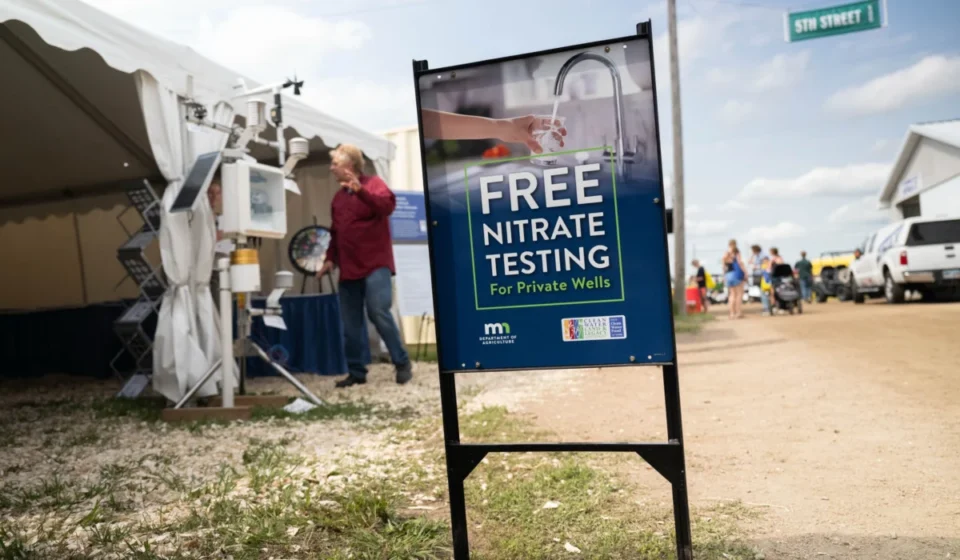
At Farmfest, the annual pilgrimage for Minnesota’s agricultural community, the atmosphere is typically defined by the smell of deep-fried corn dogs, the rumble of state-of-the-art tractors, and the polished rhetoric of politicians vying for rural votes. Yet, tucked away from the high-energy political forums and machinery displays, a more quiet, urgent scene unfolds at a nondescript booth run by the Minnesota Department of Agriculture.
Here, visitors line up not for campaign buttons or promotional trinkets, but to hand over Ziploc bags filled with water. Denton Bruening, an agency representative, oversees a spectrophotometer—a clunky, briefcase-sized device of gray plastic. He draws a sample into a clear tube, where an ultraviolet ray passes through the liquid to measure its chemical composition. After thirty seconds of processing, the digital display flashes a number: 7.3.
In the world of water safety, that number is a red flag. For the private well owner who brought this sample—water used for bathing, dishwashing, and drinking—it represents a silent, invisible, and potentially expensive health hazard.
The Magnitude of the Nitrate Problem
Nitrate contamination has been a persistent, multi-generational challenge for Minnesota. At the heart of the issue is the state’s agricultural backbone. Nitrogen-rich fertilizers and manure, essential for the state’s $9.3 billion agricultural export industry, often leach into the soil. In regions with porous geography or shallow aquifers—particularly in southwest, southeast, and central Minnesota—this chemical runoff migrates into the groundwater that supplies private residential wells.
The federal Safe Drinking Water Act mandates that public water systems meet strict safety standards for contaminants like nitrate. However, the estimated 93,000 Minnesotans who rely on private wells fall outside these federal protections. They are, for all intents and purposes, left to fend for themselves.
The federal government sets the maximum safe level for nitrate in drinking water at 10 milligrams per liter (mg/L). A result of 7.3, while technically "under" the limit, is alarmingly close to the threshold and warrants immediate concern. More critically, researchers have noted that even levels as low as 3.5 mg/L are linked to adverse health outcomes, including increased risks of certain cancers and complications during pregnancy, such as miscarriages.
A Chronology of Contamination and Awareness
The awareness of this public health crisis did not emerge overnight. The Minnesota Department of Agriculture’s initiative to provide free testing, which began in the 1990s, was a response to growing concerns from rural communities about the quality of their tap water.
- The 1990s: The Department of Agriculture launches outreach clinics to provide testing for rural well owners, acknowledging that they are the population most vulnerable to groundwater pollution.
- The 2000s–2010s: As intensive farming practices continue to evolve, the accumulation of nitrates in the water table becomes more pronounced. Data from private well testing begins to show a consistent, albeit localized, trend of high contamination in agricultural hubs.
- Present Day: The issue remains a "third rail" in Minnesota politics. While state agencies provide testing, regulatory efforts to limit the source of the nitrogen—fertilizer application—are frequently met with intense resistance from industry stakeholders.
Supporting Data: The Cost of Cleanliness
For a family whose well tests positive for high nitrates, the options are as limited as they are expensive. The most common solution is the installation of a reverse osmosis (RO) system. These systems force water through a semi-permeable membrane to strip away impurities, but the barrier to entry is financial.
According to market quotes from companies such as Culligan, an RO system in a region like Mankato can cost anywhere from $500 to $5,000. For many low-to-middle-income rural families, this is an unexpected and prohibitive burden. While some counties in the southeastern part of the state have piloted programs to provide free RO systems to those with high-nitrate wells, these programs are the exception, not the rule. Most counties simply lack the budget to subsidize filtration technology for their citizens.
The alternative—drilling a new well—can cost tens of thousands of dollars, with no guarantee that the new aquifer access point will be free from the same contamination plume affecting the old one.

Official Responses and Political Realities
The political landscape surrounding water quality is as complex as the geography of the aquifers themselves. Environmental advocacy groups have long lobbied for a reduction in the state’s maximum nitrate limit, pushing to lower the threshold from 10 mg/L to 3.5 mg/L.
However, the path to legislative change is blocked by the immense political and economic influence of the agricultural sector. Tony Runkle, lead geologist at the University of Minnesota’s geological survey, describes the push for stricter regulations as a "huge heavy lift."
"There’d be a ton of opposition from ag," Runkle notes. Given that Minnesota is the seventh-largest farming state in the nation, the industry’s economic output grants it significant leverage in the state capitol. Politicians across the aisle are careful not to alienate the farming base, often preferring voluntary conservation programs over mandatory restrictions.
Mitigation: The Path Forward
The Department of Agriculture has attempted to bridge this divide through education and management plans. Bruening, who is a former farmer himself, is careful not to cast the agricultural industry as a villain. He points out that nitrates are ubiquitous in the human diet, noting that a single serving of spinach can contain significantly higher concentrations of nitrates than what is found in contaminated water.
Yet, the department continues to promote nitrogen and fertilizer management plans. These include:
- Cover Cropping: Planting non-commercial crops during the off-season to absorb excess nitrogen from the soil before it can leach into the groundwater.
- Precision Application: Using modern technology to apply only the exact amount of fertilizer needed by the crop, reducing the excess that ends up in the water supply.
While these practices are effective, they are not mandatory. They require farmers to invest time and capital into sustainable practices that may not provide an immediate financial return. Without a state mandate, the adoption of these techniques remains voluntary and sporadic.
Implications for the Future
For the average citizen at a water clinic, the reality is a mix of resignation and adaptation. "Some people just drink bottled water," Bruening says, reflecting on his conversations with well owners. "That’s kind of become a preference for a lot of people."
The long-term implication is a rural population increasingly disconnected from their own groundwater. When residents stop trusting their taps, they turn to plastic-bottled alternatives, adding to the state’s waste stream and signaling a failure in water infrastructure.
The Department of Agriculture continues to urge well owners to test their water annually. Beyond the Farmfest booths, Soil and Water Conservation Districts throughout the state offer similar testing, and eligible community partners can even borrow the equipment to host their own clinics.
Ultimately, the goal is to ensure that Minnesotans understand the chemistry of their wells. "We want to make sure that people feel comfortable coming in and having their sample tested," Bruening says, "and then we also want to make sure that they’re understanding why they may have high nitrates."
As the state grapples with the tension between its status as an agricultural powerhouse and the health of its natural resources, the water in those Ziploc bags tells a story that cannot be ignored. Until policy catches up to the science, the responsibility—and the cost—of clean water will continue to rest on the shoulders of the rural families who live above the state’s changing landscape.