


































In the heart of Minneapolis, the Rosalux Gallery has become a site of profound intersectionality. Through her latest immersive installation, Living Threads, St. Paul-based artist Hend Al-Mansour invites viewers into a meticulously crafted dialogue about what it means to exist as an Arab woman in the modern diaspora. Utilizing the labor-intensive medium of screen printing, Al-Mansour constructs a narrative that is at once deeply personal and broadly resonant, arguing that the power inherent in the Arab female experience is a universal force.
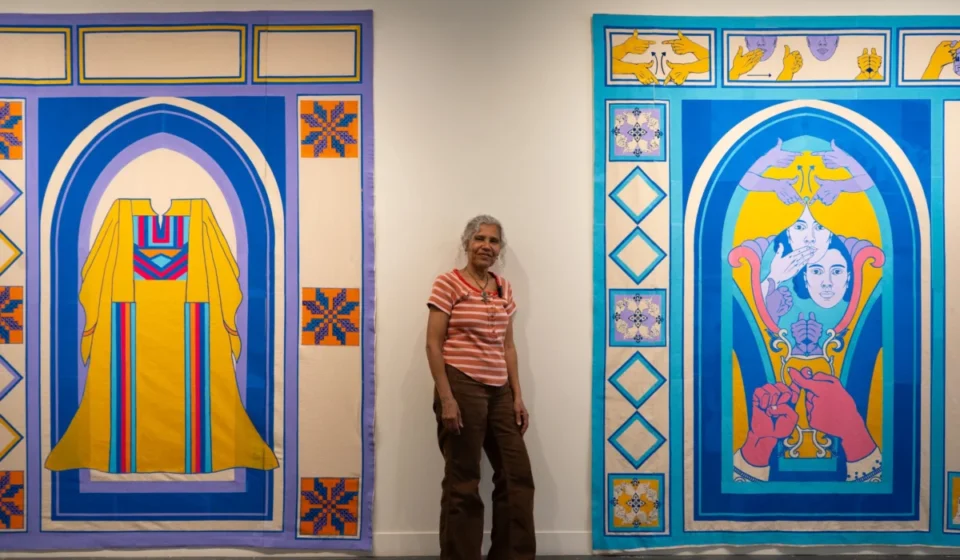
The exhibition, which serves as a continuation of her earlier explorations into portraiture and architectural symbolism, centers on the life of Yara Omer, a Palestinian American poet and educator based in Minnesota. By weaving together Islamic architectural motifs, the fluid geometry of American Sign Language (ASL), and the intricate, storytelling patterns of traditional Palestinian embroidery, Al-Mansour transforms the gallery into a sanctuary of lived experience.
The Architecture of Identity: A Chronology of Artistic Evolution
To understand the weight of Living Threads, one must look at the evolution of Al-Mansour’s practice. Born in Saudi Arabia, Al-Mansour’s trajectory into the fine arts was unconventional. Her first professional life was that of a physician; she arrived in Minnesota in 1997 as a medical fellow at the prestigious Mayo Clinic. However, the constraints she felt during her upbringing—characterized by the mandatory wearing of an abaya, the forced separation of genders, and the constant surveillance of religious police—eventually prompted a radical life change.
"You go shopping, for example, and there’s this guy following you and asking you to cover the piece of your hair that came out," Al-Mansour recalls of her youth. "For me, it was like a prison. I just couldn’t tolerate it anymore. So that’s why I just left."

Seeking a medium to process this history, she pivoted to art, eventually earning a Master of Fine Arts from the Minneapolis College of Art and Design. Her work quickly began to reflect the tensions between her past in the Middle East and her life in the Midwest.
A pivotal moment occurred in 2025 at the Minneapolis Institute of Art (Mia) with the exhibition Mihrabs: Portraits of Arab American Women. In this series, Al-Mansour placed portraits of four women within walk-in architectural structures that mirrored their cultural roots. This exhibit was not without its hurdles; an earlier, separate exhibition at the same institution was postponed due to institutional discomfort regarding depictions of the Prophet. Rather than retreat, Al-Mansour leaned into the power of the portrait, narrowing her focus to celebrate the resilience and agency of Arab women. Living Threads is the latest iteration of this mission, refining the broad scope of Mihrabs into a singular, intimate exploration of one woman’s identity.
Supporting Data: The Craft of Community
The creation of Living Threads is as much a performance of labor as it is a visual statement. Al-Mansour employs an exacting, multi-layered screen printing process that demands both physical stamina and technical precision. Because her mesh stencils are limited to a four-foot-by-four-foot scale, she must segment her large-scale image negatives into six distinct pieces, preparing a screen for each.
Each color is inked individually onto a large studio table, requiring the artist to wash and re-set stencils for every layer of the composition. This year, she was joined in the studio by William Noor, a queer Palestinian American writer. Al-Mansour, serving as both creator and mentor, taught Noor the mechanics of the craft, effectively extending the "living thread" of the project into the community she seeks to uplift.

The visual result is a series of works defined by a deceptive softness. The pastel color palette invites the viewer to linger, creating an atmosphere that feels welcoming, even intimate. Yet, these works are anchored by heavy intellectual and emotional weight. In one panel, the viewer sees the intricate geometry of a Palestinian thobe; in another, they see the hand shapes of ASL. These elements are not merely decorative—they are documentation. By incorporating ASL, Al-Mansour honors Omer’s profession as a Deaf educator, effectively translating the "spoken" poetry of her life into a visual language that transcends barriers of sound.
Official Perspectives and Personal Testimony
Al-Mansour’s work is deeply rooted in a desire to humanize a population frequently flattened by geopolitical headlines. Growing up, she was surrounded by Palestinian friends whose families were displaced during the 1948 Nakba. She retains a vivid memory of neighbors who kept the physical keys to their lost homes, a symbol of their enduring hope for return.
"It is not my direct experience, but it was very close to home," she reflects. Regarding her current artistic intent, she is clear: "I want to present Palestinian people as normal people. To show their love of beauty, what they do, what they love, what are their hopes."
This philosophy is embodied in her process of working with her subjects. Before she ever touches a screen, Al-Mansour conducts multiple interviews, meeting the women in their own homes or local coffee shops to understand their fears, goals, and daily realities. When she encountered the sign "Life is better with friends" in Yara Omer’s home, she knew it was the thematic anchor she needed.

"I really like that sentence because it described her very nicely," Al-Mansour explains. "She has her small community, and she cares for them a lot, and they are a source of support to her, including Deaf and hard of hearing children and students." By translating this specific, deeply personal sentiment into ASL imagery, Al-Mansour bridges the gap between the individual and the universal.
The Broader Implications: Art in a Time of Crisis
The relevance of Living Threads extends far beyond the walls of the Rosalux Gallery. In an era of intense global polarization, Al-Mansour’s work acts as a quiet, persistent, and essential counter-narrative. By focusing on the strength of Arab women, she dismantles the monolithic stereotypes often projected onto them.
The artist’s work has frequently intersected with cultural tensions, and she is no stranger to the push-and-pull of the art world’s institutional politics. Yet, her focus remains steadfastly on the humanity of her subjects. When asked about the ongoing struggles of the Palestinian people, her response is one of tempered, profound hope: "I hope one day they find peace and justice. That’s all I hope for. I’m not sure they’ll have the land, but at least justice."
This sense of justice is, in itself, a thread running through all her work. Whether through her contributions to the forthcoming anthology Nick of Time: Women Write about Art and Aging (University of Minnesota Press, 2026) or her presence in the Twin Cities art scene, Al-Mansour is documenting a history that is often ignored by mainstream narratives.

Conclusion: A Call to Witness
Living Threads serves as an invitation to look closer. It is a reminder that the personal is the political, and that the act of telling one’s story—or allowing someone else to tell it with dignity—is a radical act of resistance. The exhibition will be on view at the Rosalux Gallery through August 30, with an artist talk scheduled for August 15. For those who visit, the experience offers more than just aesthetic pleasure; it offers a chance to participate in a community of shared humanity, where every thread—no matter how small—is essential to the fabric of our collective history.