














































In the high-stakes world of NBA front-office management, few executives have navigated as volatile a landscape as Tim Connelly, the president of basketball operations for the Minnesota Timberwolves. Over his four-year tenure, Connelly has been characterized by his aggressive, often audacious attempts to build a championship contender. However, the recent reality in Minneapolis suggests that his primary role has shifted from architect to "fixer."
The Timberwolves are currently in the midst of a radical restructuring, marked most recently by the salary-dumping of Julius Randle on the eve of this week’s NBA Draft. This move, while painful in its admission of previous miscalculation, signals a pivot toward fiscal flexibility and a younger, more cohesive core. Yet, as the dust settles, the organization finds itself answering difficult questions about asset management, the opportunity cost of past decisions, and the true price of championship aspirations.
The Chronology of a Roster Overhaul
The narrative of the Timberwolves’ recent turmoil is best understood through a timeline of rapid-fire personnel changes. Connelly’s tenure has been defined by a pattern of "gambits"—high-risk, high-reward moves—followed by frantic efforts to rectify the subsequent fallout.
The recent departure of Julius Randle follows a series of roster adjustments that saw the swift exit of mid-tier contributors like Bryn Forbes, Shake Milton, and Troy Brown, Jr. While these were peripheral moves, the decision to pivot away from lottery pick Rob Dillingham in February represented a far more significant, and arguably more damaging, administrative erasure.
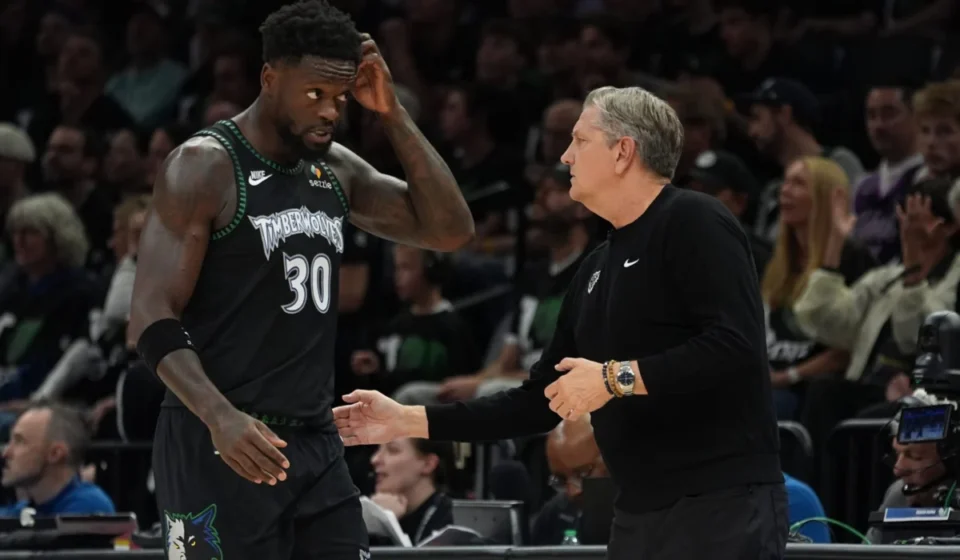
The Randle saga reached its zenith this Tuesday. Just one season ago, head coach Chris Finch praised Randle as "maybe our most important player," a sentiment backed by his role as the team’s leader in assists and second-leading scorer behind Anthony Edwards. Fast forward to the present, and that three-year contract transformed into an albatross that threatened to capsize the team’s long-term financial health.
By trading Randle to the Brooklyn Nets—one of the few teams with the cap space to absorb his $33 million salary—the Wolves were forced to attach the 28th overall pick in the draft as a "sweetener," receiving the 33rd pick in return. To facilitate the complex three-team trade, the Wolves also brought in fringe power forward Mo Gueye, a player whose 165 career NBA minutes suggest he will likely be waived before ever stepping onto the court for Minnesota.
Supporting Data: The Cost of Competitive Realignment
To understand the severity of these moves, one must look at the balance sheet. The Timberwolves’ decision to move on from Randle was not merely a reaction to his on-court performance, but a desperate maneuver to escape the punitive "first apron" of the NBA’s salary cap.
According to analysis by team insiders like Dane Moore, the trade was a mathematical necessity. By clearing Randle’s contract, the Wolves successfully dipped under the first apron, unlocking the "non-taxpayer midlevel exception." This acts as a $15 million "gift card" for teams, allowing them to sign free agents without triggering the most severe financial penalties of the new Collective Bargaining Agreement (CBA). Furthermore, the lack of incoming high-salary assets granted the team a $33.3 million trade exception, a vital piece of "wiggle room" that remains available for the next 365 days.
This financial maneuvering is being utilized to fund a new era, specifically the signing of Ayo Dosunmu to a five-year, $112 million package. When placed in the context of the team’s broader trajectory, the move makes sense: Randle’s lack of three-point accuracy hindered the floor-spacing required for Anthony Edwards to thrive, and his defensive intensity often fluctuated. His second-round playoff exit against the San Antonio Spurs, punctuated by a departure from the arena that bypassed the media, served as the final indicator that the partnership had reached a dead end.
The Shadow of Past Departures: The KAT Legacy
The current anxiety surrounding Connelly’s tenure is exacerbated by the success of former Wolves star Karl-Anthony Towns. Watching Towns play a pivotal role in the New York Knicks’ recent championship run has been a bitter pill for some fans to swallow.
When the Wolves swapped Towns for Randle, Donte DiVincenzo, and a draft pick that ultimately became center Joan Beringer, the objective was clear: shed the massive $53 million price tag of KAT’s contract to sustain the burgeoning young core of Anthony Edwards, Jaden McDaniels, and Naz Reid. While the logic was sound, the reality of a former star winning a ring so soon after his departure makes the move feel like a failure of vision rather than a success of management.
Critics often point further back to the acquisition of Rudy Gobert as the "original sin." That move, which cost the organization a treasure trove of draft capital, effectively forced the team into the uncomfortable position of having to choose between KAT and Gobert, ultimately rendering KAT’s position at center redundant. However, many analysts now argue that the true blunder was not the trade itself, but the decision to double down on Randle last offseason while allowing Nickeil Alexander-Walker to slip away to the Atlanta Hawks. Alexander-Walker’s subsequent rise to "Most Improved Player" status, performing similar duties to Randle at half the price, remains a glaring indictment of the front office’s internal evaluation process.
Official Perspectives and Internal Friction
While the Timberwolves have maintained a public face of unity, the cracks in the facade have been visible regarding specific personnel. Insiders have noted a subtle, yet distinct, difference in philosophy between Connelly and Finch.
The Rob Dillingham acquisition was widely viewed as a "Connelly pick"—a move favored by the front office that did not necessarily align with Finch’s immediate rotational needs. Conversely, Julius Randle was seen as a "Finch guy," a player the head coach championed. The fact that both players were eventually moved suggests a compromise: the front office and the coaching staff are finally aligning on a singular vision, even if that alignment required the painful departure of their respective pet projects.
Implications: Building the Championship Template
As the Timberwolves look toward the 2026-27 season, the "addition by subtraction" strategy is beginning to show its potential. By moving Randle, the team has effectively handed the keys to the kingdom to the youth movement. Naz Reid, after years of operating in the shadows of Towns and Randle, is finally positioned to anchor the starting lineup, a role he has earned through years of consistent, high-level production. Jaden McDaniels is slated for a larger role as a playmaker, providing the secondary scoring that the team desperately lacked.
The team’s core—Anthony Edwards, McDaniels, Reid, Dosunmu, Beringer, and T.J. Shannon—is now locked in for the next three years. This level of continuity is exactly what the top-tier franchises in the NBA—the ones relying on wing depth and selfless, defensive-minded play—have utilized to reach the mountaintop.
The road ahead is not without its hazards. The organization is still feeling the ripple effects of the Dillingham trade, notably the 2031 first-round pick owed to the San Antonio Spurs. Yet, the consensus among those watching the franchise closely is that the "character issue" that plagued the team during the 2025-26 season has been addressed.
Tim Connelly’s tenure has been a frantic, messy, and expensive experiment. However, by clearing the decks and committing to a sustainable financial model, he has finally established a clear, albeit difficult, path forward. The Timberwolves are no longer looking for the next "big" move to fix their mistakes; they are looking for the right moves to build a culture. Whether that transition translates into a championship remains the ultimate, unanswered question, but for the first time in years, the roster reflects a coherent identity rather than a collection of expensive, conflicting parts.