









































Weaving Identity: Hend Al-Mansour’s "Living Threads" Reimagines the Power of Arab Womanhood

In the quiet, light-filled spaces of Minneapolis’s Rosalux Gallery, a transformation is taking place. Through the intricate medium of screen printing, St. Paul-based artist Hend Al-Mansour is bridging the gap between the deeply personal and the historically profound. Her latest exhibition, Living Threads, is more than a display of technical mastery; it is a profound act of storytelling that seeks to dismantle monolithic perceptions of Arab women, replacing them with a tapestry of individual power, resilience, and humanity.
For Al-Mansour, screen printing is not merely an artistic choice—it is a vehicle for understanding. By layering colors and motifs, she invites the viewer into a dialogue about what it means to exist at the intersection of heritage, displacement, and modern identity. "My goal is to show that not only are Arab women powerful, but all women are powerful," Al-Mansour says. It is a clarion call for empathy in an era often defined by division.
The Evolution of a Vision: From the Clinic to the Canvas
To understand the depth of Living Threads, one must first look at the trajectory of Al-Mansour’s own life. Born in Saudi Arabia, she did not begin her professional journey in the art world. Her first career was that of a physician, a role that demanded precision, diagnostic skill, and a deep engagement with the human condition.
In 1997, she arrived in Minnesota as a medical fellow at the Mayo Clinic. While the clinical environment provided structure, it did not satisfy her creative spirit. Within a few years, she made the bold decision to pivot, enrolling in the Minneapolis College of Art and Design. There, she earned her Master of Fine Arts, trading the stethoscope for the silk screen and the surgical blade for the art knife. This transition was, in many ways, an extension of her previous work; both medicine and art, she discovered, are ways of examining the "anatomy" of a person’s experience.

Her path has not been without its hurdles. Al-Mansour’s work often touches on sensitive cultural and political themes. Before the success of her 2025 exhibition, Mihrabs: Portraits of Arab American Women at the Minneapolis Institute of Art (Mia), she was forced to navigate the complexities of institutional gatekeeping. An earlier, different exhibition at the same museum was postponed due to its thematic focus on the Prophet. Rather than retreat, Al-Mansour recalibrated, shifting her lens to celebrate the lived realities of Arab women—a pivot that ultimately led to the powerful, community-centered work seen in Mihrabs and now in Living Threads.
Chronology: A Commitment to Community
The timeline of Al-Mansour’s recent work reveals a deepening commitment to the subjects she chooses to profile.
- 1997: Al-Mansour moves to Minnesota, beginning her transition from medicine to the arts.
- 2024: Her voice gains significant traction in the Twin Cities art scene, marked by a widely recognized exhibition at SooVAC.
- 2025: The debut of Mihrabs: Portraits of Arab American Women at the Minneapolis Institute of Art (Mia). This project established the foundation for her current methodology: interviewing women in her community and placing their portraits within architectural structures that reflect their cultural heritage.
- 2026 (Present): Living Threads opens at the Rosalux Gallery. Shifting from the group portraiture of Mihrabs, Al-Mansour narrows her focus to the singular, complex story of Yara Omer.
The Architecture of Identity: Focusing on Yara Omer
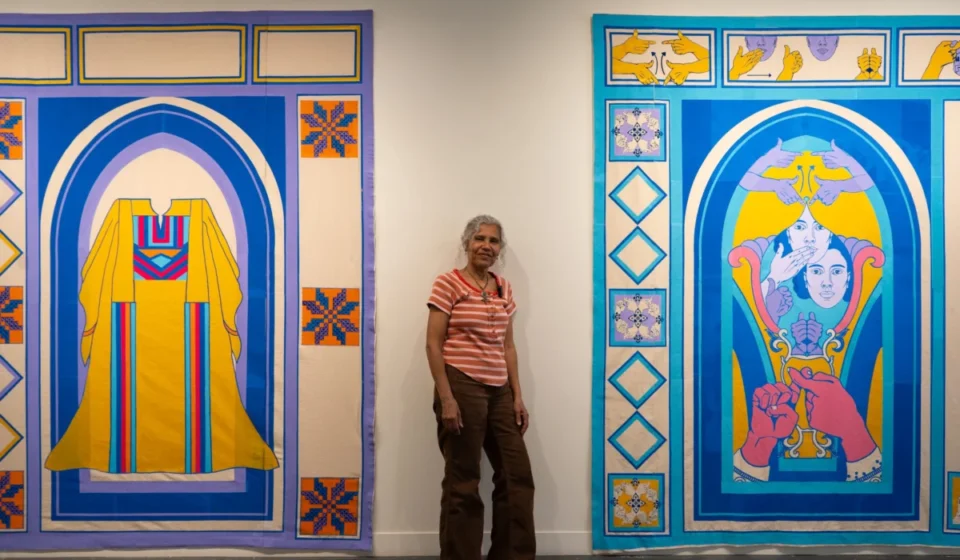
Living Threads is anchored by the story of Yara Omer, a Palestinian American poet and Deaf educator residing in Minnesota. To capture Omer’s essence, Al-Mansour employs a sophisticated visual language. She synthesizes three distinct elements: Islamic architectural motifs, the fluid movements of American Sign Language (ASL), and the intricate, ancestral embroidery patterns found in traditional Palestinian thobes.
The choice of imagery is intentional. The architectural references evoke the Dome of the Rock in Jerusalem—a symbol of endurance and historical gravity—while the ASL components highlight Omer’s professional life as an educator for the Deaf and hard-of-hearing community.

"I really like that sentence," Al-Mansour says, referring to a sign in Omer’s home that reads: Life is better with friends. For the artist, this is the thesis of the exhibition. It reflects Omer’s devotion to her community, her students, and the small, supportive networks that sustain us in times of global uncertainty. Al-Mansour translated this phrase into ASL, integrating the visual representation of the sign directly into the print, effectively allowing the artwork to "speak" in a language of inclusivity.
Technical Meticulousness as a Form of Care
The production of Living Threads is a testament to the labor-intensive nature of Al-Mansour’s practice. Because her mesh stencils are limited to four-foot-by-four-foot dimensions, she must engage in an "exacting process" to create large-scale works. She divides her image negatives into six separate sections, preparing individual screens for each.
The process is meditative and communal. She prints one color at a time onto a large studio table, washing and prepping the stencils between each layer. For this series, she collaborated with William Noor, a queer Palestinian American writer. Al-Mansour’s mentorship of Noor—taking him from a novice to a proficient printer—underscores her belief in the power of shared knowledge and collaborative creation.
The resulting aesthetic is deceptive. The prints feature soft, pastel color palettes that invite the viewer into a space of warmth and comfort. However, beneath the aesthetic appeal lies a heavy, urgent reality. The works are designed to confront the current historical moment, acknowledging the displacement and suffering of the Palestinian people while simultaneously insisting on their humanity.

Global Context and Personal Resonance
Al-Mansour’s work is deeply informed by her own history. Growing up in Saudi Arabia, she experienced a society where women’s public lives were heavily restricted by religious police and rigid social codes. "For me, it was like a prison," she reflects. "I just couldn’t tolerate it anymore."
This experience of confinement informs her empathy for the displaced. She speaks vividly of neighbors from her childhood who were refugees from the 1948 war, keeping the physical keys to homes they could no longer enter. "It is not my direct experience, but it was very close to home," she says.
Her mission with Living Threads is to bridge the gap between "the news" and the person. "I want to present Palestinian people as normal people," she explains. "To show their love of beauty, what they do, what they love, what are their hopes." By centering the individual story of Yara Omer, she reminds the viewer that behind every statistic or political headline is a person with a career, a community, and a future they are fighting to build.
Implications: The Art of Justice
The implications of Living Threads extend far beyond the walls of the Rosalux Gallery. By highlighting the intersection of Palestinian identity, Deaf culture, and female empowerment, Al-Mansour is expanding the discourse on who gets to be represented in contemporary art.

Her work suggests that justice is not merely a political outcome, but a cultural practice. When she says, "I hope one day they find peace and justice. I’m not sure they’ll have the land, but at least justice," she is framing art as a form of witness. She is ensuring that the stories of the marginalized are preserved, printed, and presented for public consumption, making it harder to look away.
Supporting Information and Upcoming Events
For those wishing to engage with the work in person, Living Threads remains on view at the Rosalux Gallery through August 30, 2026. The gallery is open Saturdays and Sundays from 12:00 p.m. to 4:00 p.m., or by appointment.
- Artist Talk: A special artist talk is scheduled for Saturday, August 15, from 2:00 p.m. to 3:00 p.m. Admission is free.
- Literary Contribution: In addition to her visual work, Al-Mansour has contributed an essay to the forthcoming anthology Nick of Time: Women Write about Art and Aging, edited by Julie Landsman, Debra J. Stone, and Morgan Grayce Willow. The book is set for publication by the University of Minnesota Press on October 20, 2026.
As the political landscape continues to shift, Al-Mansour’s work serves as a steady, vibrant reminder of the power of the individual voice. Through the patient application of ink and the careful layering of identity, she offers a vision of the world that is, in the end, defined by its threads—the invisible but unbreakable connections that bind us all.