Main Facts: More Than a Race, an Australian Institution
Every year on the first Tuesday of November, Australia comes to a virtual standstill. The Melbourne Cup, famously dubbed "the race that stops a nation," is a 3,200-meter Group 1 handicap that transcends the boundaries of elite horse racing to become a defining cultural ritual. Held at the historic Flemington Racecourse in Melbourne, Victoria, the event commands a global audience of millions, turning a test of equine stamina into an international spectacle.
+-------------------------------------------------------------------------+
|                          THE MELBOURNE CUP                              |
|  Established: 1861 | Location: Flemington | Distance: 3,200m (Handicap) |
+-------------------------------------------------------------------------+
While the race is a centerpiece of the global racing calendar, its true legacy is written in the stories of the horses, trainers, and jockeys who have braved its demanding conditions. The Melbourne Cup is uniquely challenging because of its handicap format, where higher-rated horses carry heavier weights to equalize the field. Winning the Cup requires an extraordinary combination of speed, tactical brilliance, and sheer endurance. Over more than a century and a half, the triumphs of figures like Phar Lap, Makybe Diva, and Bart Cummings have become national folklore, reflecting the values of resilience, egalitarianism, and determination that define Australian identity.
Chronology: The Great Eras of Flemington Legends
The history of the Melbourne Cup is best understood through the legendary figures who dominated different eras of the turf, shifting the race from a colonial curiosity to an international phenomenon.
CHRONOLOGY OF FLEMINGTON LEGENDS
1861: Archer wins the inaugural Cup
  │
1890: Carbine carries a record 66kg to victory
  │
1930: Phar Lap provides hope during the Great Depression
  │
1934: Peter Pan completes a legendary post-illness comeback
  │
1986: At Talaq masters a rain-soaked track
  │
1990: Kingston Rule sets the enduring track record (3:16.3)
  │
2005: Makybe Diva secures an unprecedented third consecutive Cup
  │
2015: Michelle Payne becomes the first female jockey to win
The Foundation Stones: Archer (1861, 1862) and Carbine (1890)
The inaugural running of the Melbourne Cup in 1861 was won by Archer, a bull-necked bay stallion from New South Wales. Archer’s back-to-back victories in 1861 and 1862 established the initial prestige of the race.
According to enduring Australian folklore, Archer’s trainer walked the horse over 500 miles (approximately 800 kilometers) from Terara in New South Wales to Flemington to compete. While modern historians debate the literal truth of this journey, the legend itself captured the public imagination, symbolizing the rugged pioneer spirit of 19th-century Australia. Archer’s dominant performances proved that the 3,200-meter distance required a rare breed of horse possessing both immense power and deep reserves of stamina.
Nearly three decades later, Carbine delivered what many turf historians consider the greatest single performance in Melbourne Cup history. In 1890, amidst a severe economic depression, Carbine lined up against a massive field of 39 runners—the largest in the race’s history.
Carrying an astonishing weight of 66 kilograms (145.5 pounds), Carbine gave weight to all his rivals and still crushed the field, winning in a then-record time of 3 minutes and 28.25 seconds. His triumph brought joy to a struggling public, and his subsequent career as a sire ensured his bloodline influenced legendary champions worldwide, including the great Phar Lap.
Icons of Resilience: Phar Lap (1930) and Peter Pan (1932, 1934)
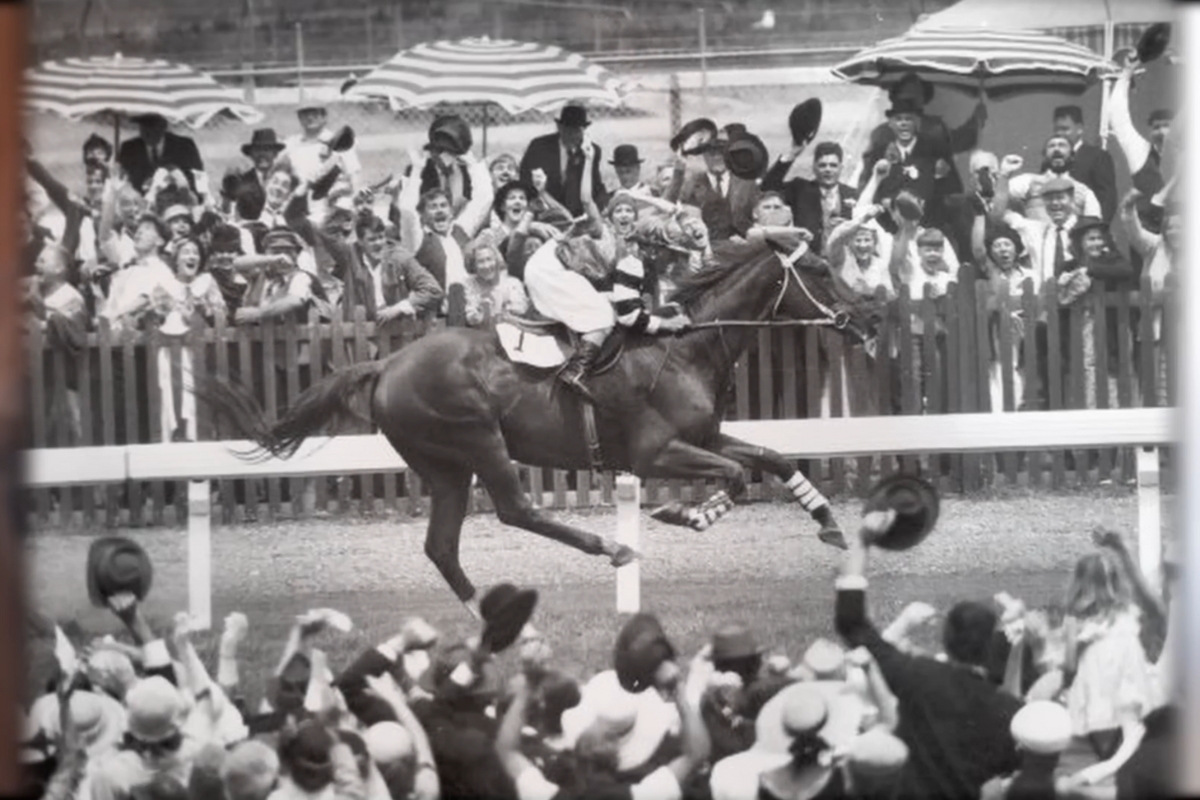
In the dark days of the Great Depression, Australia found a singular source of hope in a giant chestnut gelding known affectionately as "Big Red." Phar Lap was more than a champion; he was a national savior.
In the 1930 Melbourne Cup, despite facing death threats and an actual shooting attempt by bookmakers on the Saturday before the race, Phar Lap lined up as the shortest-priced favorite in Cup history. Carrying 62.5 kilograms, he cruised to an effortless victory.
His physical presence, characterized by an enormous stride and an oversized heart (which weighed 6.3 kilograms, more than twice the size of an average horse’s heart), made him seemingly invincible. Phar Lap’s tragic and mysterious death in the United States in 1932 devastated Australia, cementing his status as an eternal national symbol of hope in desperate times.
       [Phar Lap's 1930 Victory: A Beacon in the Great Depression]
       +--------------------------------------------------------+
       | Weight Carried: 62.5 kg | Odds: 8/11 ($1.73 favorite)  |
       | Legacy: A symbol of resilience during economic ruin.   |
       +--------------------------------------------------------+
Shortly after Phar Lap’s passing, another chestnut stallion captured the hearts of racing fans. Peter Pan won his first Melbourne Cup in 1932 as a three-year-old. Shortly thereafter, he was struck down by a severe bout of vesicular illness that nearly ended his life.
Against all medical expectations, Peter Pan returned to the track. In the 1934 Cup, run on a track turned into a muddy bog by torrential rain, Peter Pan carried a crushing 61.5 kilograms from a difficult outside barrier to claim his second victory. His comeback became a masterclass in courage, mirroring the resilience of an Australian public fighting its way out of economic ruin.
Speed and Turf Mastery: At Talaq (1986) and Kingston Rule (1990)
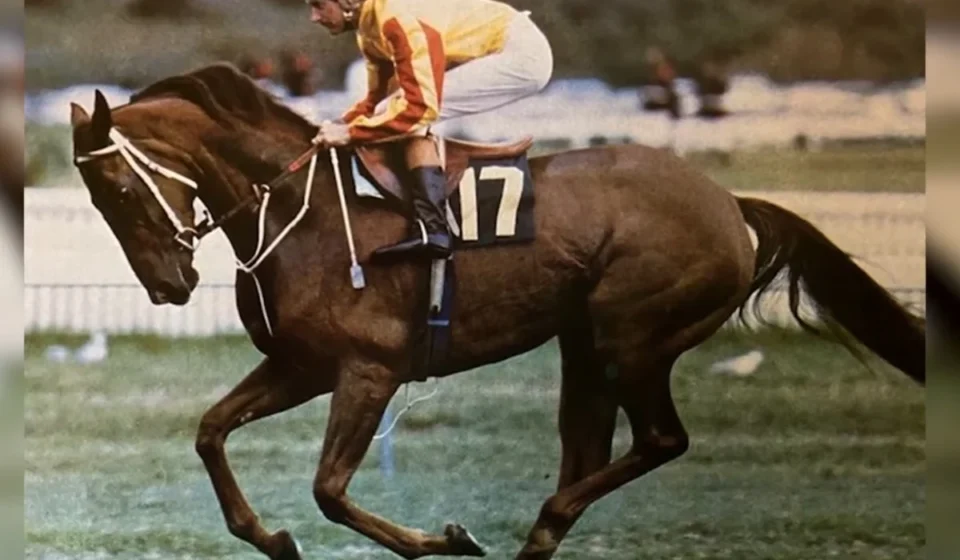
The late 20th century saw the Melbourne Cup transition into a faster, more tactically sophisticated race. In 1986, the American-bred, British-trained stallion At Talaq demonstrated the growing international appeal of the race.
Owned by Sheikh Hamdan bin Rashid Al Maktoum and trained by the legendary Colin Hayes, At Talaq mastered a heavily rain-soaked track. Ridden by jockey Michael Clarke, he surged from deep in the pack to claim a dramatic victory, proving that the modern Cup required adaptability to shifting weather and track conditions.
Four years later, in 1990, Kingston Rule redefined the speed limits of the Flemington track. Bred in the United States, Kingston Rule was royalty, sired by the legendary Triple Crown winner Secretariat out of the champion mare Rose of Kingston.
Trained by Bart Cummings, Kingston Rule stopped the clock at 3:16.3—a record time for the 3,200-meter distance that remains unbroken to this day. His victory proved that even in a long-distance handicap, world-class genetic speed could triumph over pure stamina.
The Modern Epoch: Makybe Diva (2003–2005) and Glen Boss
No horse in the history of the Melbourne Cup has achieved what the British-bred, Australian-trained mare Makybe Diva accomplished between 2003 and 2005. Before her, no horse had ever won three Melbourne Cups, let alone three in succession.
                       MAKYBE DIVA'S HISTORIC TRILOGY
          +--------------------------------------------------------+
          | Year | Weight Carried | Jockey    | Trainer            |
          +------+----------------+-----------+--------------------+
          | 2003 | 51.0 kg        | Glen Boss | David Hall         |
          | 2004 | 55.5 kg        | Glen Boss | Lee Freedman       |
          | 2005 | 58.0 kg        | Glen Boss | Lee Freedman       |
          +------+----------------+-----------+--------------------+
Her final victory in 2005, carrying a modern mare’s record of 58 kilograms, was a legendary performance. As she rounded the home turn, caller Greg Miles famously declared, "A champion becomes a legend, and a legend becomes a national treasure!"
Crucial to her historic trilogy was jockey Glen Boss, whose tactical brilliance and nerves of steel allowed him to guide the mare through congested fields. Boss’s ability to time Makybe Diva’s runs to the millisecond created one of the most successful and celebrated partnerships in global sporting history.
The Master of Flemington: Bart Cummings
If the horses are the heroes of the Melbourne Cup, trainer Bart Cummings was its architect. Known universally as "The Cups King," Cummings achieved a record that will almost certainly never be broken: 12 Melbourne Cup victories as a trainer.
                      BART CUMMINGS: THE 12-CUP LEGACY
   +--------------------------------------------------------------------+
   | 1965: Light Fingers | 1966: Galilee       | 1967: Red Handed       |
   | 1974: Think Big     | 1975: Think Big     | 1977: Gold and Black   |
   | 1979: Hyperno       | 1990: Kingston Rule | 1991: Let's Elope      |
   | 1996: Saintly       | 1999: Rogan Josh    | 2008: Viewed           |
   +--------------------------------------------------------------------+
Cummings’ first victory came in 1965 with Light Fingers, and his last in 2008 with Viewed. His training philosophy emphasized long-term conditioning, patience, and a deep understanding of equine psychology. Cummings possessed an unmatched ability to peak a horse precisely on the first Tuesday of November, rewriting the training manuals of Australian racing.
Breaking the Stained-Glass Ceiling: Michelle Payne (2015)
In 2015, the Melbourne Cup transcended sport once again to become a milestone for gender equality. Riding the 100-to-1 outsider Prince of Penzance, Michelle Payne rode a perfect tactical race to cross the line first, becoming the first female jockey to win the Cup in its 155-year history.
Payne’s victory was a triumph over both the grueling race and the deeply entrenched prejudices of a historically male-dominated industry. In her post-race interview, Payne delivered a fiery message that resonated far beyond the racetrack:
"It’s such a chauvinistic sport, a lot of the owners wanted to kick me off. Everyone else can get stuffed, because they think women aren’t strong enough, but we just beat the world."
Her victory and her words inspired a generation of sportswomen, changing the cultural landscape of Australian horse racing forever.
Supporting Data: The Numbers Behind the Myth
The prestige of the Melbourne Cup is backed by historical, economic, and performance metrics that highlight its difficulty and scale.
Weight-Carrying Records (Winners)
The handicap system is designed to prevent consecutive victories and stop superior horses from dominating. The weights carried by historical champions illustrate the magnitude of their achievements:
Carbine (1890): 66.0 kg (All-time record)
Phar Lap (1930): 62.5 kg
Peter Pan (1934): 61.5 kg
Makybe Diva (2005): 58.0 kg (Record for a mare)
Unbroken Track Records
Despite advancements in breeding, training, and track technology, the speed record set over three decades ago still stands:
Kingston Rule (1990): 3 minutes, 16.3 seconds.
3:16.3 ───────────────────────────────────────────────────────────► (1990 - Present)
[Kingston Rule's Unbroken Record Time]
Economic and Social Scale
Public Holiday Status: Since 1877, Victoria has observed a gazetted public holiday for the Melbourne Cup, a rare honor for a sporting event.
Global Reach: The race is broadcast to an estimated audience of over 650 million people in 163 territories worldwide.
Wagering: The event regularly generates over $100 million AUD in domestic betting turnover alone, reflecting its deeply ingrained status in Australian leisure culture.
Official Responses and Industry Perspectives
Over the decades, the Victoria Racing Club (VRC) and various racing authorities have had to balance tradition with modernization.
In the late 20th century, the VRC actively globalized the race. Following the historic victory of the Irish-trained challenger Vintage Crop in 1993, the Cup became a global target. This transformation prompted responses from local trainers, who initially feared that international raiders with superior staying power would dominate the field, shutting out local talent.
In recent years, the industry’s focus has shifted heavily toward equine welfare. Following several high-profile fatalities of international runners, the VRC and Racing Victoria implemented some of the most stringent veterinary screening protocols in the world in 2021. These regulations require all international entrants to undergo pre-travel and post-arrival CT and MRI scans.
While some international trainers initially criticized these protocols as overly restrictive, VRC officials defended the measures as essential for the sport’s survival.
"The future of the Melbourne Cup relies on our ability to demonstrate that we place the safety and welfare of our equine athletes above all else," a VRC representative stated during the announcement of the reforms.
Societal and Cultural Implications
The Melbourne Cup is a mirror reflecting the evolution of Australian society. From its origins in 1861 as a gathering for colonial settlers, it has grown alongside the nation, capturing its shifts in wealth, class, fashion, and social values.
                         THE CUP AS A SOCIAL MIRROR
   +--------------------------------------------------------------------+
   | 1877: Declared a public holiday, establishing leisure as a right.  |
   | 1930s: Provided national solidarity during economic crises.        |
   | 1960s: Introduced "Fashions on the Field," defining style trends.  |
   | 2015: Shattered gender barriers with Michelle Payne's victory.     |
   +--------------------------------------------------------------------+
The Democratization of Leisure
The establishment of the Melbourne Cup holiday in 1877 solidified the idea that recreation and sport were rights shared by all citizens, not just the wealthy elite. The race became a rare space where working-class laborers, high-society elites, and politicians stood side-by-side at the betting windows, united by a shared interest.
Fashion and Global Identity
In 1962, the VRC introduced "Fashions on the Field" to attract more women to the races. In 1965, British model Jean Shrimpton shocked the nation by wearing a white minidress without stockings, gloves, or a hat to Derby Day at Flemington. The moment became a cultural flashpoint, signaling the onset of the sexual revolution and cementing Flemington as a global runway for fashion and self-expression.
The Modern Debate
Today, the Melbourne Cup faces evolving social pressures. Younger generations of Australians are increasingly questioning the ethics of horse racing and sports betting advertising. The "Nup to the Cup" movement, which advocates against animal cruelty, has gained traction, prompting the industry to adapt.
The Cup’s survival depends on its ability to evolve. By implementing strict safety measures, supporting retirement programs for thoroughbreds, and celebrating milestones like Michelle Payne’s historic win, the event seeks to preserve its heritage while meeting modern ethical standards.
Ultimately, the Melbourne Cup remains an unmatched sporting tradition. The stories of Archer, Phar Lap, Makybe Diva, and the people who guided them are woven into the fabric of the nation. Year after year, as the field turns into the straight at Flemington, Australians stop to watch, waiting to see which new legend will write their name into the country’s history.