

























































By Sports Editorial Staff
In the fast-paced, often transient world of professional basketball, a decade-long career usually implies a veteran presence who has seen it all. For 31-year-old forward Nia Coffey, however, the first ten years of her WNBA journey were defined by constant movement. Having donned the jerseys of five different franchises since being drafted fifth overall out of Northwestern in 2017, Coffey’s career felt like a series of chapters in search of a cohesive story.
This summer, that narrative finally found its anchor. Returning to the Twin Cities—her home turf—to join the powerhouse Minnesota Lynx has provided more than just a sense of comfort; it has sparked a career renaissance. As the league-leading Lynx (11-3) continue to dominate the competition, Coffey has emerged as a cornerstone of their defensive identity and an unexpected offensive catalyst, proving that sometimes, the right player just needs the right system to thrive.
The Path Home: A Decade in Transition
To understand the significance of Coffey’s current success, one must look at the road traveled. Since entering the league as a highly touted prospect, Coffey spent years as a role player, fighting for minutes and consistency. Her journey was marked by the relentless churn of the WNBA’s free agency landscape.
For many, such a nomadic career can stifle development, yet Coffey maintained her work ethic. Growing up in the Twin Cities, she was deeply ingrained in the local basketball culture. Her pedigree is undeniable: the daughter of Richard Coffey, an Army paratrooper who starred for the University of Minnesota before a stint in the NBA, and the sister of current Phoenix standout Amir Coffey. She was a product of the legendary Hopkins High School program, a factory for basketball talent that later produced 2025 first-overall pick Paige Bueckers.
Despite this pedigree, Coffey’s WNBA tenure prior to Minnesota was characterized by fluctuating roles. She had only recorded one season in her career where she averaged more than seven points per game. But when the Lynx—a franchise known for its rigid, championship-caliber standards—came calling, both parties sensed a perfect match.
Chronology of a Breakthrough
The impact of this acquisition was immediate. Following an offseason that saw the Lynx lose several core players to free agency and the expansion draft, head coach Cheryl Reeve was tasked with recalibrating her roster. She didn’t just need a placeholder; she needed a high-IQ defender who could integrate seamlessly into a complex system.
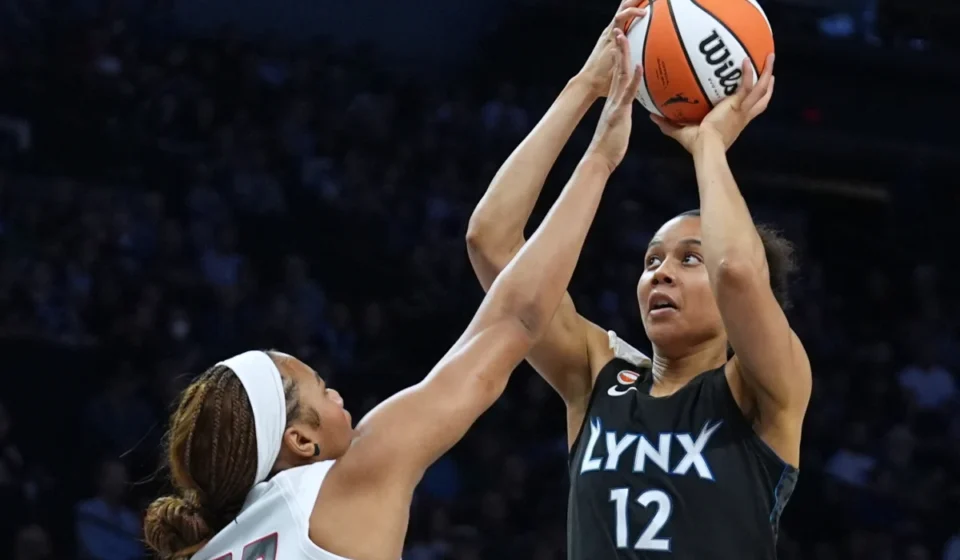
On Monday, during a 107-74 dismantling of the Portland squad, the results of this integration were on full display. The Lynx set a franchise record with seven players finishing in double-digit scoring, a testament to their unselfish ball movement. Among them, Coffey stood out as the engine of the performance.
Her stat line—15 points, five rebounds, four assists, three steals, and three blocks—placed her in rare company, becoming only the fifth player in the storied history of the Lynx franchise to hit those specific statistical benchmarks in a single game. The performance included a scorching first quarter featuring three 3-pointers and a buzzer-beating layup that brought the Target Center crowd to its feet. The reward was immediate: Coach Reeve presented her with the game ball, an honor reserved for the most impactful contributors of the night.
Statistical Analysis: The "Coffey Effect"
The numbers suggest this is not merely a hot streak, but a fundamental evolution in Coffey’s game. Under Reeve’s tutelage, Coffey is currently posting career-best averages across the board. She is playing a career-high 26.4 minutes per game, and her contributions have scaled accordingly:
- Points per game: 8.7 (Career high)
- Rebounds per game: 5.9 (Career high)
- Assists per game: 2.1 (Career high)
- Field Goal Percentage: 50%
- 3-Point Percentage: 43.9%
Perhaps most impressively, these numbers are being produced while the Lynx navigate the absence of star Napheesa Collier, who is currently sidelined following ankle surgery. Coffey has stepped into the starting lineup with seamless authority. Her ability to space the floor as a perimeter shooter while maintaining the "verticality" required for rim protection has allowed the Lynx to maintain their league-leading pace without missing a beat.
Official Perspectives: The Coach and the Player
The symbiotic relationship between Cheryl Reeve and Nia Coffey is perhaps the most compelling subplot of the season. Known for her demanding coaching style and tactical brilliance, Reeve has found in Coffey a pupil who prioritizes execution over ego.
"Her level of compete, her ability to play so vertically, shot-blocking, rebounding—she gives you all that energy and sets the tone for us," Reeve remarked in a post-game press conference. "She’s such a big part of our defensive identity and our toughness, and then shooting the 3 as we’ve asked for. We do ask a lot from her at both ends."
Beyond the metrics, Reeve highlighted a trait that is becoming increasingly rare in professional sports: radical coachability. "There are so many things. I think what I appreciate about her—probably because I don’t get it from the rest of the starters—is she listens," Reeve noted with a dry laugh. "She really looks at you dead in your eye and receives the information and goes out there and does exactly what you’re asking her to do."
For her part, Coffey remains humble, viewing the opportunity in Minnesota as a long-awaited chance to learn from one of the greatest coaching minds in the game. "I like to do a good job, so you kind of have to know what they’re asking for," Coffey said. "I’ve always known [Reeve] was a great coach from afar, so the fact that I can see it first-hand is really cool. I’m still learning a lot."
Implications for the Lynx and the League
The implications of Coffey’s emergence are significant for the remainder of the season. As the WNBA playoffs loom on the horizon, the Lynx have proven that their depth is not just a safety net, but a primary weapon.
- Tactical Flexibility: By developing a player who can defend multiple positions and stretch the floor, the Lynx have become increasingly difficult to scout. Opponents can no longer focus solely on the star power of the backcourt, as Coffey has demonstrated she can be a primary offensive option when necessary.
- Culture and Continuity: In a league defined by rapid roster turnover, the success of a veteran like Coffey finding a "second act" in her home state serves as a reminder of the importance of organizational culture. The Lynx have successfully turned a "rebuilding" year into a championship pursuit by identifying players who fit their specific, high-intensity DNA.
- The Road Ahead: With Napheesa Collier’s eventual return, the Lynx will face the challenge of integrating their star back into a rotation that has already found a rhythm. However, with the emergence of high-IQ contributors like Coffey, the coaching staff has the luxury of deep rotations that can keep the team fresh for a deep postseason run.
As the season progresses, all eyes will be on whether this momentum can be sustained. For Nia Coffey, the journey has been long, winding, and at times uncertain. But as she continues to dominate in the familiar surroundings of Minneapolis, it is clear that she hasn’t just found a team—she has found her identity as a pivotal force in the WNBA. The girl from the Twin Cities has finally come home, and the league is taking notice.