






















































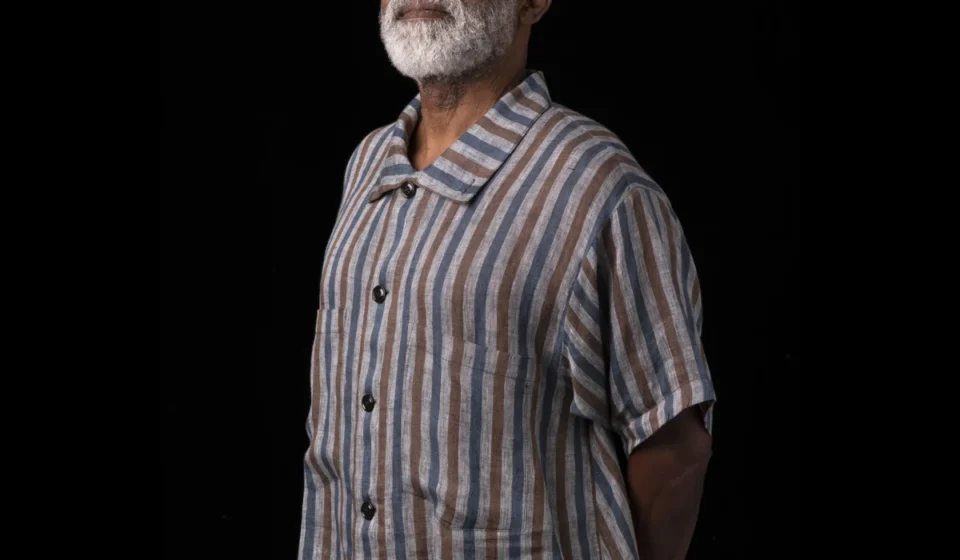

For decades, Seitu K. Jones has been a foundational pillar of the Twin Cities’ cultural landscape. Whether through his large-scale public art, his community-driven meals that feed both body and spirit, or his activism in food justice, Jones has operated at the intersection of environmentalism and Black history. Yet, despite a career spanning generations and a national reputation that has seen his work acquired by the Walker Art Center and honored with the prestigious ArtPrize Grand Juried Prize, the Minnesota Museum of American Art (the M) is currently presenting something long overdue: his first-ever solo museum exhibition.
Titled “The Smell of Earth: Seitu K. Jones Working in the Elements,” the exhibition, which opened on October 22 and runs through July 25, 2027, offers an intimate, sprawling look at an artist whose technical range is as vast as his historical curiosity.
A Botanical Thread: The Symbolism of the Collard Green
Upon entering the gallery, visitors are immediately greeted by a recurring, earthy motif: the collard green. This humble, hearty vegetable acts as the exhibition’s connective tissue, manifesting in charcoal drawings, layered paintings, and even a unique sculptural form housed within a hand-carved box crafted from Minnesota basswood.
“I keep coming back to collard greens as a way of accessing Southern cuisine,” Jones explains. “And then exploring these African American culinary traditions—this line that connects us all to Africa.”
For Jones, the collard green is not merely a subject of still life; it is a historical document. By meticulously documenting the plant’s life cycle—from germination to maturity—Jones draws a parallel between the endurance of the plant and the survival of the African diaspora. It is a testament to his background in landscape design and environmental history, grounding his artistic practice in the very soil that his ancestors were forced to labor upon, yet which he chooses to nurture.
Chronology: A Lineage of Land and Labor
To understand the depth of Jones’ work, one must look at his family’s four-generation trajectory in Minnesota. His great-grandfather, a man who emancipated himself from slavery before fighting for the Union Army in the Civil War, eventually settled in Red Wing. There, he worked as a porter at the St. James Hotel, saving every penny to realize a dream that had been denied to him: owning his own land.
This legacy of land-stewardship passed to Jones’ grandmother, who migrated to the Old Rondo neighborhood of St. Paul over a century ago. In an act of quiet, radical defiance, she transformed her backyard into a productive farm. Jones carries vivid sensory memories of those years: the scent of plum trees and the sound of his grandmother and aunts “fussing back and forth” in the kitchen on Fuller Avenue.
These early experiences laid the foundation for his professional life. With an undergraduate degree in landscape design from the University of Minnesota’s School of Agriculture and a graduate degree in environmental history, Jones’ art has always been inextricable from his scientific and ecological knowledge. He is a co-founder of Frogtown Farms, an organization that serves as a living laboratory for food justice, proving that for Jones, art and agriculture are two sides of the same coin.

Supporting Data: Technical Range and Archival Preservation
The exhibition is the result of a rigorous collaboration between Jones and archivists Ego Ahaiwe Sowinski and Alexandra Nicome. The process of curating “The Smell of Earth” was essentially an archaeological dig through the artist’s own storage. Many of the works on paper had spent years rolled up in tubes, hidden from public view.
“We were interested in showing these works where Seitu had an opportunity to slow down and really work at a more intimate scale,” Nicome notes. The result is a revelation of technical virtuosity. One piece, a hyper-detailed rendering of a germinating collard, displays a level of draftsmanship that contrasts sharply with the bold, public-facing nature of his street installations.
The museum’s team also undertook significant conservation work to prepare the show. A 1997 painting titled “Sabian,” which depicts his cousin’s son ice fishing, required careful restoration to address a tear. By repairing these pieces, the museum is not just presenting an exhibition; it is actively participating in the preservation of Black artistic heritage—a cause to which Jones has dedicated his life.
The Urgency of Memory: The Black Gate Initiative
The lack of a solo museum retrospective until this point is, as many in the art world acknowledge, a symptom of a broader, systemic failure. Jones speaks with a somber clarity about the fragility of Black artistic legacies in America.
“I’ve lost so many friends, collaborators, mentors, people who I looked up to, who passed on and whose work has literally ended up in a dumpster, or whose legacies are not remembered,” Jones says. “Unfortunately, what happens more and more to African American artists and Indigenous artists and other artists of color is that after a generation, their memories are gone.”
This realization led him to establish The Black Gate, an archival initiative dedicated to identifying, documenting, and preserving the work of Black artists. In the context of this exhibition, the archives serve as a bulwark against erasure. By bringing these works to the museum, Jones is forcing the institution to acknowledge a history that has been systematically overlooked.
Implications: The Self-Portrait as Historical Witness
The exhibition also serves as a poignant exploration of the Black male experience. Through a series of self-portraits, Jones inserts himself into the narrative of the last 400 years of American life.
“I’ve been doing these portraits of myself, placing myself in the situations that many African American men have found themselves in,” Jones explains.

In the museum’s atrium, large-scale charcoal drawings depict figures in states of transcendence, floating in the air—a nod to his public art practice. Yet, in other areas, the work takes a darker, more visceral turn. “Street Scene (Self portrait)” shows the artist with his eyes closed, lying in the street near a pair of abandoned boots, a chilling reference to the cycles of state-sanctioned violence and police brutality that have defined the modern era.
Another piece shows feet dangling against a beautiful, lush landscape. It is a harrowing juxtaposition: the quiet beauty of the natural world set against the brutal, historical reality of lynching. These works do not merely document pain; they demand that the viewer bear witness to the complexity of existing as a Black man in a landscape that is both home and site of trauma.
The Intersection of Legacy and Future
The exhibition also places Jones’ work in conversation with others, including the late George Morrison and his long-time friend and collaborator, Ta-coumba T. Aiken. Perhaps most moving is the inclusion of an unfinished painting by Jones’ own father. The work depicts a young Seitu, and while it shows clear artistic promise, its unfinished nature speaks volumes about the constraints of a life defined by manual labor and the daily struggle for survival.
“The Smell of Earth” is more than an exhibition; it is a retrospective of a life lived in service to the land, the community, and the truth. By centering the exhibition on the elemental—the soil, the food, the hands that work the earth—Jones provides a roadmap for how we might remember those who came before us.
As the museum doors remain open until next July, visitors have the rare opportunity to see an artist who has spent his life working in the shadows of public spaces finally claim his place in the spotlight. It is a show that asserts, with quiet, earthy power, that the most important work is that which keeps the memory of a people alive.
Exhibition Details:
- The Smell of Earth: Seitu K. Jones Working in the Elements
- Dates: October 22, 2026 – July 25, 2027
- Location: Minnesota Museum of American Art, 350 Robert St N, St. Paul
- Admission: Free
- More Information: mmaa.org/the-smell-of-earth-the-work-of-seitu-k-jones/