



























































On a sun-drenched late summer morning in Hibbing, Minnesota, the rhythmic creak of swing sets and the laughter of toddlers offer a deceptive sense of permanence. Dave Benz watches closely as his twin granddaughters, Maya and Lucy, navigate the playground equipment at Greenhaven Elementary. In just a few days, the girls will turn three—a milestone typically celebrated with the anticipation of future school years. But for this family, the playground feels like a relic of a vanishing era.
Out in front of the school, a stark, oversized yellow “For Sale” sign stands as a sentinel of shifting times. Following a grueling budget cycle that identified a $2 million deficit, the Hibbing School Board voted in March to shutter the doors of Greenhaven. For residents like Benz, the closure is more than just an administrative decision; it is a profound, localized loss. "Yeah, it was a sad one," he admits, his voice trailing off as he keeps a protective hand on the twins.
Across Minnesota, school districts are finding themselves caught in a tightening vice of declining enrollment and ballooning operational costs. As the state’s rural communities face these fiscal realities, the conversation has moved from minor budget cuts to the existential question of whether the small-town schoolhouse—the traditional anchor of rural life—can survive the 21st century.
A Historical Pattern: The 1990s Blueprint
The current wave of anxiety surrounding education in Northern Minnesota is not without precedent. In the 1990s, the state experienced a seismic shift in its educational landscape. Driven by the twin pressures of shrinking student populations and mounting financial instability, rural Minnesota saw the dissolution of one-fifth of its school districts.
Legislative incentives at the time encouraged consolidation, leading to the shuttering of over 150 school buildings as districts merged into larger, more centralized entities. While these consolidations often promised fiscal sustainability, they left many farming communities grappling with the loss of their primary social and economic hubs. Today, that cycle appears to be repeating, albeit with a new sense of urgency. In Hibbing and its neighbor, Chisholm, while no formal merger has been finalized, the word "consolidation" is appearing with increasing frequency in public discourse.
"It might have to happen in order to grow and be stronger," Benz reflects, though he is quick to acknowledge the personal cost. "I’m from here, so I’m a little biased. I would prefer the Hibbing school stay open."

The Weight of Identity: Schools as Community Anchors
In the rugged Iron Range—a region defined by its distinct history of mining and immigration—the relationship between a community and its school is deeply intimate. Paul Peltier, a former educator and the current director of the Range Association of Municipalities and Schools (RAMS), understands this tension better than most.
Peltier’s own youth was defined by the education shake-ups of the past. He attended four different schools before graduating from Grand Rapids High School. "We felt like we were bounced around," he recalls. "But we were just ‘Balsam boys.’ That’s what happens when you live 30 miles away from a school."
For Peltier, the school is more than a building; it is a repository of shared history. "Communities and families anchor themselves in their school," he says. "Schools owe it to them to make sure they are custodians and stewards of that identity." When a school closes, residents often feel as though a piece of their collective soul has been removed. This sentiment is particularly acute in towns born from the mining booms of a century ago, where the school was often the first institution established after the mine itself.
Modern Solutions: The Rock Ridge Model
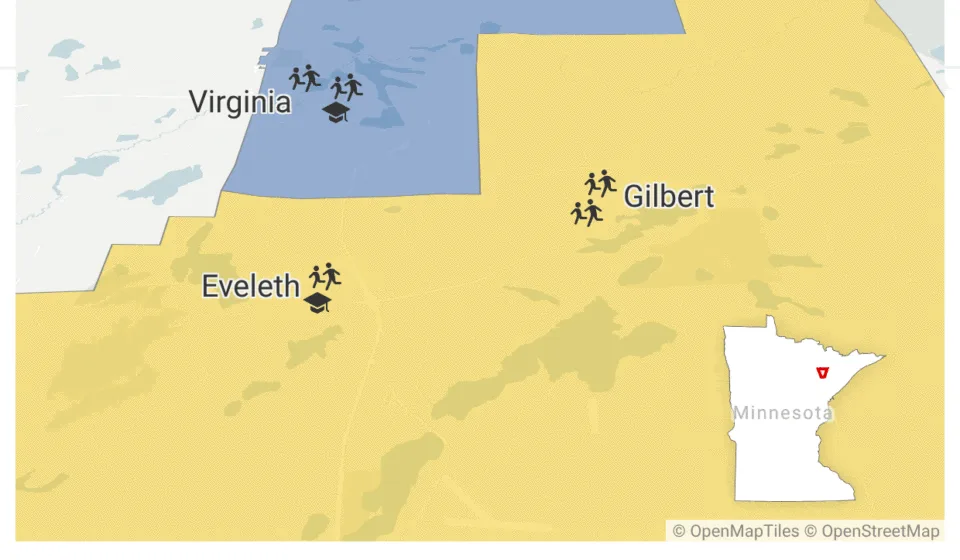
While the emotional toll of consolidation is high, some districts are attempting to flip the narrative by focusing on advanced facilities and expanded opportunities. Rock Ridge High School, which serves the combined communities of Virginia and Eveleth-Gilbert, stands as a prime example of this strategy. Now in its fourth year, the school is a modern marvel, complete with a grand piano in the cafeteria and a high-tech shop featuring a 3-ton crane.
Superintendent Noel Schmidt, who spearheaded the merger, views the facility as a necessary evolution. "If you’re a rural school, this is what you have to do," he says, gesturing to the career-academy-focused workshops. Schmidt notes that Rock Ridge raised over $3 million in community donations, suggesting that when the vision is clear, communities are willing to invest in the future.
John Uhan, the School Board Chair who helped guide the Eveleth-Gilbert district through the transition, calls the consolidation a "no-brainer." He points to the dire state of the old buildings—a century-old boiler that was failing and a shrinking kindergarten class of just 29 students. "Eveleth-Gilbert would have been in huge trouble," Uhan asserts. For him, the loss of the old school is a sacrifice worth making for the enhanced curriculum and athletic success the new district provides.

The Opposition: Voices of Discontent
Despite the technological upgrades, the transition has not been universally embraced. For every parent who appreciates the new opportunities, there is another who mourns the loss of the neighborhood institution. At the edge of the Rock Ridge commons, one parent expresses a visceral, expletive-laden frustration, describing the merger as a failure.
Critics of the Rock Ridge model point to the physical scars left behind: empty lots where elementary schools once stood for generations. In Gilbert, the site of a century-old school is now vacant land. While proponents argue that tearing down old, inefficient buildings is a strategic move, others feel the erasure is too absolute. "It was cool their kids got to go to the old elementary, too, before it was torn down," says one resident.
The conflict between "embracing the new" and preserving local history remains the central friction point in these consolidations. As Mayor Adam Roen of Eveleth notes, "The biggest downside that we feel in Eveleth is we don’t have our school district building right in the heart of it."
Supporting Data: The Arithmetic of Survival
The fiscal argument for consolidation is grounded in cold, hard numbers. Aaron Fischer, Executive Director of the Minnesota Rural Education Association, notes that schools are the lifeblood of rural economies. "When you have a football game and that neighboring town comes in, it’s your chance as a community to showcase what you have," he explains.
However, the mathematical reality of funding is unforgiving. With state revenue failing to keep pace with inflation and enrollment numbers trending downward, small districts are increasingly unable to afford the "basics": superintendents, principals, business managers, and support staff.
In Carlton County, the recent consolidation of Carlton and Wrenshall—which narrowly passed a public vote—serves as the latest data point in this trend. The message from experts is consistent: without enough students, the administrative overhead becomes unsustainable. Collaboration, such as sharing business services or sports teams, is often the first step, but many officials believe it is merely a stopgap measure for a much larger structural crisis.

Implications for the Future
The path forward is fraught with uncertainty. Paul Peltier, now running for the Rock Ridge School Board, emphasizes that the "pressure cooker" of education funding is leading to a state of apathy in the legislature. He fears that rural districts are being forgotten, or worse, that they are expected to fail.
Superintendent Schmidt offers a sobering warning to other districts: "My biggest concern is that rural schools won’t move fast enough. If we wait for an external factor to cause the consolidation, the improvement of education for our rural kids, we’re done for."
This "death by a thousand paper cuts" is the reality facing many rural educators today. Even after consolidating, districts like Rock Ridge are not immune to the demographic trends affecting the rest of the state. The challenge is no longer about saving a single building; it is about redefining what a school district looks like in a shrinking, changing landscape.
As the sun sets over the Iron Range, the empty playgrounds and the "For Sale" signs serve as quiet reminders of a transition that is as inevitable as it is painful. The communities of Northern Minnesota are learning that identity is not found in the bricks and mortar of a century-old school, but in the students themselves—and in the difficult, often heart-wrenching decisions their elders must make to ensure those children have a fighting chance in the world beyond the schoolhouse gates.
"Somebody is going to lose an identity," Steve Giorgi concludes. It is a harsh truth, but as the districts move forward, they are betting that the gains in opportunity for the next generation will eventually outweigh the losses of the past. Whether that bet pays off remains the defining question for rural education in the decade to come.