























































The High-Octane Culture War: How American Infrastructure Became the New Frontline of Masculinity

By [Your Name/Journalistic Desk]
"Freedom doesn’t ring, it revs!"
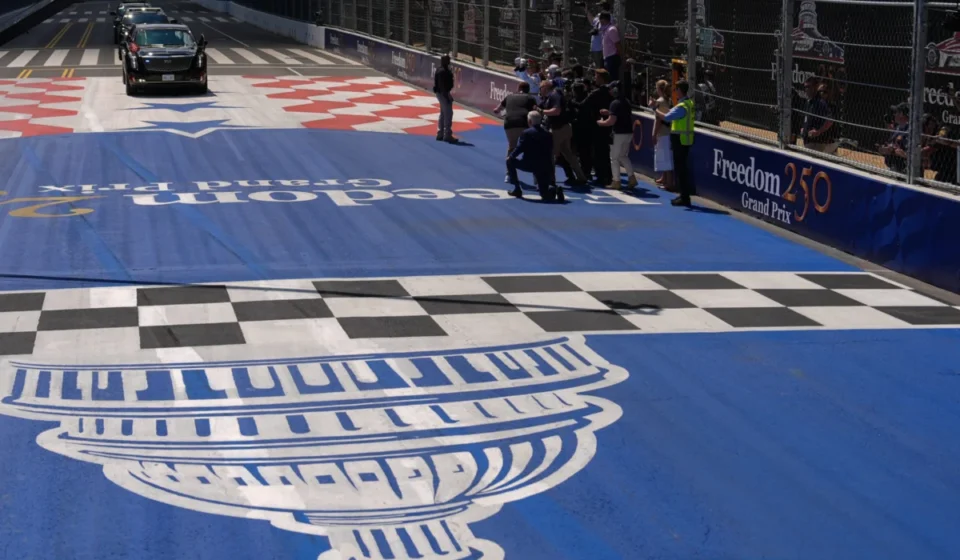
This punchy, high-octane tagline served as the rallying cry for the inaugural Freedom 250 Grand Prix, an IndyCar street race that transformed the historic National Mall in Washington, D.C., into a temporary speedway this past weekend. While the event was billed as a celebration of American engineering and motorsport, its staging in the nation’s capital—under the watchful eye of the current administration—served as a vivid, visceral manifestation of a shifting cultural landscape.
The race is merely the latest chapter in a broader political theater that has recently seen UFC fighters brawling on the White House lawn and Cabinet officials engaging in televised fitness face-offs. In this era, transportation policy has ceased to be a dry, technocratic pursuit of efficiency; it has become a defining battleground for what it means to be a man in America.
The Intersection of Policy and Performance
At the heart of this cultural shift is Transportation Secretary Sean Duffy. A former Real World cast member turned political heavyweight, Duffy has become the primary architect of a "petro-masculinity" agenda. His influence is unmistakable, from his participation in the viral "Pete and Bobby" fitness challenge—a series of push-ups and pull-ups performed at an airport by Secretary Duffy and HHS Secretary Robert F. Kennedy Jr.—to his aggressive legislative push to dismantle what he terms "DEI bike lanes."
This performance of masculinity is not an accidental byproduct of policy; it is the policy itself. By prioritizing car-centric infrastructure and publicly disparaging alternative transit, the current Department of Transportation (DOT) is leaning into a nostalgia-fueled vision of American life—one where the open road is the ultimate symbol of liberty and the automobile is the final bastion of individual autonomy.
Chronology: From Sustainability to the "Freedom 250"
To understand the current tension, one must look back at the radical pivot in transportation philosophy over the last three years.
- 2024–2025: Under the Biden administration, Transportation Secretary Pete Buttigieg shifted the department’s focus toward climate-conscious urban planning. The emphasis was on multimodal transport, safety, and equity, with significant federal grants allocated to bike lanes and pedestrian-friendly infrastructure in underserved urban centers.
- January 2025: Upon taking office, the second Trump administration immediately reversed course. Secretary Duffy issued a sweeping order directing that transportation funding preference be given to communities with high marriage and birth rates, effectively prioritizing suburban car-dependent regions over dense urban cores.
- Summer 2025: The "war on bike lanes" intensified. Duffy began canceling federal grants for pedestrian infrastructure, characterizing these projects as "hostile to vehicles."
- August 2026: The Freedom 250 Grand Prix takes place, symbolically cementing the administration’s commitment to internal combustion and high-speed car culture as a cornerstone of the national identity.
Supporting Data: The Cost of the Culture War
The debate over bike lanes is frequently framed as a fight against "woke" ideology, yet the data presents a complex reality regarding public need and safety.

A 2025 YouGov survey revealed that approximately 75 percent of American adults support the implementation of bike lanes in their communities, with one-third of respondents actively calling for more. Despite this, the current administration has doubled down on its opposition. The Department of Transportation’s own recent decisions to redact safety data—specifically statistics regarding crashes involving pedestrians and cyclists—have drawn sharp criticism from urban planners who rely on that data to prevent fatalities.
The physical consequences of this policy shift are becoming increasingly visible. According to reports from the New York Times, pedestrian and cyclist deaths have surged 75 percent and 87 percent, respectively, since 2010. Experts suggest this is partially due to the increasing size and weight of modern SUVs and pickup trucks, which create larger blind spots and increase the lethality of impacts.
"It is a direct, measurable consequence of policy," says Tara Goddard, a researcher at California Polytechnic State University. "When you prioritize vehicle speed and volume over the human scale, you aren’t just building roads—you are creating a more dangerous environment for anyone outside of a vehicle."
Official Responses and the "Petro-Masculinity" Theory
The ideological underpinnings of this movement were perhaps best articulated by scholar Cara Daggett, who coined the term "petro-masculinity." According to Daggett, the current backlash is a "reactionary defense" of traditional gender roles.
"This particular division of the private and public—the housewife and the breadwinner—was built on a flow of cheap fossil fuels and car culture," Daggett noted in an interview with The 19th. "The car became the physical manifestation of that autonomy."
When asked for comment, a DOT spokesperson defended the department’s redirection of funds, arguing that bike lanes often exacerbate traffic congestion and negatively impact small businesses. "Our primary responsibility is the efficient movement of people and commerce," the spokesperson stated. "Projects that impede vehicle capacity and speed at the expense of necessary transit are not the best use of taxpayer dollars."
Critics, however, point out that the investment in bike infrastructure is a "fraction of a penny" compared to overall highway spending. They argue that the term "DEI bike lane" is a rhetorical weapon designed to trigger the same cultural anxieties that led to the popularity of "truck nuts"—the hanging scrotum ornaments that became a status symbol among a subset of supporters of President Donald Trump.
Implications: A Tale of Two Cities
The tension is playing out on a municipal level as well. In cities like New York, Mayor Zohran Mamdani has taken a polar opposite approach to Secretary Duffy. Mamdani has championed bike boulevards and increased registration fees for oversized, heavy vehicles, framing them as a public safety issue.

"The industry is pushing larger and larger vehicles, tying it to notions of masculinity," Mamdani said during a 2023 legislative hearing. "But these machines have a direct link to the higher likelihood of killing children and people on our streets."
The contrast is stark: While Secretary Duffy posts videos to social media revving the engine of a brand-new Ram pickup truck, mayors like Mamdani are being scrutinized for their choice of headgear while riding bikes with school children.
The Broader Cultural Reckoning
Ultimately, the dispute over bike lanes and IndyCar races is a proxy war for the future of the American public square. For supporters of the current administration, the automobile is the final holdout against a globalizing, feminizing force that seeks to strip men of their traditional roles as providers and protectors.
Conversely, for those advocating for expanded infrastructure, the issue is one of basic human rights: the right to move safely through one’s city without the requirement of a multi-ton, gas-powered machine.
As the 250th anniversary of the nation approaches, the divide could not be clearer. One side views the pavement as a track for the next generation of "macho" icons, while the other sees it as a shared space that, in its current iteration, is becoming increasingly lethal. The "Freedom 250" may have been a celebration of speed, but it left behind a quiet, burning question for the American public: Is the freedom to drive the only freedom that still rings true, or is there a way to build a country that moves, and cares, for everyone?
For now, the roar of the engines in D.C. suggests that, at least in the halls of power, the answer is currently favoring the loudest voice on the road.