

























































The New Frontier of Scientific AI: How London’s Inherent Labs is Punching Above Its Weight

In the high-stakes arena of artificial intelligence, where "bigger is better" has long been the industry mantra, a small London-based startup is quietly disrupting the status quo. Inherent, a laboratory founded by alumni of Google DeepMind, recently unveiled its debut AI agent, Faraday. Despite being built on a model significantly smaller than the industry-standard "frontier" models, Faraday has demonstrated an uncanny ability to independently replicate complex scientific findings—a feat that suggests the future of AI may rely more on "research taste" than raw parameter count.
This breakthrough comes just weeks after the startup emerged from stealth mode with a $50 million seed round, signaling a significant shift in how investors and researchers are viewing the efficiency of AI development.
The Core Achievement: A David vs. Goliath Moment
At the heart of Inherent’s announcement is Faraday, an AI agent capable of digesting published scientific papers and independently reproducing their core findings without prior knowledge of the results. While critics might dismiss this as a "party trick," Chief Scientist Edward Hughes views it as a fundamental milestone.
"Many PhD students actually start by doing this," Hughes explained. The ability to replicate experimental data is the bedrock of the scientific method. By successfully automating this process, Inherent is not merely performing a benchmark task; it is laying the groundwork for a future where AI acts as a collaborative partner in the discovery of entirely new scientific knowledge.
The most jarring aspect of this success is the underlying architecture. While competitors like Anthropic and OpenAI rely on massive, resource-heavy models, Faraday runs on Qwen 3.6—a model with a modest 27 billion parameters. When pitted against models the scale of Claude Opus 4.8 or GPT-5.5, Faraday’s performance suggests that intelligence is not merely a function of size, but of training methodology and architectural efficiency.
Chronology: From DeepMind Alumni to Independent Innovators
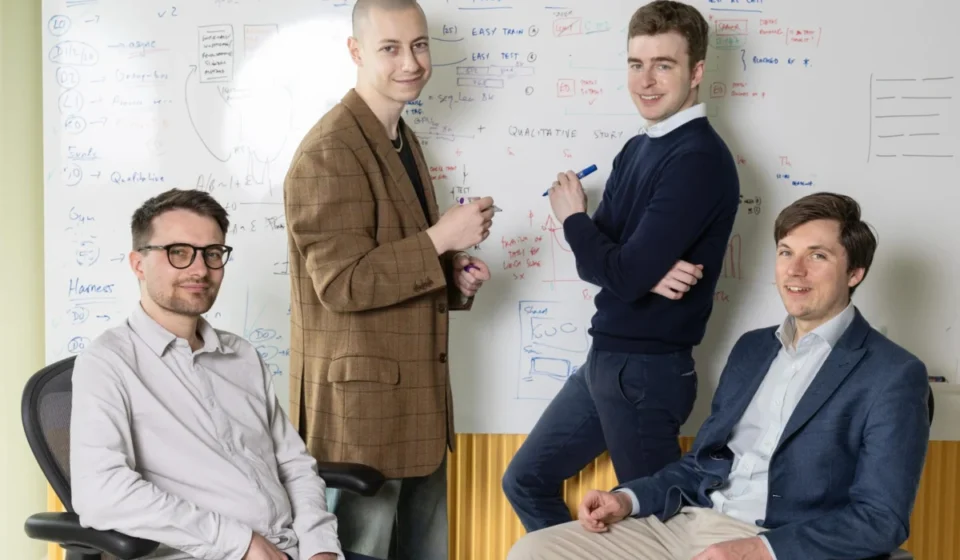
The story of Inherent is deeply intertwined with the evolution of the London AI ecosystem. The co-founding team—Louis Kirsch, Kaloyan Aleksiev, Tantum Collins, and Edward Hughes—cut their teeth at Google DeepMind, an organization that essentially birthed the modern era of AI research.
1. The Genesis of Inherent
The founders spent years inside the halls of DeepMind, witnessing firsthand the transition from academic curiosity to commercial dominance. However, as the field moved toward massive, monolithic models, the team felt a different path was required—one focused on "world models" and agents capable of independent reasoning.
2. Emerging from Stealth
Following their departure, the team secured a $50 million seed investment, providing the runway necessary to build their vision. Operating out of London’s King’s Cross, they intentionally chose to stay out of the public eye until their internal benchmarks were met.
3. The Faraday Milestone
With the release of Faraday, Inherent has signaled that it is no longer in the conceptual phase. By demonstrating that a 27-billion-parameter model could outperform industry giants, they have validated their hypothesis: that high-quality, reward-based training can produce "research taste"—the intangible ability to discern which experiments are worth pursuing.
The Secret Sauce: Reinforcement Learning and "Research Taste"
The central challenge in building a "scientist" AI is teaching it "taste." How does a machine know which variable to change in a complex experiment? How does it decide if a hypothesis is worth testing?
Inherent is betting on reinforcement learning (RL) as the answer. Unlike traditional training, which requires vast amounts of pre-labeled data or rigid rule-following, RL incentivizes the AI based on the outcomes of its actions. By rewarding successful scientific experimentation, Inherent is training Faraday to develop an instinct for effective scientific inquiry.
Avoiding the "Echo Chamber"
A key design philosophy at Inherent is avoiding "user-pleasing" AI. Many current LLMs are optimized to provide the most statistically probable answer, which often results in sycophancy—telling the user exactly what they want to hear.
In contrast, Inherent aims to build an AI that acts like a rigorous colleague. "I got curious about this, and I went off and I did these experiments," is the ideal interaction model the company is striving for. By integrating external tools—such as using OpenAI’s GPT-5.5 Codex for coding tasks rather than building a redundant, proprietary tool—Inherent is modeling its AI after a human scientist who effectively leverages existing software to solve problems.
The London Advantage and the "Garden Leave" Debate
Inherent’s location is no accident. King’s Cross has transformed from a former industrial, somewhat rundown district into one of the world’s most dense clusters of AI talent. For the Inherent team, physical presence is non-negotiable. Their dozen employees work in-person, fostering a culture of high-intensity collaboration that they believe is impossible to replicate in a fully remote or distributed environment.
However, the UK’s labor environment remains a friction point. Edward Hughes has been a vocal critic of the "garden leave" system, a common UK practice where departing employees are legally barred from joining or starting a competitor for several months.
"I was affected by the garden leave problem," Hughes stated. He notes that this acts as a significant headwind for British startups, as it effectively puts a pause on the career progression of top talent, whereas US-based researchers are often free to move immediately. Despite these hurdles, Inherent is actively hiring, with plans to grow their headcount to 25 by the end of the year, positioning themselves as a prime destination for disillusioned DeepMind staff who are looking for a more nimble, mission-driven environment.
Implications: The Future of Scientific Discovery
The success of Faraday and the broader goals of Inherent Labs carry massive implications for the future of scientific research. If an AI agent can reliably replicate, iterate, and innovate on scientific experiments, the pace of discovery could increase by orders of magnitude.
1. Scaling Scientific Productivity
Currently, scientific progress is bottlenecked by the time it takes for humans to conduct experiments and analyze results. If AI agents can assist with the "grunt work" of replication and routine experimentation, researchers will be freed to focus on high-level hypothesis generation and interpretation.
2. Efficiency as a Competitive Edge
Inherent’s success proves that massive compute is not the only path to advanced AI. As the industry faces growing scrutiny over energy consumption and the astronomical costs of training frontier models, the "Inherent model"—focused on efficiency, targeted reinforcement learning, and architectural elegance—offers a sustainable alternative.
3. The Rise of Independent Labs
The success of Inherent suggests that the "AI Gold Rush" is shifting toward specialization. As the giants fight over consumer chatbots and general-purpose reasoning, smaller, mission-specific labs are beginning to dominate niche, high-value fields like scientific discovery and specialized agentic tasks.
Conclusion
Inherent is not trying to build the next chatbot; they are trying to build the next generation of scientific collaborators. By focusing on the elusive quality of "research taste" and proving that efficiency can trump scale, the team at King’s Cross is carving out a unique and vital role in the AI landscape.
As they scale their team and refine Faraday, the broader scientific community will be watching. If Inherent can successfully transition from replicating old results to discovering new ones, they may well prove that the most important breakthrough in AI wasn’t a bigger model, but a smarter way of thinking.