

























































The global race to achieve energy independence and mitigate the catastrophic effects of climate change is currently bottlenecked by a harsh reality: we do not have enough human hands to build the infrastructure required for a net-zero future. As nations commit to massive solar energy build-outs, the construction industry is facing a severe labor shortage, struggling to fill the grueling, dangerous, and repetitive roles necessary to deploy utility-scale solar arrays.
Enter Gritt, a robotics startup emerging from stealth with a bold proposition: if the construction industry cannot find enough workers, it must build a new class of "physical AI" to fill the gap. Founded by Carnegie Mellon-trained roboticists Puneet Puri and Vishal Dugar, Gritt aims to transform the chaotic, unstructured environment of the modern construction site into a theater of precision automation.
The Genesis of a Robotics Powerhouse
The journey of Gritt began with a fundamental observation about the limitations of traditional industrial robotics. For decades, robots were confined to the predictable, highly structured environments of factory floors. In these settings, every variable is controlled, and the robot repeats the same motion millions of times without variation. Construction sites, by contrast, are the antithesis of this: they are muddy, uneven, exposed to the elements, and constantly shifting.
Puri and Dugar realized that the "old" way of programming robots—hardcoding every movement for a specific scenario—would never succeed in the field. Instead, they leveraged the recent, rapid advancements in artificial intelligence models to create systems capable of learning and adapting to dynamic environments.
This week, the company announced its emergence from stealth mode, bolstered by a successful $26 million Series A funding round led by Obvious Ventures. With participation from prominent investors like Union Square Ventures and Active Impact Investment, Gritt’s total funding has reached $34 million. Previous backing from First Round Capital, Climactic, and others underscores the high level of institutional confidence in their "software-first" approach to heavy machinery.
Chronology: From Concept to Field Deployment
The trajectory of Gritt represents the rapid maturation of the "robot-as-a-service" model in the construction sector.
- Foundation Phase: Founded by Puri and Dugar, the startup spent its early days focusing on the intersection of machine vision and dexterity. Unlike competitors attempting to design custom robots from the chassis up, Gritt opted for a strategic pivot: utilizing off-the-shelf industrial hardware.
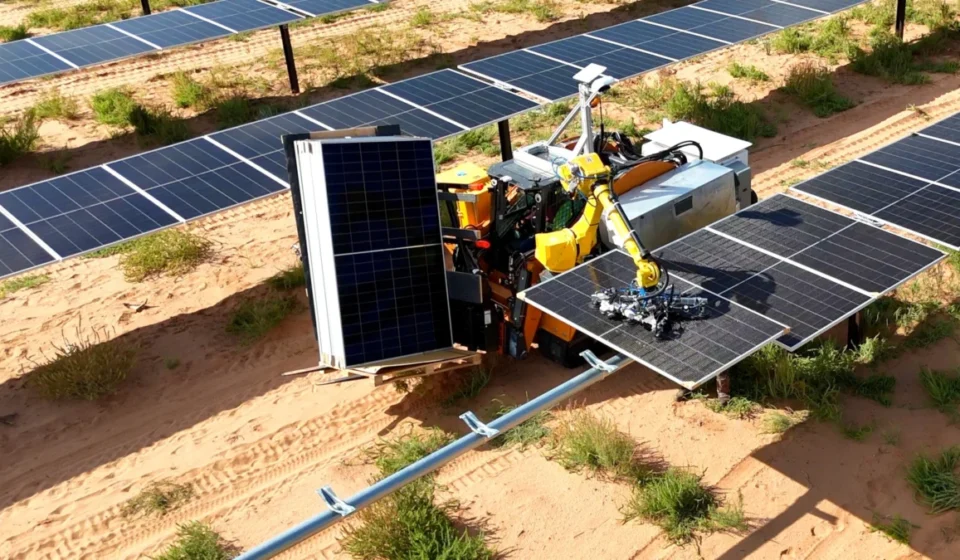
- Proof of Concept: The team experimented with existing platforms, such as robotic arms from Kawasaki and rented skidders, integrating them with their proprietary AI "brain." By focusing on the intelligence layer, they avoided the R&D "valley of death" that has hindered many hardware-heavy robotics companies.
- Initial Deployment: Gritt successfully moved from the lab to the field, deploying its first two systems to live solar installation sites. These systems proved capable of unloading heavy glass panels and maneuvering them into place with sub-millimeter precision.
- Scale and Growth: Currently, the company has secured contracts to assist in the installation of 2.8 gigawatts of solar capacity over the next 18 months. With three of the top 10 U.S. power construction firms already on their client list, Gritt is aggressively scaling toward a fleet of 48 operational systems within the next six months.
Data-Driven Performance: The Efficiency Multiplier
The primary metric for success in the solar industry is speed and cost-per-watt. Manual labor, while essential, is subject to human fatigue, weather-related downtime, and safety risks.
Data from Gritt’s early deployments offers a compelling case for the economic viability of their systems. A traditional, highly skilled eight-person crew can typically install around 800 solar panels in a single workday. When that same crew is augmented with Gritt’s robotic systems, the output jumps to 3,000 to 4,000 panels per day.
This is not merely an increase in volume; it is a fundamental shift in the economics of utility-scale energy. By reducing the reliance on manual lifting—where workers are often tasked with repeatedly maneuvering 100-pound panels—Gritt significantly lowers the risk of workplace injuries. One anonymous client, a veteran of the solar construction industry, noted that the system is a game-changer for remote sites where recruiting and retaining labor is a persistent and expensive headache.
Official Perspectives: The "Physical AI" Thesis
The investment community sees Gritt as the bridge between two worlds: the high-precision aerospace engineering sector and the gritty, practical world of heavy civil construction.
Andrew Beebe, the partner at Obvious Ventures who led the Series A round, highlights the rare combination of skills possessed by the founders. "There are people who used to build rockets that went into space and had infinite budget for the smallest little part, and then there are people who know what it means to get into dirty, dull, and dangerous jobs and scale them like mad," Beebe remarked. "These guys are in the second camp, and that’s a special kind of entrepreneur that has the technical chops, the AI, and the machine vision skills to make it work."
For CEO Puneet Puri, the goal is simple yet profound: "Our thesis is that if we truly want to speed up construction, you need an intelligence which can work in the outdoor, chaotic environments of these construction sites, and it has to be generalizable enough that it can work in these varied environments."
Puri emphasizes that the "intelligence" is the true product. By using the same underlying software pipeline, the system can learn new tasks with remarkable speed. He cites the transition from learning to stack cinder blocks to learning how to tie rebar—a process that once took weeks but was reduced to a single day of training thanks to the adaptability of their AI models.
Implications: The Future of Construction
Gritt enters a competitive landscape, facing off against rivals like Luminous Robotics, Cosmic, and China’s Trinabot. However, Gritt’s strategy of utilizing off-the-shelf, "agnostic" hardware differentiates it from those focusing on bespoke robot designs. This approach could lead to a leaner cost structure and faster deployment, allowing the company to pivot as construction needs change.
The long-term vision for Gritt extends well beyond simply placing solar panels. The company plans to expand into drilling posts, assembling mounting racks, and tackling other labor-intensive tasks such as rebar tying.
Perhaps most significantly, Gritt aims to transform its robots into "site managers." With a suite of advanced sensors and real-time processing, the systems are being developed to monitor the entire construction site. Imagine a robot that, while working, notices an open trench as a storm approaches and proactively alerts a human supervisor to cover it, or a machine that scans the site to identify missing inventory before a bottleneck occurs.
As Gritt continues to deploy, the implications for the global construction industry are vast. By creating a layer of "physical AI" that can handle the dull, dirty, and dangerous aspects of building, the company is not just accelerating the green energy transition—it is setting a new precedent for how infrastructure will be built in the 21st century.
If successful, the sight of robotic systems working alongside human crews will become the standard, potentially solving the labor crunch that threatens to derail our climate goals. In the eyes of Gritt’s founders, this is not just about robots; it is about providing the tools civilization needs to build its future at the pace the planet requires.